Written by the ChemicalPeel.org editorial team. Published August 14, 2026. Updated September 2, 2026.
Clinical review pending. This page has not yet been reviewed by a licensed clinician; read it as patient education, not medical advice. How we review
A chemical peel for under eyes is a low-concentration, provider-applied exfoliating treatment used on the thin skin around the eye socket to soften fine lines, crepey texture, and pigment-based darkness. It uses the same acids applied elsewhere on the face, at a fraction of the strength, because periorbital skin is the thinnest on the body. It is also widely misunderstood: most people want it to erase dark circles or under-eye bags, and a peel addresses only one of the conditions behind that shadowed look. This guide covers what it can improve, what it cannot touch, which acids are used at what strengths, and where the real risks sit.
What Is a Chemical Peel for Under Eyes?
An under-eye peel is a controlled chemical exfoliation of the periorbital skin: the lower eyelid and the region bounded by the orbital rim, the bony ridge beneath your eye. A provider applies a measured amount of acid, leaves it on for a short timed interval, then neutralizes or removes it. As the treated layers shed, newer skin with more even pigment replaces them.
Depth governs results and risk. Superficial peels work within the epidermis. Medium peels reach the papillary to upper reticular dermis, with seven to 14 days of crusting and peeling (Cleveland Clinic). Deep phenol peels reach the mid reticular dermis and are physician-performed with cardiac monitoring. Our overview of chemical peel types and depths covers that ladder. Around the eyes, providers stay at its shallow end.
Why the Under-Eye Area Follows Different Rules
Eyelid and under-eye skin measures roughly half a millimeter thick, against about two millimeters across much of the face. It has little fat beneath it, fewer oil glands, and a dense capillary network close to the surface, so a concentration that is mild and predictable on a cheek can penetrate considerably deeper here. Fluid also pools easily, which makes brief swelling expected rather than alarming.
That anatomy makes this a provider-only treatment zone. Home peel kits make no allowance for it, and a self-applied acid near the eye risks both a chemical burn and a direct injury to the eye. Our comparison of at-home versus professional peels explains where the safe line sits. Here it is not a matter of degree: do not peel this area yourself.
Dark Circles Are Not One Condition, and a Peel Only Helps One Cause
“Dark circles” describes an appearance, not a diagnosis, and that is the most important thing to understand before booking. At least four mechanisms produce it, they often occur together, and a peel helps exactly one of them.
Pigmented dark circles: the cause peels can improve
Periorbital hyperpigmentation is genuine excess melanin in the skin itself. It is often constitutional and inherited, most pronounced in Fitzpatrick phototypes IV through VI, and it can also follow chronic rubbing, eczema, or sun exposure. The clue is that the darkness sits in the skin rather than beneath it. This is where a low-strength peel earns its place, alongside a brightening regimen and daily sunscreen. The logic behind chemical peels for hyperpigmentation applies here, at lower strengths.
Vascular dark circles: peels do not fix these
In many people the blue or purple cast comes from vessels showing through skin that is already thin and translucent. Nothing is over-pigmented; the skin is simply see-through. A peel does not remove a vessel, and by exfoliating the surface it moves the skin in the wrong direction, toward thinner rather than thicker. Vascular darkness is generally addressed by other modalities, such as vascular-targeted laser and light devices. If your darkness looks bluish and shows fine vessels up close, ask whether a peel is appropriate at all.
Shadowing from hollows and bags: anatomy, not skin
A peel cannot fix a shadow cast by a contour. When volume is lost along the tear trough, the groove running from the inner corner of the eye along the orbital rim, that depression catches light and reads as a dark half-moon even when the skin above it is perfectly uniform. Under-eye bags are the same physics in reverse: the orbital fat pads cushioning the eye push forward through a weakening membrane, creating a bulge with a shadow beneath it. Neither is pigment, and neither responds to exfoliation. So if you came here looking for a chemical peel for under eye bags: it will not remove them. Hollowing is treated with filler or fat grafting, and true herniated fat pads surgically.
Lifestyle, allergy, and habit
Poor sleep, alcohol, and smoking deepen under-eye shadows. Allergic rhinitis produces the classic “allergic shiner,” a congested lower lid that improves once the allergy is treated, and chronic eye rubbing drives real post-inflammatory pigment. Identify these first: rubbing will undo any peel you pay for.
The Use Case That Holds Up Best: Fine Lines and Crepey Texture
The most defensible reason to peel this area is not pigment. It is texture. Light peels stimulate a modest wound-healing response that supports new collagen and reorganizes the epidermis, which can soften fine crepey lines and the papery quality this skin develops with age and sun exposure. Improvement is gradual, needs a series, and reads as smoother and brighter rather than as line removal. It will not address dynamic wrinkles or lower-lid laxity. Our guide to chemical peels for wrinkles covers which lines respond at which depths.
Which Acids Are Used Around the Eyes, and at What Strength
The governing principle: periorbital skin is treated at reduced concentration compared with the same acid used elsewhere, starting at the lowest effective strength.
- Lactic acid. A large-molecule AHA that penetrates slowly and hydrates as it exfoliates, a common first choice for thin periorbital skin.
- Mandelic acid. The largest-molecule common AHA, gentle and slow-penetrating, often preferred in melanin-rich skin because it is less likely to provoke the inflammation that drives post-inflammatory hyperpigmentation.
- Glycolic acid. Effective but fast-penetrating, so periorbital use means lower concentrations, shorter contact times, and careful neutralization.
- Trichloroacetic acid (TCA). Searches for a “TCA under eye peel” are common, and TCA is used periorbitally, but at roughly 10 to 15 percent rather than the higher medium-depth strengths used on cheeks and forehead. It is self-neutralizing, so timing and technique carry the entire safety margin. Our TCA peel guide explains how concentration maps to depth.
- Agents to treat cautiously. Jessner’s solution contains resorcinol, which many providers avoid near the eye. Deep phenol resurfacing is physician-performed with cardiac monitoring, not a routine eye-area treatment.
What an Under-Eye Peel Session Looks Like
- Consultation and diagnosis. Your provider identifies which cause of darkness you have, reviews your phototype, medications, and cold sore history, and checks lower-lid laxity by pulling the lid gently away to see how fast it returns.
- Priming, where indicated. For higher phototypes or stubborn pigment, several weeks of a prescribed topical regimen beforehand can lower post-inflammatory hyperpigmentation risk. A test spot is reasonable first.
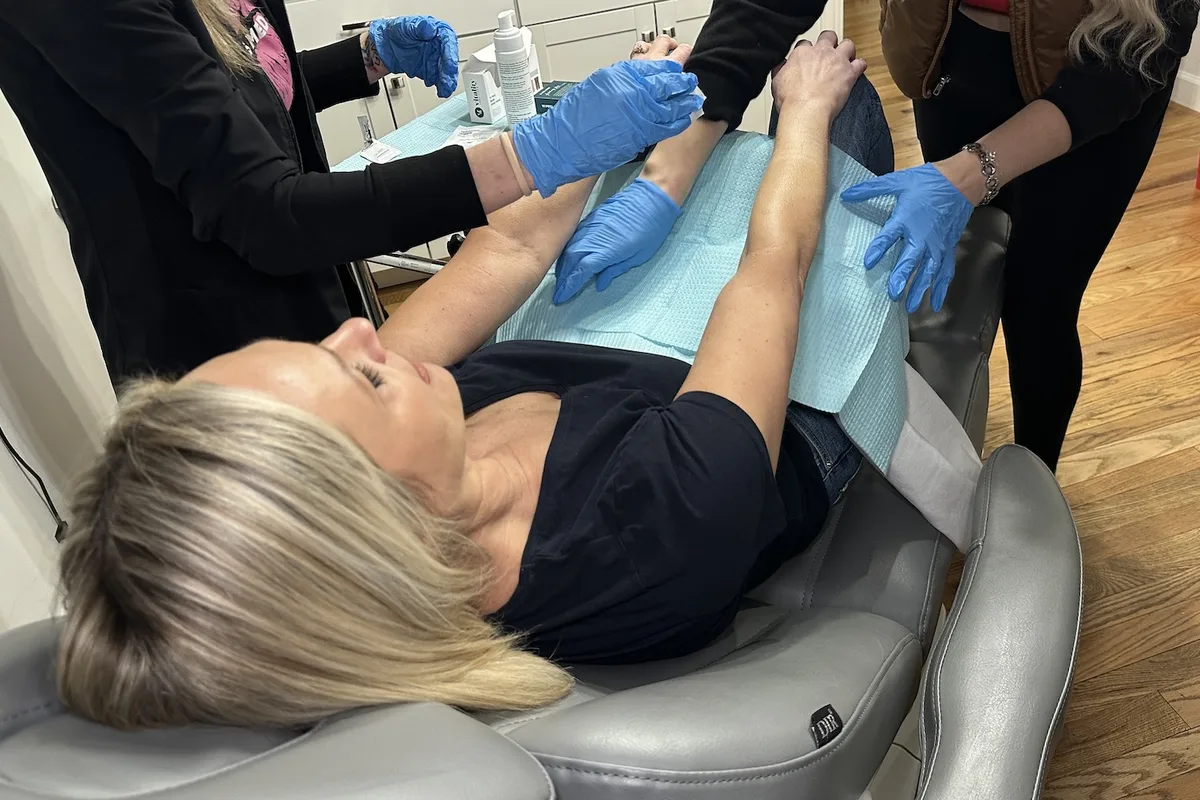
- Preparation and eye protection. You lie back with your eyes closed and kept closed. Barrier ointment is placed along the lash line and inner corner to block migration toward the eye, and saline stays within reach for irrigation.
- Application and endpoint. The acid goes on with a cotton-tipped applicator pressed nearly dry, working from the orbital rim inward and stopping short of the lash line. Nothing is allowed to pool. Contact time is short, and the provider stops on the clock, mild erythema, or a light frost.
- Neutralization and soothing. AHAs are neutralized, self-neutralizing acids are removed and cooled, then a bland ointment and cool compresses follow, with written aftercare and a follow-up plan.
Recovery: What to Expect
- Day of treatment to day two. Pink or red skin, brief stinging, watering, and puffiness, because fluid collects here readily. Tightness and mild swelling follow, usually worst on waking. Bland moisturizer, cool compresses, no active ingredients.
- Days two to seven. Light flaking begins and finishes, typically finer than peeling elsewhere. Some light peels never visibly flake, which does not mean they failed. Low-strength TCA may run to ten days.
- Throughout. No rubbing, picking, or scrubbing, and no retinoids or exfoliating acids until your provider clears them. Broad-spectrum SPF 30 or higher every morning plus sunglasses, since unprotected sun on freshly resurfaced skin reliably creates new pigment.
Results build across a series: three to five superficial sessions may be needed, and they may be repeated every two to five weeks. Pigment can return with sun exposure or eye rubbing, so the routine matters as much as the appointments.
Risks and Complications to Understand First
Under-eye peels are generally well tolerated in experienced hands, but the risk profile differs from a full-face peel.
- Irritation, stinging, and prolonged redness. The most common outcomes, and redness lingers longer here than on thicker skin. Milia, small keratin cysts, are also common.
- Post-inflammatory hyperpigmentation. The complication that matters most, because it produces exactly the darkening the patient came in to fix. Risk is highest in Fitzpatrick phototypes IV through VI, the group most likely to have constitutional periorbital hyperpigmentation. That is not a reason to avoid peels in darker skin, but a reason to use the lowest effective strength, prime beforehand, and choose a provider experienced with melanin-rich skin.
- Hypopigmentation and demarcation lines. Associated with deeper work, and visible against untreated skin.
- Herpes simplex reactivation and infection. Report any cold sore history so antiviral prophylaxis can be considered, and report spreading redness, pus, crusting, or fever promptly.
- Ectropion. An outward turning of the lower eyelid caused by scarring and contraction of healing skin. It is a rare complication of aggressive deep resurfacing, concentrated in patients with lax lids or prior eyelid surgery, and it is why lid laxity is checked first.
- Ocular injury. Acid reaching the eye is the most serious immediate hazard and can injure the cornea. Correct technique, barrier ointment, closed eyes, and irrigation largely prevent it, and any solution reaching the eye must be irrigated immediately and evaluated.
Who Should Not Have an Under-Eye Peel
Postpone or avoid treatment if you have an active infection, cold sore, or inflamed eczema in the area; an open wound near the eye; significant lower-lid laxity or prior eyelid surgery, pending an oculoplastic assessment; an active eye condition, recent eye surgery, or severe dry eye; recent isotretinoin use, with the interval set by your provider; a known allergy to the proposed agent; a keloid tendency; or the expectation that a peel will remove bags. Pregnancy and breastfeeding are a conversation for your clinician. The American Academy of Dermatology emphasizes matching procedure depth to the patient and choosing a qualified provider.
How an Under-Eye Peel Compares to the Other Options
| Option | What it actually addresses | Typical downtime | When it is the wrong choice |
|---|---|---|---|
| Low-strength chemical peel | Surface pigment, dullness, fine crepey texture | About 1 to 7 days, longer for light TCA | Darkness is vascular, or comes from a contour |
| Topical regimen (retinoid, azelaic acid, vitamin C, supervised hydroquinone) | Epidermal pigment, gradual collagen support | None, but months of consistency | The cause is structural |
| Laser and energy-based devices | Pigment and texture; vascular devices target visible vessels | Days to about two weeks by device | The operator lacks periorbital experience |
| Tear-trough filler (hyaluronic acid) | The hollow that casts the shadow | About 1 to 14 days of swelling or bruising | The problem is pigment, or skin is thin enough to show a bluish Tyndall effect |
| Lower blepharoplasty (surgery) | Herniated fat pads, meaning true under-eye bags | Roughly 1 to 2 weeks visible | There are no bags and the concern is pigment or fine lines |
What Does an Under-Eye Chemical Peel Cost?
Under-eye work is usually priced as part of a full-face peel, and many practices will not sell it alone. As industry estimates in the United States, superficial peels run about $100 to $400 per session and medium-depth peels about $300 to $1,500 per session. Because results depend on a series, budget for the series. These are industry estimates, not a quote, and price varies with geography, provider credentials, and session count. Our chemical peel cost guide breaks down pricing by depth.
Frequently Asked Questions
Can a chemical peel get rid of dark circles under the eyes?
Only when the darkness is caused by excess pigment in the skin. Periorbital hyperpigmentation can lighten over a series of low-strength peels combined with topical care and daily sunscreen. Darkness from visible vessels, tear-trough hollowing, or herniated fat pads has a different cause, and a peel does not address it.
Is a chemical peel safe under the eyes?
It can be, when performed by a provider experienced specifically with the periorbital area, at reduced concentration, with the eyes closed and protected and irrigation on hand. Periorbital skin is roughly half a millimeter thick, so the margin for error is small. Never apply a peel near your own eyes.
Will a chemical peel remove under-eye bags?
No. Under-eye bags are herniated orbital fat pads pushing through a weakened retaining membrane, an anatomical problem rather than a skin-surface one. Exfoliating the skin above them does not change the contour or its shadow. Lower blepharoplasty addresses true bags, and filler addresses the adjacent hollow.
What strength of TCA is used for an under eye peel?
Periorbital TCA is used at low concentrations, commonly around 10 to 15 percent, rather than the higher medium-depth strengths applied elsewhere on the face. TCA is self-neutralizing, so timing and technique carry the entire safety margin. The exact strength is a clinical decision, and TCA should never be self-applied near the eye.
Do chemical peels help under-eye wrinkles and crepey skin?
Yes, modestly and gradually. Light peels support epidermal renewal and a measured collagen response that can soften fine crepey lines and papery texture. Improvement builds across a series rather than after one session. Peels do not treat dynamic lines from squinting and smiling, or lower-lid laxity.
Medical Disclaimer
This page is provided by ChemicalPeel.org for patient education and is not medical advice. Individual results vary, and the information here does not replace a consultation with a qualified provider. Always discuss your medical history and treatment options with a licensed clinician before pursuing any chemical peel.
Find a Provider Who Treats the Eye Area
The right first step is a diagnosis, not a booking. Ask a clinician which cause of under-eye darkness you have, and how much periorbital experience they have. Find a qualified provider near you, or compare all chemical peel types and depths first.