Written by the ChemicalPeel.org editorial team. Published April 17, 2026. Updated September 1, 2026.
Clinical review pending. This page has not yet been reviewed by a licensed clinician; read it as patient education, not medical advice. How we review
A search for "chemical peel before and after" mostly turns up gallery pages built to sell one clinic, or stock photography captioned as if it were a real result. ChemicalPeel.org runs no clinic and has no bank of patient photos, so this page is the honest, text based version of that search: how to read a before and after photo, what each peel depth and concern realistically changes, what a healing face looks like day by day, and the questions that separate a real result from a polished one.
How to Read a Chemical Peel Before and After Photo
Two photos of the same face rarely differ only because of the peel. Check what else moved before comparing them.
- Lighting. Harsh light exaggerates texture in a "before" shot; soft, even light smooths an "after" shot. A fair comparison uses the same light both times.
- Angle. Tilting the head or moving closer to the camera changes shadows more than a peel does.
- Makeup. A bare "before" face next to a made up "after" face is showing foundation, not a result.
- Time since treatment. A photo taken on day three of a medium peel, while skin is still peeling, looks worse than the same face at week four.
- Number of sessions. One visit and the end of a full series are not the same claim.
- Filters and editing. Skin smoothing filters can fake the texture change a peel is supposed to produce; a credible gallery states its photos are unedited.
Realistic Results by Peel Depth
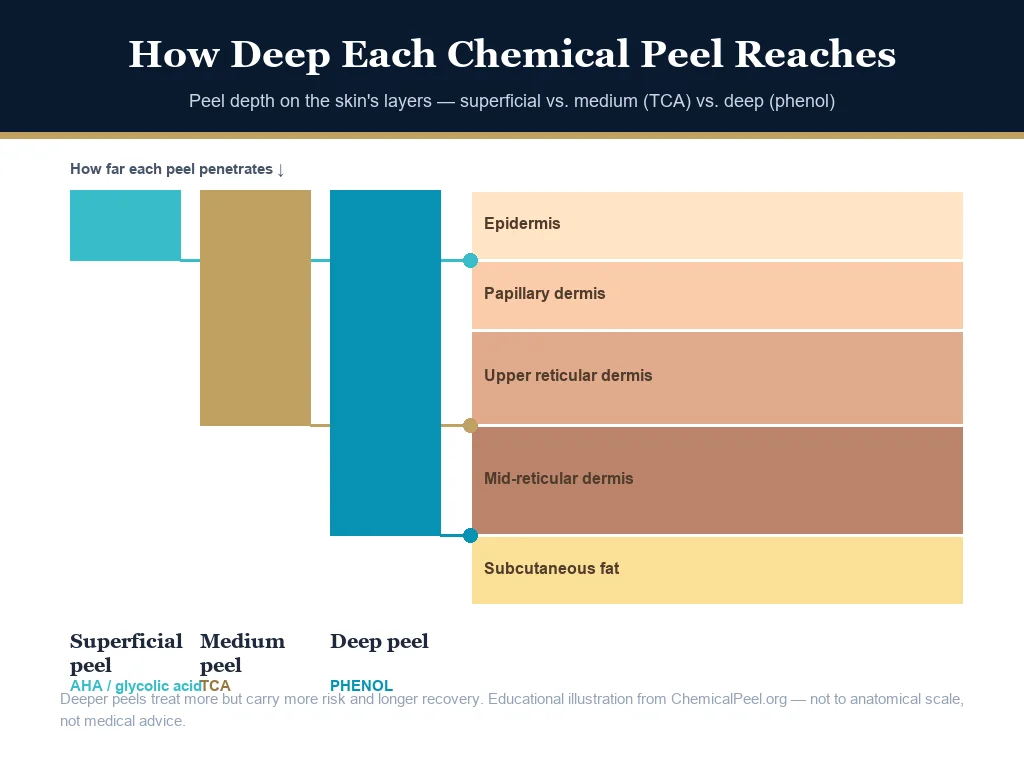
What an "after" photo can honestly show depends more on depth than on which acid was used. Our guide to chemical peel depths covers the mechanism; here is what each depth changes on camera.
Superficial Peels
A salicylic acid peel or a glycolic acid peel works within the epidermis. The honest "after" photo for one visit is a subtle glow, not a transformation; real change builds across a series. It does not change static wrinkles, pore size, or scarring below the surface.
Medium Peels
A TCA peel, alone or after a coat of Jessner's solution, reaches the upper dermis; a Jessner's peel on its own is a superficial peel. One session can visibly improve sun damage, tone, and fine to moderate wrinkles once healing is complete. The "after" photo that matters is taken after peeling finishes, not while skin is still shedding. It does not change deep wrinkles, laxity, or pitted scarring.
Deep Peels
A deep phenol peel, covered in our phenol peel guide, reaches the mid reticular dermis, and you can have only one deep peel on your face. The realistic "after" photo is dramatic, improving deep wrinkles and severe sun damage in a way no lighter peel matches, but treated skin is often visibly lighter than the skin around it for good.
Realistic Results by Skin Concern
The concern being treated changes what an honest "after" photo can show as much as depth does. Our skin concerns hub covers each condition in full.
Acne
A series calms active breakouts and unclogs pores, so the "after" photo should show fewer active lesions, not flawless skin. See our guide to peels for acne.
Dark Spots and Melasma
Ordinary sun spots and post-acne marks fade well. Melasma responds more slowly, needs a gentler plan, and can return, so one dramatic melasma "after" photo is a reason for caution. See our guides to dark spots and melasma.
Fine Lines
Superficial peels soften fine surface lines by smoothing texture around them, not by erasing static wrinkles visible at rest. See our guide to peels for wrinkles.
Sun Damage
This is where peels perform most visibly. A medium peel can even out blotchy pigment and weathered texture, and the "after" photo genuinely can look like a different complexion. See our sun damage guide.
Texture
Rough texture and congested pores respond well to a series and read smoother in good light, though a peel does not shrink pore structure itself. See our guide to peels for large pores.
Scars
Flat marks left after acne fade well with a series. True pitted or raised scars are a structural change a standard peel can soften but rarely erases. See our guide to peels for acne scars.
Peel Depth: What the "After" Photo Typically Shows
| Peel depth | What the "after" typically shows | When to photograph | Sessions before a real difference |
|---|---|---|---|
| Superficial (glycolic, lactic, salicylic, Jessner's, light TCA) | Brighter tone, smoother texture, faded surface pigment | Real comparison: 4 to 6 weeks into a series | 3 to 5 may be needed, every 2 to 5 weeks |
| Medium (TCA, Jessner's plus TCA, VI Peel) | Smoother tone and texture, softened fine to moderate wrinkles | Once peeling has fully finished; Cleveland Clinic says the skin crusts and peels off over 7 to 14 days | TCA, alone or with Jessner's: may be visible after one session; wait 3 to 6 months before repeating. VI Peel: a short series; your provider sets the spacing |
| Deep (phenol) | Dramatic smoothing of deep wrinkles and severe sun damage | Weeks to months out, once redness has settled | One procedure; only one on the face |
The Recovery Timeline: What the Face Looks Like Day by Day
Our full recovery timeline guide and aftercare guide cover this in detail. Here is the short version for each depth, the window a fair before and after comparison has to account for.
Superficial Peel Timeline
Day 1: Pink and tight, like a mild sunburn. Day 3: Light flaking may begin. Day 7: Flaking has usually finished and skin looks brighter. Week 4: Tone and texture keep improving. Month 3: A completed series shows visible, stable results.
Medium Peel Timeline
Day 1: Red and tight, sometimes still showing frosting. Day 3: Skin darkens or bronzes and peeling begins around the mouth and chin. Day 7: Peeling in larger pieces is usually finishing, revealing fresh skin. Week 4: Pinkness has faded and the improvement is visible in ordinary light. Month 3: Results are fully settled; this is the fair "after" comparison point.
Deep Peel Timeline
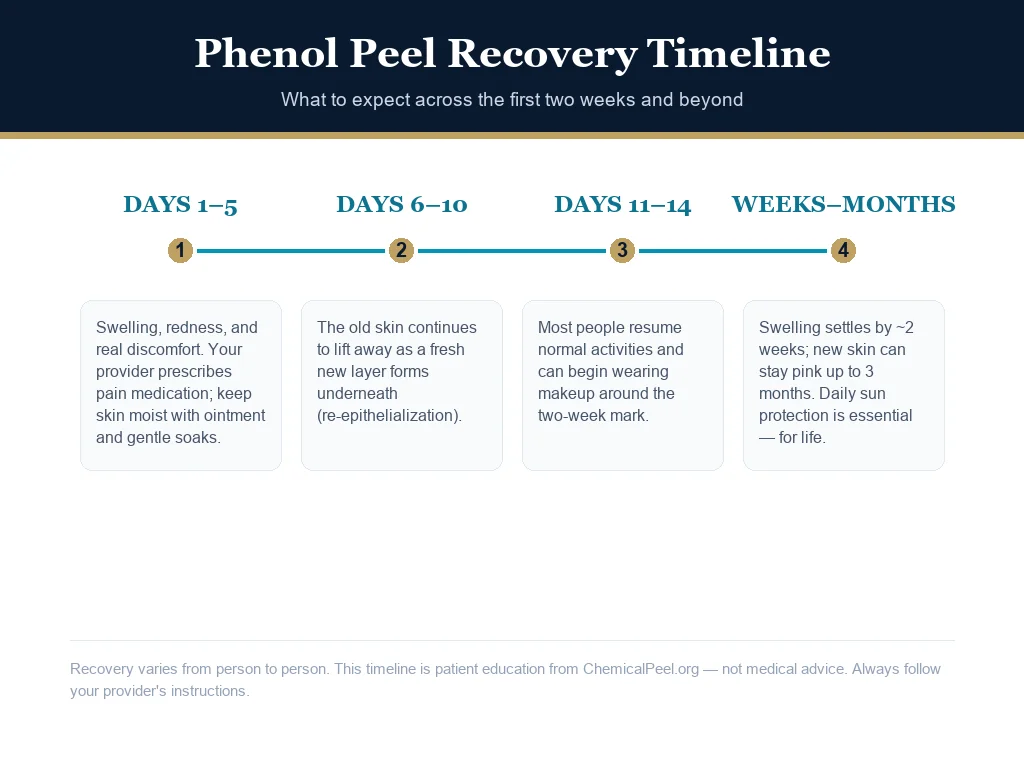
Day 1: Significant swelling, redness, and real discomfort. Day 3: Old skin is actively lifting away as a fresh layer forms beneath it. Day 7: The face still looks raw, not ready for a photo meant to represent the result. Week 4: Swelling has settled and normal activities have resumed. Month 3: The final result is often not judged until now.
How Many Sessions Before You See a Difference
For superficial peels, Mayo Clinic says light peel results are subtle but increase with repeated treatments, so the change a fair "after" photo should show, meaning faded pigment and smoother texture, builds across a series: three to five peels may be needed, and they may be repeated every two to five weeks. Medium peels are different: a single medium-depth session, such as TCA alone or combined with Jessner's solution, can produce a visible difference once healing is complete, and DermNet advises waiting 3 to 6 months before repeating one. A Jessner's peel on its own is a light peel and follows the light-peel timing above. You can have only one deep phenol peel on your face; the wait is for healing, not for another treatment. Our guide to how often to get a chemical peel covers spacing by depth in full.
How Long Do Results Last
Superficial results fade as skin naturally renews, so ask your provider whether and when to repeat a peel after the series. After a medium peel, Mayo Clinic says treated skin will be noticeably smoother, and DermNet advises waiting 3 to 6 months before repeating one. A deep phenol peel is the outlier: Cleveland Clinic says it produces the most dramatic results, though Mayo Clinic says results may not be permanent. Nothing a peel does stops new sun damage or aging from starting over, so ongoing sun protection is what protects an "after" result.
What a Bad Result Looks Like
An honest before and after conversation also covers what does not go to plan. Ordinary healing looks red, tight, and flaky, and reliably looks worse before it looks better. A genuinely bad result looks different: blistering, honey colored crusting, spreading or hot redness, escalating pain, grey or white skin, or dark marks that keep deepening instead of fading. Our guide to when a chemical peel goes wrong covers the warning signs and when to call a provider. If a gallery photo looks suspiciously perfect with no healing phase shown, ask to see the in between photos too.
Questions to Ask a Provider About Their Before and After Gallery
- Are these your own patients, or licensed stock photography?
- How many sessions separate the before photo and the after photo?
- How long after the last session was the after photo taken?
- Were both photos taken in the same lighting and angle, with no makeup?
- Are the photos unedited and unfiltered?
- Can I see the healing phase too, not only the finished result?
A provider who answers these plainly and examines your skin before promising any outcome is worth more than any single photo. Our guide to choosing a provider has more consultation questions. You can find a qualified provider or browse our med spa directory to compare options near you.
Frequently Asked Questions
Is a chemical peel worth it for visible results?
For the right concern and depth, yes. Superficial peels brighten tone across a series, medium peels visibly improve sun damage and fine lines in one session, and deep peels can produce dramatic, lasting change, as long as the depth actually matches the concern.
How long until you see results from a chemical peel?
A superficial peel can leave a subtle glow by the next day, though the fuller change builds across a series over weeks. A medium peel shows its real result once visible peeling has finished, and Cleveland Clinic says the skin will crust and peel off over seven to 14 days. A deep peel takes longest: swelling settles by about week 4, and the final result is often judged closer to month 3.
Do chemical peel results last?
It depends on depth. Superficial results fade as skin renews, so ask your provider whether and when to repeat one. After a medium peel, Mayo Clinic says treated skin will be noticeably smoother. You can have only one deep phenol peel on your face, and Mayo Clinic says results may not be permanent. At every depth, unprotected sun exposure shortens a result fastest.
What does a before and after look like for melasma?
More cautious than most pigment concerns. Melasma fades with a gentle, sustained plan and strict sun protection, but it responds more slowly than ordinary dark spots and has a real tendency to return. Treat a dramatic melasma "after" photo with no stated timeline with skepticism. Our melasma guide covers a realistic plan.
What does a before and after look like for acne scars?
It depends on the scar type. Flat red or brown post-acne marks fade well, and a series can show a genuinely smoother "after" photo. Pitted or raised scars are a structural change a standard peel can soften at best; a claim that a peel erased true scarring likely involved a different, more targeted technique. Our guide to peels for acne scars explains the difference.
What can't a chemical peel fix?
Peels do not remove sagging skin, build new volume, shrink pore structure, or permanently erase deep, pitted, or raised scars. They also cannot stop future sun damage or aging, which is why sun protection protects any "after" result over time.