Written by the ChemicalPeel.org editorial team. Published June 27, 2026. Updated September 1, 2026.
Medically reviewed on by Stefanie Drozd, MSN-APRN. How we review · Our reviewers
Our reviewers work for or own Express Med Spa and Catara Med Spa, clinics marketed by this site's publisher. That is a commercial conflict of interest and it is worth weighing when you read a review here.
- Peel depth
- Deep
- Downtime
- 1 to 2 weeks
- Best for
- Deep facial wrinkles and creases, significant sun damage, deep acne and textural scarring, certain precancerous actinic keratoses, and stubborn pigmentation that has not responded to lighter treatments.
- Not for
- People with deeper skin tones (Fitzpatrick types IV through VI) face a higher chance of uneven pigmentation or lasting color change and need especially careful evaluation, and often a different treatment plan, so ask your provider about safer options for darker skin tones. A phenol peel is also not appropriate for anyone with significant heart, kidney, or liver conditions, and it should never be attempted outside a medical setting.
A phenol peel is a deep chemical peel that uses phenol, also called carbolic acid, to remove the damaged outer and middle layers of facial skin so that smoother, more even skin can regenerate in their place. It is the most intensive peel a clinician can perform. While a superficial peel exfoliates only the surface, a phenol peel penetrates all the way to the mid-reticular dermis, the deeper structural layer of the skin. That depth is what allows it to address concerns lighter peels cannot, and it is also why the procedure carries more risk and a longer recovery.
Modern phenol peels are rarely phenol alone. The classic Baker-Gordon formula combines phenol with croton oil, soap, and water, and the croton oil is the ingredient that increases and evens out the depth of the peel. Searches for a phenol croton oil peel refer to this same family of deep peels. The exact formula and how it is applied are tailored by the provider to your skin and your goals.
Where a Phenol Peel Sits on the Peel Depth Ladder
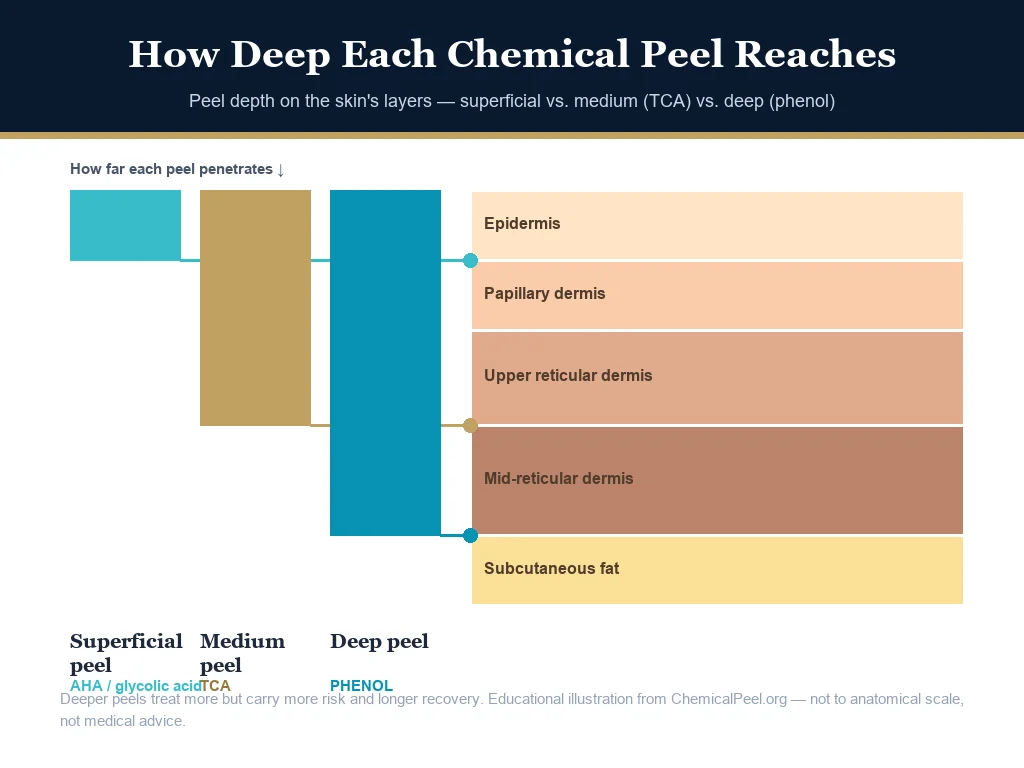
Chemical peels are grouped by how deeply they work. Superficial peels, such as glycolic acid or other alpha hydroxy acid peels, treat only the outermost layer and have little downtime. Medium-depth peels, such as trichloroacetic acid (TCA) peels, reach the upper dermis and handle moderate wrinkles and pigment concerns. A phenol peel sits at the deep end of that ladder, reaching the mid-reticular dermis, which is why it produces the most dramatic change and also requires the most planning and recovery. If you are early in your research, our overview of chemical peels explains each depth, and our guide to the glycolic acid peel covers a popular lighter option. A dedicated TCA peel guide is coming soon.
What Recovery Looks Like
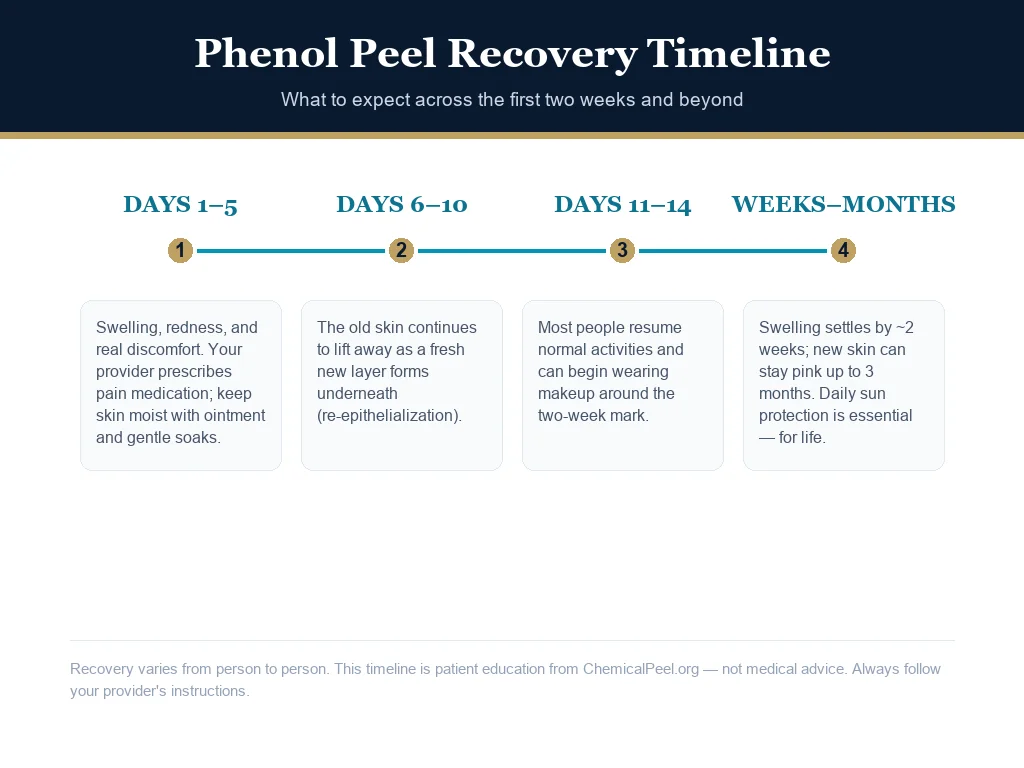
A phenol peel has the longest recovery of any chemical peel. The first few days bring swelling and discomfort that your provider manages with prescribed medication, the old skin lifts over the following week, and most people return to normal activities and makeup around two weeks. New skin can stay pink for up to three months. For a fuller walkthrough of what peeling feels like and how to care for healing skin, see our chemical peel recovery and peeling timeline. A day-by-day breakdown also appears in the recovery section further down this page.
Results: What to Expect and How Long They Last
The trade-off for a demanding recovery is a dramatic result. Mayo Clinic says that after a deep chemical peel you will see a dramatic improvement in the look and feel of treated areas, and that results may not be permanent, since age and new sun damage can lead to new lines and skin color changes. You can have only one deep peel on your face. Results vary from person to person based on skin condition, age, sun habits, and how diligently the skin is protected afterward. Because outcomes depend so heavily on the individual and the provider, look for a clinician who can show you their own before-and-after results during a consultation rather than relying on stock images.
How Much Does a Phenol Peel Cost?
A phenol peel is the most expensive type of chemical peel, reflecting the sedation, monitoring, clinical setting, and physician time involved. In practice, as an industry estimate, a full-face phenol peel runs higher, roughly $2,500 to $6,000 or more, depending on the provider, region, and whether anesthesia and facility fees are included. These figures are industry estimates, not a quote. ChemicalPeel.org is an education resource rather than a clinic, so always confirm pricing directly with a provider. A detailed chemical peel cost guide is coming soon.
Phenol Peel vs. TCA Peel: Which Is Right for You?
Many people researching a phenol peel are really asking whether they need the deepest option at all. A TCA (trichloroacetic acid) peel is the most common medium-depth alternative, and for moderate concerns it can be the better-balanced choice.
| Phenol peel (deep) | TCA peel (medium) | |
|---|---|---|
| Depth | Mid-reticular dermis (deepest) | Upper dermis (moderate) |
| Best for | Deep wrinkles, significant sun damage, deep scars | Moderate lines, uneven tone, mild scarring |
| Downtime | About two weeks, redness up to three months | Skin crusts and peels off over 7 to 14 days (Cleveland Clinic) |
| Sedation and monitoring | Sedation plus cardiac monitoring | Usually topical numbing only |
| Cost | Highest of all peels | Moderate |
| Frequency | Only one on the face | Can be repeated periodically |
If your concerns are moderate, a TCA peel or even a series of lighter peels may achieve your goals with far less downtime and risk. Laser skin resurfacing is another deep-resurfacing alternative worth discussing with a provider. The right answer depends on your skin, your concerns, and how much recovery time you can commit to. Our dedicated TCA peel guide is coming soon.
This page is provided by ChemicalPeel.org for patient education and is not medical advice. Individual results vary, and the information here does not replace a consultation with a qualified provider. Always discuss your medical history and treatment options with a licensed clinician before pursuing any chemical peel.
Benefits
- Softens deep wrinkles. Smooths stubborn lines and creases, including the deep wrinkles around the mouth known as perioral rhytides.
- Reverses significant sun damage. Addresses the leathery texture and blotchy tone that come with years of UV exposure.
- Improves deep scarring. Resurfaces deep acne scars and other textural scarring, often in a single deep treatment.
- Treats certain precancerous spots. Can remove some precancerous growths such as actinic keratoses when a clinician judges a deep peel appropriate.
- Evens stubborn pigmentation. Improves pigmentation problems that have not responded to lighter peels.
- Dramatic improvement. Mayo Clinic says that after a deep chemical peel, you will see a dramatic improvement in the look and feel of treated areas, though results may not be permanent.
What happens during the treatment
- Preparation. Your provider may ask you to prepare your skin for up to eight weeks beforehand, sometimes with a retinoic acid cream, to help the peel work more evenly.
- Sedation and comfort. Because a full-face phenol peel is intense, you are usually given a sedative to relax along with a local anesthetic to numb the skin.
- Heart monitoring. Phenol is absorbed into the body and can affect the heart, so the procedure is performed with cardiac (EKG) monitoring and intravenous fluids in place throughout.
- Staged application. The clinician treats the face in sections rather than all at once, about fifteen minutes per section, to keep the amount of phenol absorbed at any moment within a safer range.
- Frosting. As the solution is applied, the treated skin turns white or gray, a reaction called frosting that signals the peel has reached the intended depth.
- Healing begins. Over the following days the old skin lifts away and a new layer forms beneath it, a process called re-epithelialization.
Who is a candidate
A phenol peel tends to be most appropriate for people with fairer skin tones, generally Fitzpatrick skin types I through III. Good candidates are in sound cardiovascular, kidney, and liver health, and they are realistic about committing to lifelong sun protection afterward, because treated skin often loses its ability to tan normally. Only a hands-on consultation with a qualified provider can confirm whether a phenol peel is right for you.
Risks and contraindications
A phenol peel can deliver striking results, but it is a serious medical procedure, and an honest look at the risks matters more here than with any lighter peel. The most important consideration is the heart. Phenol carries a risk of cardiotoxicity, meaning it can disturb heart rhythm, which is exactly why cardiac monitoring is required and why the solution is applied in timed sections rather than all at once. For the same reason, your provider will review your heart, kidney, and liver health before approving the procedure. The other defining risk is to skin color. A phenol peel can lighten the treated skin, and that lightening can be long lasting. It can also leave a visible line where treated skin meets untreated skin, called a line of demarcation, which is why skilled clinicians feather the edges of the treated area. Other possible complications include scarring and infection. These are uncommon in experienced hands, but they are real, and they are the reason a phenol peel should only be performed by a qualified dermatologist or plastic surgeon.
Preparation
Your provider may ask you to prepare your skin for up to eight weeks before a phenol peel, sometimes with a prescription retinoic acid cream, so the peel works more evenly. You will also be screened for heart, kidney, and liver health, since phenol is absorbed by the body during treatment.
Downtime and recovery
- Days 1 to 5. Expect swelling, redness, and discomfort. Your provider will prescribe pain medication, and you will keep the skin moist with ointment and gentle soaks several times a day.
- Days 6 to 10. The old skin continues to lift and a fresh new layer begins to form underneath.
- Days 11 to 14 and beyond. Most people can resume normal activities and begin wearing makeup around the two-week mark.
- Weeks to months. Swelling generally settles by about two weeks, but the new skin can stay pink or red for up to three months as it matures.
Aftercare
After a phenol peel, keep the skin moist with the ointment your provider recommends and follow their soaking and cleansing instructions closely. Avoid sun exposure entirely while you heal, and commit to daily broad-spectrum sun protection for life, because the new skin is more sensitive to UV light and often loses its ability to tan normally.
Frequently Asked Questions
How much does a phenol peel cost?
A phenol peel is the most expensive chemical peel. As an industry estimate, a deep phenol peel runs around $2,500 to $6,000 or more for a full face depending on the provider, region, and fees. Always confirm pricing with the clinician.
How painful is a phenol peel?
The procedure itself is made comfortable with a sedative and local anesthetic, so you are relaxed and numbed during treatment. Afterward, expect real discomfort for roughly the first five days, which your provider manages with prescribed pain medication.
How safe is a phenol peel?
In the hands of a dermatologist or plastic surgeon, with cardiac monitoring and proper candidate screening, a phenol peel is performed safely. The key risks are to heart rhythm, which is why monitoring is mandatory, and to skin color, which can lighten long term, so candidate selection and provider skill matter greatly. It is not a procedure to attempt outside a medical setting.
How long do phenol peel results last?
Mayo Clinic says that after a deep chemical peel you will see a dramatic improvement in the look and feel of treated areas, but results may not be permanent: over time, age and new sun damage can lead to new lines and skin color changes. You can have only one deep peel on your face.
Can I do a phenol peel at home?
No. Phenol is absorbed into the body and can affect the heart, so a phenol peel requires sedation, cardiac monitoring, and a trained physician. There is no safe at-home version. For gentle at-home exfoliation, look to superficial products instead, and leave deep peels to qualified providers.