Written by the ChemicalPeel.org editorial team. Published September 25, 2026.
Clinical review pending. This page has not yet been reviewed by a licensed clinician; read it as patient education, not medical advice. How we review
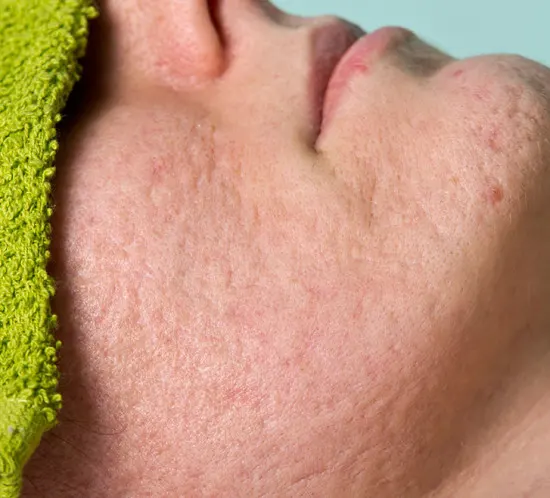
A chemical peel for acne scars does two different jobs, and it is much better at one than the other. The flat red and brown marks that linger after a breakout are discoloration, not scars, and a series of superficial peels clears them reliably. True acne scars are pits and ridges in the skin's structure, and a peel can soften the shallow ones while deeper scars need focused techniques or combination therapy. If you are still breaking out, start with our guide to chemical peels for active acne, because scars treated before the acne is controlled get treated twice. This guide covers how to tell marks from scars, which peels suit which scar types, what TCA CROSS is, how many sessions to expect, and what changes for deeper skin tones.
Marks Versus Scars: The Distinction That Decides Everything
Run a fingertip across the area. If the spot is flat and the only difference is color, it is a mark. If you can feel a dip or a bump, it is a scar. That test is not a diagnosis, but it predicts how a peel will perform.
Post-Inflammatory Marks
A pimple is an inflamed wound, and inflammation leaves color behind. Brown or gray marks are post-inflammatory hyperpigmentation, meaning pigment cells overproduced melanin while the skin healed. Pink or red marks are post-inflammatory erythema, meaning small blood vessels in the healing area are still dilated. Both fade on their own over months, and faster with peels, because the acid speeds the turnover of pigment-loaded surface cells. Our guide to peels for hyperpigmentation covers that pathway in detail.
True Acne Scars
A scar forms when a breakout damages the skin's deeper support layer and the repair is imperfect. Too little collagen leaves a depression, which is an atrophic scar. Too much leaves a raised ridge, which is a hypertrophic or keloid scar. Peels work from the surface down, so the deeper the structural change, the less a peel can reach it.
Scar Types and How Each Responds to Peels
| Type | What it looks like | Peel response |
|---|---|---|
| Post-inflammatory marks | Flat red, pink, brown, or gray spots | Responds well to a superficial series |
| Rolling scars | Broad, shallow waves with soft edges | Softens with medium-depth peels; often paired with subcision |
| Boxcar scars | Wider dents with sharp, defined edges | Shallow ones blend with TCA; deep ones need resurfacing plus other tools |
| Ice pick scars | Narrow, deep pits, like a puncture | Standard peels do little; TCA CROSS is the peel technique used |
| Hypertrophic and keloid | Raised, firm, sometimes growing | Not a peel candidate; peels can make them worse |
Most people have a mix of these, which is why an honest plan usually combines methods rather than promising one procedure fixes everything.
Which Peels Are Used for Acne Scars
Superficial Peels for Marks and Texture
A series of light peels is the starting point for discoloration and for the rough, uneven surface old acne leaves behind. A salicylic acid peel suits oily, breakout-prone skin because it works inside the pore, and a glycolic acid peel is the classic choice for brightening and smoothing. Neither reaches deep enough to change a true scar's shape. They are the right tool for marks and the wrong tool for pits.
Medium-Depth TCA for Shallow Boxcar and Rolling Scars
A TCA peel at medium strength reaches the upper dermis, which is where shallow scars live. The controlled injury triggers collagen remodeling over the following months, which fills in a little under the scar and softens its edges. Rolling scars and shallow boxcars are the best candidates. Our explainer on peel depths shows why going deeper across the whole face is rarely the answer.
TCA CROSS for Ice Pick Scars
CROSS stands for chemical reconstruction of skin scars. Instead of coating the face, a clinician applies a very high concentration of TCA to the base of each ice pick scar with a fine applicator, leaving the surrounding skin untouched. The scar base frosts, heals, and lays down new collagen from the bottom up, and over a series of treatments spaced several weeks apart the pit becomes shallower. It is a focal medical procedure, not a facial: the concentrations used would burn normal skin, so it belongs with a dermatologist or physician who performs it regularly, and it is often combined with a full-face medium peel in the same plan.
What to Expect: Softening and Blending, Not Erasing
A good outcome from peels for acne scars is skin that looks smoother in ordinary light, marks faded to match the surrounding tone, and scars that are shallower and blend in rather than standing out. What peels cannot deliver is skin that was never scarred. Deep ice pick scars and wide, sharp-edged boxcars usually need a combination of tools, and a provider who promises to erase them with a peel alone should be treated with caution.
How Peels Compare With Other Scar Treatments
- Microneedling. Triggers collagen without removing the surface, which makes it safer than aggressive peels in deeper skin tones and a common partner to peels for rolling scars. Our comparison of peels versus microneedling covers the tradeoffs.
- Laser resurfacing. Offers precise depth control and is often the next step when a medium peel has done what it can, at a higher cost per session. See peels versus laser.
- Subcision. A needle releases the bands tethering a rolling scar downward so the surface can lift. It is often paired with a peel or microneedling.
How Many Sessions It Takes
- Consultation. A provider maps your scar types, confirms your acne is controlled, and asks about isotretinoin use, cold sores, and keloids.
- Priming. Two to six weeks of provider-directed topicals and daily sunscreen, especially before medium peels and in deeper skin tones.
- Superficial series. Marks and surface texture are usually treated over four to six light peels spaced two to four weeks apart.
- Medium peel or TCA CROSS. A medium TCA peel is typically done once, then repeated after several months if needed. TCA CROSS is planned as a series of several treatments spaced weeks apart.
- Reassessment. Collagen keeps remodeling for months, so results are judged well after the peeling stops.
Aftercare That Protects Healing Scars
Aftercare matters more after a scar treatment than after a brightening peel, because the skin is rebuilding rather than simply shedding. Our full aftercare guide applies, with these points weighted heavily:
- Do not pick or peel. Pulling skin off early is how a healing scar becomes a worse one.
- Sunscreen every day. Broad-spectrum SPF 30 or higher on healing skin, reapplied outdoors. Sun on a treated area is a direct route to new marks.
- Keep treated spots moist. A bland ointment as directed, particularly on TCA CROSS sites, which heal as small individual wounds.
- Pause actives. Retinoids and acids return on your provider's schedule.
- Report trouble early. Spreading redness, pus, blistering, or worsening pain are reasons to call.
Risks, Especially in Deeper Skin Tones
The main risk with any peel for acne scars is trading a scar for a mark. Skin with more melanin responds to inflammation by producing pigment, so a peel that is too strong, or a healing site that catches sun, can leave post-inflammatory hyperpigmentation that lasts longer than the scar bothered you. That risk is highest with medium-depth full-face peels and with TCA CROSS, where each treated pit can darken temporarily as it heals. Providers manage it with lower starting strengths, longer priming, test spots, and a preference for microneedling over aggressive resurfacing when the scars are mainly rolling. Our guide to chemical peels for dark skin covers how to choose a provider and a plan. Anyone with a history of keloids should say so before any treatment.
What It Costs
Treat these as the ranges often quoted rather than as prices. A superficial salicylic or glycolic series for marks is often quoted at about $150 to $300 per session, and four to six sessions is the realistic budget. A medium-depth TCA peel is often quoted at $500 to $1,500 depending on strength, area, and provider, in line with our TCA peel cost guide. TCA CROSS is priced per session by the provider, usually according to how many scars are treated, and a full plan typically involves several sessions. Scar treatment is cosmetic and not typically covered by insurance. ChemicalPeel.org is an education resource, not a clinic, so confirm pricing with your provider.
Choosing Who Treats Your Scars
Scar work rewards experience, because the decisions are about which tool fits which scar. Ask a prospective provider how they classify your scars, whether they perform TCA CROSS themselves, how they handle your skin tone, and what they would combine a peel with. Our guide to choosing a provider lists the questions worth asking, and a dermatologist who treats acne scarring regularly is the safest starting point beyond superficial peels. In the Chicago area, our med spa directory lists local practices; elsewhere, use our find a doctor page.
Frequently Asked Questions
Do chemical peels get rid of acne scars?
Partly. Peels clear the flat red and brown marks acne leaves behind very well, and medium-depth peels soften shallow rolling and boxcar scars by stimulating new collagen. They do not erase deep ice pick scars or wide, sharp-edged boxcars, which usually need TCA CROSS, microneedling, subcision, laser, or a combination. Expect blending, not disappearance.
Which chemical peel is best for acne scars?
It depends on what you actually have. A salicylic or glycolic acid series is best for post-inflammatory marks and surface texture. A medium-depth TCA peel is the usual choice for shallow rolling and boxcar scars. Ice pick scars call for TCA CROSS, a focal technique where high-strength TCA is applied only to the scar base by a clinician.
How many peels does it take to see results on scars?
Marks usually need a series of four to six superficial peels spaced two to four weeks apart. A medium TCA peel is typically done once and reassessed after several months, since collagen keeps remodeling long after the peeling stops. TCA CROSS is planned as several treatments spaced weeks apart, with pits growing shallower across the series.
Can a chemical peel make acne scars worse?
Yes, in two ways. A peel that is too strong for your skin, or healing skin exposed to sun, can leave post-inflammatory hyperpigmentation, which is most likely in deeper skin tones. And peels can aggravate raised hypertrophic or keloid scars, which are not peel candidates at all. Conservative strengths, priming, and strict sun protection lower the risk.
Is TCA CROSS a chemical peel?
It is a chemical peel technique, but not a full-face peel. CROSS stands for chemical reconstruction of skin scars: a clinician applies very high-strength TCA to the base of each ice pick scar with a fine applicator, sparing the skin around it. The scar heals from the bottom up over a series of treatments. Because of the concentration used, it is performed only by trained physicians.
Should I treat active acne before treating scars?
Yes. Ongoing breakouts create new marks and scars while you are paying to treat old ones, and inflamed skin responds unpredictably to resurfacing. Providers generally want acne controlled first, often with a superficial peel series that treats breakouts and early marks at the same time, before moving to medium peels or TCA CROSS for established scars.