Written by the ChemicalPeel.org editorial team. Published September 26, 2026.
Clinical review pending. This page has not yet been reviewed by a licensed clinician; read it as patient education, not medical advice. How we review
TCA CROSS for ice pick scars is a focal treatment: a clinician applies a tiny amount of high-strength trichloroacetic acid (TCA), 65 to 100 percent in DermNet's descriptions, to the base of each ice pick scar and spares the skin around it. The acid sets off a local inflammatory reaction that leads to new collagen, and a 2021 review of 19 articles found that CROSS seems to be effective specifically for ice pick scars. Most patients need a series of sessions, and the aim is improvement, not complete removal. This skin concerns guide goes deeper than the summary in chemical peels for acne scars.
What TCA CROSS Is
CROSS stands for chemical reconstruction of skin scars, a technique Lee and colleagues described in 2002 in Dermatologic Surgery for atrophic, meaning sunken, acne scars. DermNet notes that TCA is typically used at 20 to 35 percent for a regular TCA peel, while TCA CROSS deposits small amounts at 70 to 100 percent onto the scar itself, aiming to reduce the shadows cast over scar depressions. The authors of a 2010 pilot study in the Journal of Cutaneous and Aesthetic Surgery explain that healing is more rapid, with a lower complication rate, because the normal skin next to each scar is spared.
Why Scar Type Matters: Ice Pick Versus Rolling Scars
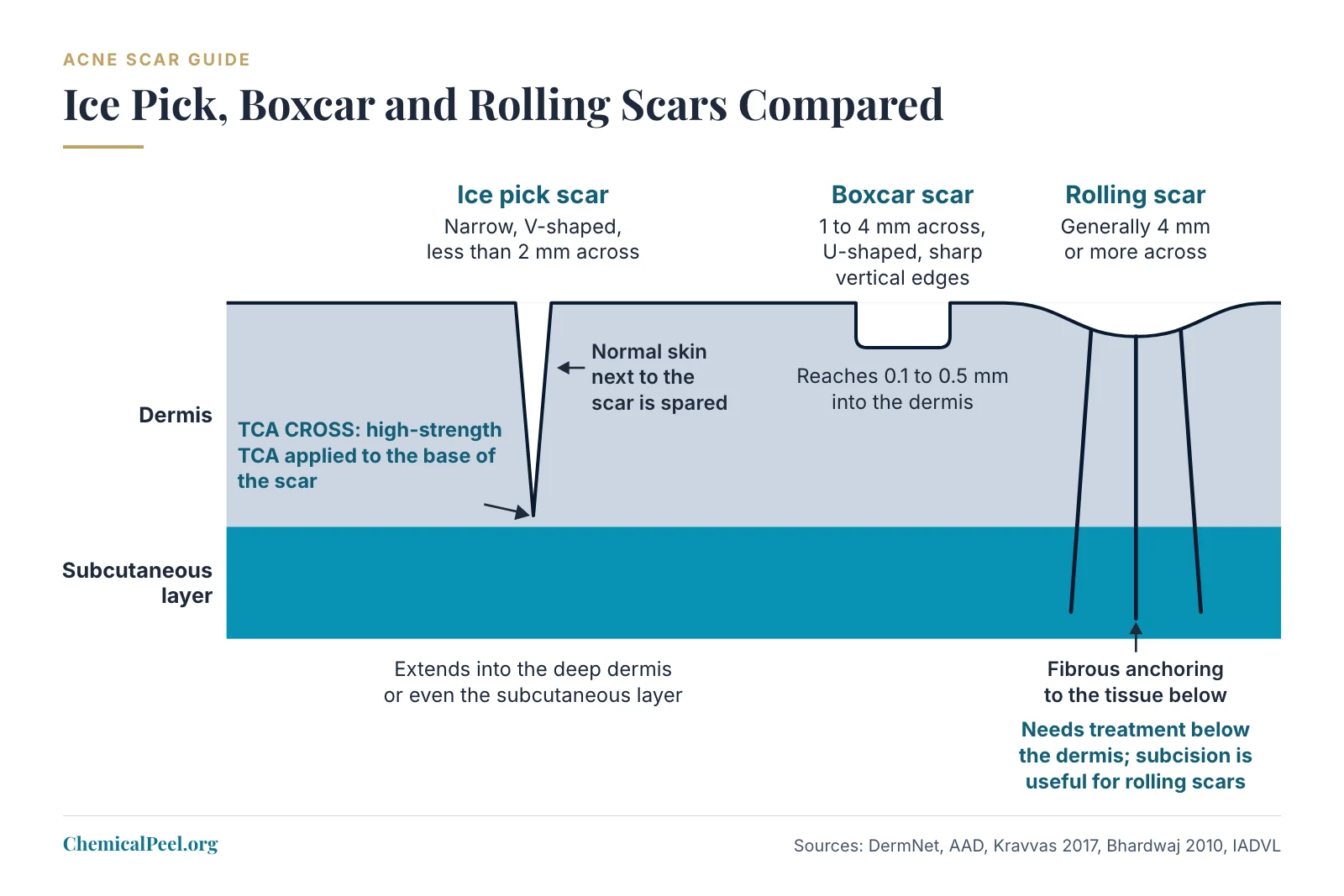
Ice pick scars are the most common acne scar type, according to the American Academy of Dermatology (AAD), and look small but go deep. A 2017 systematic review describes them as narrow, V-shaped tracts less than 2 mm across that extend into the deep dermis or even the subcutaneous layer, which makes them resistant to conventional resurfacing. Higher TCA concentrations can reach deeper, and CROSS restricts them to the scar.
Rolling scars are generally 4 mm or more across, and fibrous anchoring to the tissue below means they need treatment below the dermis. Boxcar scars sit in between: 1 to 4 mm across, U-shaped with sharp vertical edges, reaching 0.1 to 0.5 mm into the dermis. The AAD notes that ice pick scars require different treatment than rolling scars.
Two split-face studies compared CROSS with other treatments. In 20 patients with rolling scars (Ramadan, 2011), subcision reduced scar size and depth more than 100 percent TCA CROSS, with fewer pigment side effects. In 20 patients, 10 with rolling and 10 with ice pick scars (Kim, 2009), a fractional laser did significantly better than CROSS on rolling scars, with no significant difference on ice pick scars. DermNet still lists rolling and boxcar scars among its uses.
TCA Concentrations Reported in Studies
The 2021 review also found that no standardized treatment guideline exists for CROSS, and a 2020 narrative review of acne scar surgery in skin of color reports concentrations from 35 to 100 percent. Studies comparing strengths include:
- 65 versus 100 percent. The original 2002 report, an analysis of 65 treated patients with skin types IV to V, used both strengths; the skin of color review reports better results with 100 percent.
- 70 versus 100 percent. A randomized trial of 40 patients (2025) found no significant difference in overall efficacy, but crusting lasted longer after 100 percent.
- 50 versus 80 percent. A nonrandomized, single-blinded split-face trial of 31 patients with ice pick scars (2024) found no significant difference in improvement between the two sides, with more serious adverse events on the 80 percent side.
A 2026 review of 34 publications found that higher TCA concentrations increased the risk of complications.
How Many Sessions, and How Far Apart
DermNet's TCA CROSS page gives two schedules. Its procedure section says CROSS is generally repeated on several occasions at 2 to 4 week intervals. Its aftercare section says most patients need 3 to 6 treatments for optimum improvement, which may be repeated at 2 to 8 week intervals over 6 months. Individual studies set their own schedules:
| Study | Design and size | TCA strength | Sessions and spacing |
|---|---|---|---|
| Bhardwaj and Khunger, 2010 | Open prospective pilot study, 12 patients | 100 percent | Four, every two weeks |
| Khunger and colleagues, 2011 | Study of 30 patients, skin types IV and V | 100 percent | Four, every two weeks |
| Agarwal and colleagues, 2015 | Clinical trial, 53 patients | 70 percent | Every two weeks |
| Leheta and colleagues, 2011 | Randomized trial, 30 patients, half given CROSS | 100 percent | Four, 4 weeks apart |
The 2026 review found that multiple sessions yielded greater improvement. The Bhardwaj and Khunger studies primed the skin for two weeks first with 4 percent hydroquinone and 0.025 percent tretinoin.
What a Session and Recovery Look Like
Before
DermNet advises treating active acne before scar management (see chemical peels for acne). The AAD asks you to tell your dermatologist about all acne treatments used within the last two years, since some can cause unwanted side effects with scar treatments.
During
DermNet describes a procedure that takes minutes, depending on the number of scars. The clinician cleanses the skin, then uses a fine, blunt-tipped instrument to apply the acid to the base of each scar, stopping at the start of frosting, a whitening of the skin that usually appears within 10 seconds. No anesthesia is needed, according to the skin of color review. Eye covers may be used, and emergency eye irrigation equipment should be at hand.
After
Per DermNet, frosting lasts up to 12 hours, and the skin around treated sites is red and sore for 24 to 48 hours. A small scab develops after 2 to 3 days and falls off after 3 to 7 days. You may wash as normal and wear makeup, and sunscreen is recommended to reduce the chance of pigmentation. Do not pick: DermNet notes that picking delays healing and causes scarring. See our aftercare guide, though your clinician's instructions come first.
How Long Change Takes
DermNet describes the expected change over a 6-month period, and the 2010 pilot study authors note that dermal collagen remodeling after TCA may continue for several months. Indian acne surgery guidelines put the goal plainly: improvement rather than perfection, because deep acne scars cannot be entirely eliminated.
Risks, Including Pigment Changes in Darker Skin
DermNet calls TCA CROSS generally well tolerated, with complications rare in expert hands. It lists:
- Prolonged local irritation and redness
- Damage to the lip, nostril, or eye if acid lands there, with painful ulceration and potential scarring
- Darkening, usually temporary, or lightening, which may be permanent
- Neighboring scars merging into larger scars
- A weak response or no improvement
Precision matters: in a 2021 case report, one patient's scars worsened after CROSS delivered by electronic micropipette, which the authors say may be less precise than a 30-gauge needle. See chemical peel side effects.
Darker Skin Tones
The 2020 skin of color review says approximately a third of patients with darker skin types may develop post-inflammatory hyperpigmentation after TCA CROSS, which may persist in some. The 2011 study's authors concluded that adequate priming and continued use of hydroquinone and tretinoin reduces complications and promotes healing. See chemical peels for dark skin and peels for hyperpigmentation.
Who Should Wait or Skip It
- Recent isotretinoin. DermNet advises avoiding TCA CROSS within 12 months of systemic retinoid therapy, and the 2010 pilot study excluded people on systemic isotretinoin.
- Active inflammatory lesions, infection, or cold sores. That study excluded active inflammatory lesions and infections such as herpes labialis (cold sores), and Indian peel guidelines list active infection and open wounds as contraindications.
- A tendency to form keloids. Both the pilot study and the peel guidelines rule it out.
See who should not get a chemical peel for the general list.
Warning Signs
Watch for infection or irritation and redness that persist. DermNet advises letting your doctor know promptly about any problem, because complications are easier to deal with early than late.
Who Performs TCA CROSS
TCA CROSS is not a self-treatment. It uses far stronger acid than a TCA peel, and the 2008 Indian guidelines on acne surgery, which cover TCA CROSS, say the physician should be a trained dermatologist with hands-on training and experience in chemical peeling. Do not try it at home: the AAD warns that some chemical peels sold for at-home use have caused serious injuries, and that the FDA advises using a chemical peel only under the supervision of a licensed, trained provider such as a dermatologist (see at-home chemical peels).
Ask which of your scars are ice pick scars, what strength and applicator will be used, how many sessions are planned, and how your skin tone will be protected. See choosing a provider for credentials, or find a qualified provider near you. In the Chicago area, our med spa directory lists local practices; ask whether a practice offers TCA CROSS and who would perform it.
What TCA CROSS Costs
None of the sources behind this guide gives a TCA CROSS price, and fees vary by provider, so ask for a per-session quote and the planned number of sessions. DermNet describes TCA CROSS as inexpensive but not always effective. The AAD notes that medical insurance does not cover the cost of acne scar treatment. Our TCA peel cost guide covers full-face TCA peels, a different service.
Alternatives and Combinations
The AAD notes that people with acne scars often develop more than one type of depressed scar, and the Indian guidelines say a patient may need more than one type of treatment:
- Punch techniques. Punch excision, elevation, and grafting are useful for deep scars with sharp vertical walls, such as ice pick and boxcar scars.
- Subcision. A needle breaks the fibrous strands that tether a scar to the tissue below; it is useful for rolling scars.
- Microneedling. The AAD describes microneedling, also called collagen induction therapy, as safe for all skin tones. In the Leheta randomized trial of 30 patients, percutaneous collagen induction and 100 percent TCA CROSS showed no significant difference in improvement. See chemical peels versus microneedling.
- Lasers. In a 2014 open-label randomized pilot trial of 28 patients with ice pick scars, a pinpoint CO2 laser technique was more effective than TCA CROSS. See chemical peels versus laser.
DermNet notes that TCA CROSS can be combined with topical retinoids, microneedling, fractional laser, and subcision.
Frequently Asked Questions
What is the best treatment for ice pick scars?
No single treatment works for every acne scar, and treatment depends on scar type. Ice pick scars are narrow and deep, which makes them resistant to conventional resurfacing. Options with published evidence include TCA CROSS, which a 2021 review of 19 articles found seems effective specifically for ice pick scars, and punch techniques that remove or lift individual deep scars. A small randomized pilot trial of 28 patients found a pinpoint CO2 laser technique more effective than TCA CROSS. People with acne scars often have more than one type.
Is TCA stronger than salicylic acid?
As a peel, TCA can reach deeper. DermNet lists salicylic acid among superficial peels and names TCA, usually at 20 to 35 percent, as the most common chemical for a medium depth peel. Indian dermatology guidelines class a 20 to 30 percent salicylic acid peel as very superficial. TCA CROSS uses far higher strengths, 65 to 100 percent in DermNet's descriptions, on tiny areas, and Indian acne surgery guidelines say a trained dermatologist should perform it.
How long does TCA CROSS take to work?
DermNet describes the expected change over a 6-month period. It says most patients need 3 to 6 treatments and gives two intervals: 2 to 4 weeks in its procedure section and 2 to 8 weeks in its aftercare section. Each treated scar forms a small scab after 2 to 3 days that falls off after 3 to 7 days. Collagen remodeling after TCA may continue for several months, and in some patients early change may partly reflect swelling. The aim is improvement, not complete removal.
How expensive is TCA CROSS?
ChemicalPeel.org publishes no TCA CROSS price, because none of the sources behind this guide gives one, and fees vary by provider. Ask for a per-session quote and the number of sessions planned, since DermNet says most patients need 3 to 6 treatments. DermNet describes TCA CROSS as inexpensive but not always effective, and study authors call it cost-effective. The AAD notes that medical insurance does not cover acne scar treatment. Full-face TCA peel pricing, a different service, is covered in our TCA peel cost guide.
Is TCA CROSS safe for darker skin?
It has been studied in skin types IV and V, but pigment change is a known risk. A 2020 review of acne scar surgery in skin of color says approximately a third of patients with darker skin types may develop post-inflammatory hyperpigmentation after TCA CROSS, which may persist in some. Two studies in skin types IV and V primed the skin for two weeks with hydroquinone and tretinoin first. DermNet recommends sunscreen after treatment to reduce the chance of pigmentation.
Can you do TCA CROSS at home?
No. TCA CROSS is not a self-treatment. It uses high-strength TCA, 65 to 100 percent in DermNet's descriptions, far above the 20 to 35 percent typical of a TCA peel, and acid that reaches the eye, lip, or nostril can cause painful ulceration and potential scarring. Indian guidelines on acne surgery, which cover TCA CROSS, say the physician should be a trained dermatologist. The AAD warns that some peels sold for at-home use have caused serious injuries.