
Written by the ChemicalPeel.org editorial team. Published September 26, 2026.
Clinical review pending. This page has not yet been reviewed by a licensed clinician; read it as patient education, not medical advice. How we review
Is Dermamelan better than Cosmelan? A PubMed search found no study that compares the two head to head, so the evidence cannot tell you that either one is better. Both come from the same manufacturer, mesoestetic, and both pair in-office masks with months of products used at home; the manufacturer describes Dermamelan as requiring a doctor's supervision and Cosmelan as an aesthetic treatment. This guide is part of our peel types series.
What Dermamelan and Cosmelan Are
Both methods are made by mesoestetic, a company in Barcelona, Spain. The manufacturer describes two phases for each: a mask with an intensive depigmenting action, applied by a professional in a clinic, then products you use at home. The manufacturer says each treatment must be done at an authorized center with a professional's follow-up. Its Dermamelan pack page says online sales are not allowed and that the method should always be done under the supervision of a professional in an authorized center; the daily home products come afterward, as a separate phase.
The manufacturer notes that Cosmelan is often referred to as a peel, but says the method goes beyond a peel: unlike traditional chemical peels, which primarily act on the skin's surface, it is a multi-phase professional protocol. Our Cosmelan peel guide covers Cosmelan on its own, and our guide to chemical peel depths explains the depth scale used for acid peels.
How the Manufacturer Says They Differ
The manufacturer says Cosmelan is an aesthetic treatment, while Dermamelan requires a doctor's supervision and monitoring. It calls Dermamelan a new generation treatment with two patents for the most severe and resistant spots, though it also describes Cosmelan as a treatment for the most severe and resistant skin blemishes. It says both formulas use melaphenone, a molecule it developed in-house to regulate pigment production, and that Dermamelan also contains a complex of three active ingredients. These are the manufacturer's statements, not independent findings.
How the Mask and Home Phase Work
The details below are the manufacturer's descriptions; your provider sets the actual times.
Cosmelan
According to the manufacturer's US site, the professional cleanses the skin to remove excess oil and applies the cosmelan 1 mask. The site says you then go home with the mask on and leave it for the time the professional indicates, between 6 and 8 hours. It says the home phase begins 7 days after the mask is removed: cosmelan 2 cream morning and night, followed by a soothing balm and, in the daytime, a tinted sunscreen. The manufacturer puts the whole method at approximately 6 months, varying with the severity of the spots.
Dermamelan
The manufacturer says Dermamelan begins with a diagnosis by a medical professional, then a session in which two masks are applied. It says you remove them at home after the time the professional indicates; its international site lists 4 hours for this in-consultation phase. The home phase, it says, starts 48 to 72 hours after the in-consultation phase and lasts 4 months, with 3 products applied every day.
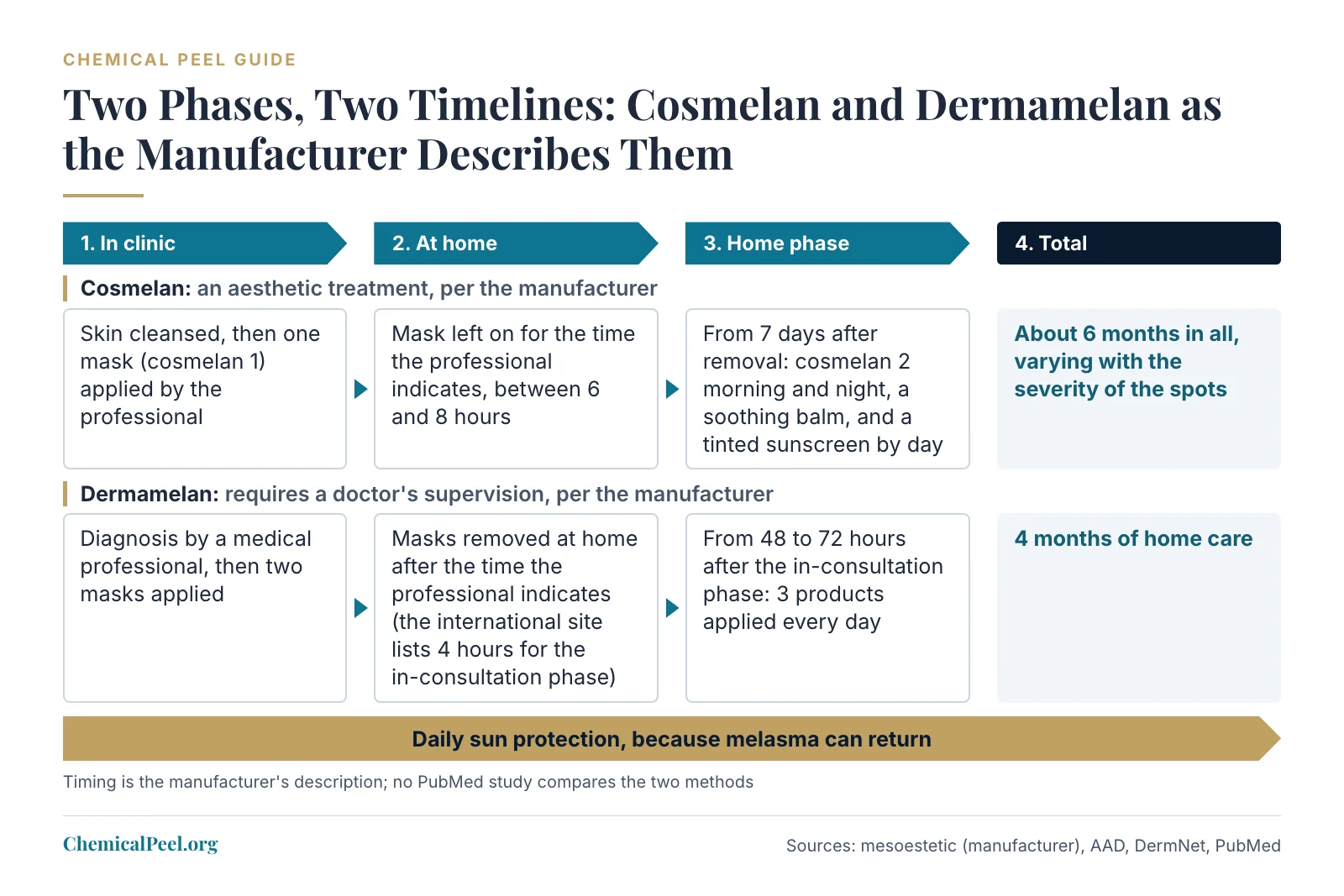
| Feature | Cosmelan | Dermamelan |
|---|---|---|
| Supervision, per the manufacturer | Aesthetic treatment, applied by an aesthetic professional | Requires a doctor's supervision and monitoring |
| In-office step, per the manufacturer | One mask | Two masks, after a diagnosis |
| Mask time, per the manufacturer | Between 6 and 8 hours, at home | Set by the professional; the international site lists 4 hours for the in-consultation phase |
| Home phase, per the manufacturer | From 7 days after removal; about 6 months in all | From 48 to 72 hours after the in-consultation phase; 4 months |
| Studies found in PubMed | None | One 2011 pilot of 10 women |
What the Evidence Shows, and What It Does Not
Published evidence on both methods is thin. A PubMed search for either product name, run for this guide on September 26, 2026, returned only one study of either product, and no study comparing them.
The One Dermamelan Study
That pilot study, published in 2011 in the Journal of Drugs in Dermatology, enrolled 10 women with melasma, skin types II to IV, in an open-label trial lasting four months. Dermamelan was applied once a day for three months, which differs from the two masks and home phase the manufacturer describes today, and the manufacturer describes the current product as a new formula. Mild irritation was the only side effect the authors observed. They wrote that the study suggests Dermamelan produces rapid improvement of melasma. The 2 women found at the start to have melanophages, pigment-carrying cells in the deeper skin layer called the dermis, had a poorer outcome. With no comparison treatment, the study cannot show how Dermamelan compares with other melasma treatments.
Cosmelan
The same search found no Cosmelan study in PubMed. Claims about how well Cosmelan works come from outside PubMed, including the manufacturer's own site.
What the Broader Melasma Evidence Says
A 2020 evidence-based review in the American Journal of Clinical Dermatology, which included 113 studies with 6,897 participants from a search limited to randomized and controlled clinical trials, found triple combination cream (hydroquinone, tretinoin, and a corticosteroid) and hydroquinone alone the most effective and well-studied melasma treatments. It found chemical peels and laser and light treatments equal or inferior to topical treatments, with a higher risk of side effects. The American Academy of Dermatology lists both creams among medications a dermatologist may prescribe, notes that hydroquinone is no longer sold without a prescription, and says there is no one best treatment for melasma. See chemical peels for melasma for acid peel options.
Who Each Is Meant For
The manufacturer lists melasma, post-inflammatory hyperpigmentation (dark marks that can follow acne), solar lentigines, and freckles among the spots Cosmelan is meant to treat, and says Cosmelan is not indicated for active acne.
Get the Diagnosis First
Melasma can be mistaken for another skin condition, so the diagnosis comes before the brand. The American Academy of Dermatology says a dermatologist can often diagnose melasma by looking closely, may use a Wood's lamp or dermatoscope to see how deeply the pigment reaches, and may take a small biopsy to rule out a look-alike. Depth matters: DermNet notes that epidermal melasma usually responds well to treatment, dermal melasma usually responds poorly, and mixed melasma, the most common type, usually improves partly. See melasma versus hyperpigmentation and peels for hyperpigmentation.
Safety: Irritation, Pregnancy, and Darker Skin
Irritation
In the 2020 review, side effects across melasma treatments tended to be mild and were mainly irritation, dryness, burning, redness, and post-inflammatory hyperpigmentation. With melasma, irritation can backfire: the American Academy of Dermatology says a skin care product that burns or stings is irritating your skin and may darken dark spots, and DermNet warns that chemical peels and lasers carry a risk of worsening melasma. See chemical peel side effects.
Pregnancy
The American Academy of Dermatology advises waiting until you have your baby to treat melasma, which may improve, and sometimes even go away, after you give birth. See chemical peels during pregnancy.
Darker Skin Tones
The American Academy of Dermatology says women with medium to dark skin tones are the most likely to develop melasma, and that some melasma treatments can irritate darker skin, which can worsen melasma and make it darker. For chemical peels in general, Mayo Clinic says treated skin can turn darker or lighter than normal, that this is more common in people with brown or black skin, and that it can sometimes be permanent. The only Dermamelan study included no one with skin types V or VI. See our guide to chemical peels for dark skin.
Other Reasons to Wait, and When to Call
General chemical peel cautions are worth raising with your provider too. Mayo Clinic says a doctor may caution against a chemical peel if you have taken isotretinoin in the past six months, have a personal or family history of keloids, are pregnant, or have frequent or severe cold sores, and that a peel can lead to infection, such as a cold sore flare-up. If anything worries you after treatment, tell the provider who treated you promptly; DermNet notes that complications are easier to deal with early than late. See who should not get a chemical peel for the full list.
Why Melasma Can Return After Either One
Melasma is a chronic pigment disorder. The American Academy of Dermatology says treatments cannot make it go away forever, and that it is common for melasma to return when you spend time outdoors without protecting your skin from the sun. DermNet adds that even after a good result, pigment may reappear with summer sun, and stresses the need for lifelong sun protection. The academy says you need daily sun protection to get results from treatment, and recommends a broad-spectrum, water-resistant sunscreen with SPF 30 or more, reapplied at least every two hours, a wide-brimmed hat, and a tinted sunscreen with iron oxide, because visible light can also worsen melasma. The manufacturer, for its part, says daily depigmenting care and year-round sun protection are needed after treatment to prevent repigmentation.
Cost and Whether It Is Worth It
This guide gives no Dermamelan or Cosmelan fee, because there is no verified figure for either. Ask whether a quote covers the office session, the home products, and follow-up visits. The American Academy of Dermatology notes that melasma treatment is not considered medically necessary, so most insurers will not cover the cost. Our chemical peel cost guide lists standard peel fees.
Whether Dermamelan is worth it cannot be settled by the evidence, since the only PubMed study was a 10-woman pilot with no comparison treatment. It is worth discussing once a clinician has confirmed melasma, if you can keep up months of daily home products and sun protection, and if you accept that melasma can return.
Questions to Ask Before You Choose
- Is my pigment melasma, another condition, or both, and how deep does it reach?
- Why this method rather than prescription creams alone?
- Who applies the mask, and will a doctor supervise if it is Dermamelan?
- How long will the mask stay on, and what should I do if it burns or stings?
- What does the fee include, and do you often treat melasma in skin like mine?
Our guide to choosing a provider covers what else to ask. When you are ready, you can find a qualified provider or search for a med spa near you.
Frequently Asked Questions
Is Dermamelan better than Cosmelan?
No study shows that either one is better. A PubMed search found no study comparing Dermamelan with Cosmelan directly, and it turned up only one small Dermamelan study and no Cosmelan study. Both come from the manufacturer mesoestetic and pair an in-office mask with months of home products. The manufacturer describes Dermamelan as a newer method that requires a doctor's supervision, but that is its own description, not an independent finding.
How much does a Dermamelan peel cost?
This guide gives no Dermamelan price because there is no verified figure to cite. The American Academy of Dermatology suggests asking your dermatologist about the cost of melasma treatment before you start. Ask whether a quote covers the in-office masks, the 4 months of home products the manufacturer describes, and follow-up visits. The academy notes that melasma treatment is not considered medically necessary, so most insurers will not cover the cost.
Is Dermamelan worth it?
The evidence cannot answer that yet. The only Dermamelan study we found in PubMed was a 2011 open-label pilot of 10 women, all treated with Dermamelan and none with the darkest skin types, and we found no study comparing it with Cosmelan. It is worth discussing once a clinician confirms melasma, and only if you can keep up 4 months of daily home products and sun protection. Melasma can return after any treatment.
What are the side effects of Dermamelan?
In the one Dermamelan study in PubMed, mild irritation was the only side effect the authors observed, but it included just 10 women with skin types II to IV. A 2020 review found that side effects across melasma treatments tend to be mild and are mainly irritation, dryness, burning, redness, and dark marks from inflammation. The American Academy of Dermatology warns that some melasma treatments can irritate darker skin, which can worsen melasma and make it darker. Tell your provider promptly about any problem.
Can you get Dermamelan or Cosmelan while pregnant?
The American Academy of Dermatology advises waiting until you have your baby to treat melasma. It notes that melasma often begins during pregnancy and may improve, and sometimes even go away, after you give birth. Mayo Clinic also lists pregnancy among the reasons a doctor may caution against a chemical peel. If you are pregnant or planning to be, tell the provider before any depigmentation treatment is scheduled.
Will melasma come back after Dermamelan or Cosmelan?
It can. The American Academy of Dermatology says treatments can help fade melasma but cannot make it go away forever, and that it is common for melasma to return when you spend time outdoors without sun protection. DermNet notes that pigment may reappear with summer sun even after a good result. The academy advises daily sunscreen and a wide-brimmed hat to keep spots from getting darker or returning, plus a tinted sunscreen with iron oxide.