Written by the ChemicalPeel.org editorial team. Published July 24, 2026. Updated September 2, 2026.
Medically reviewed on by Stefanie Drozd, MSN-APRN. How we review · Our reviewers
Our reviewers work for or own Express Med Spa and Catara Med Spa, clinics marketed by this site's publisher. That is a commercial conflict of interest and it is worth weighing when you read a review here.
A Cosmelan peel is a professional depigmentation treatment that fades melasma and stubborn dark patches by suppressing the skin’s melanin production at its source. Unlike a traditional peel built around a single exfoliating acid, Cosmelan is a two-phase system: an intensive mask applied in the office by a trained provider, followed by a take-home maintenance cream used over the following weeks. That structure is exactly why providers reach for it when pigment has shrugged off simpler treatments, and why it has become one of the most requested options for melasma. This guide explains what the Cosmelan method is, what it treats, how the protocol works step by step, who makes a good candidate, what recovery and results look like, and what it costs.
What Is a Cosmelan Peel?
A Cosmelan peel, often called the Cosmelan method or Cosmelan mask, is a professional depigmentation program developed by the Spanish pharmaceutical company mesoestetic. Rather than relying on one strong acid to strip away pigmented skin, it uses a proprietary blend of pigment-regulating ingredients, commonly cited to include azelaic acid, kojic acid, phytic acid, and arbutin, to slow the overproduction of melanin itself. The treatment unfolds in two phases: an in-office mask that a provider applies and you later rinse off at home, and a maintenance cream called Cosmelan 2 that you use daily for weeks afterward.
That design separates it from the classic peels most people picture. A traditional chemical peel removes layers of pigmented cells that already exist. Cosmelan works upstream, dialing down the machinery that makes new pigment while the mask’s milder exfoliating action helps existing discoloration shed. If you are still mapping the landscape, our overview of chemical peel types explains how superficial, medium, and deep peels differ, and where a depigmentation system like this one stands apart.
What a Cosmelan Peel Treats
Cosmelan is a specialist, and its specialty is pigment that refuses to leave. Providers most often recommend a Cosmelan peel for melasma, the hormonally driven condition that creates symmetrical brown or gray-brown patches across the cheeks, forehead, and upper lip. Because melasma is rooted in overactive pigment production rather than surface damage alone, it is famous for resisting, and even rebounding after, treatments that rely purely on exfoliation. Beyond melasma, providers use the method for:
- Stubborn hyperpigmentation that has not responded to lighter peels or topical brighteners
- Post-inflammatory hyperpigmentation, the dark marks left behind by acne or irritation
- Sun-related discoloration and blotchy, uneven tone
- Pigment concerns in medium and deeper skin tones, where aggressive resurfacing carries more risk
It is not the right tool for wrinkles, scarring, or skin laxity, and it is rarely the first choice for a single small sun spot. For the full menu of options at every depth, see our guides to chemical peels for melasma and chemical peels for hyperpigmentation.
How the Cosmelan Peel Works
The active step in most unwanted pigment is an enzyme called tyrosinase, which melanocytes (the skin’s pigment cells) use to build melanin. Cosmelan’s core mechanism is tyrosinase inhibition: its ingredient blend interrupts that enzyme so the skin produces less excess pigment, while the treated surface gradually sheds the discoloration it already has. Because production is being regulated rather than burned away, improvement continues to build for weeks as the home phase does its slower, steadier work. A typical course looks like this:
- Consultation and assessment. Your provider confirms that your pigment is melasma or another suitable concern, reviews your history and medications, takes baseline photos, and sets your mask wear time based on your skin type and pigment depth.
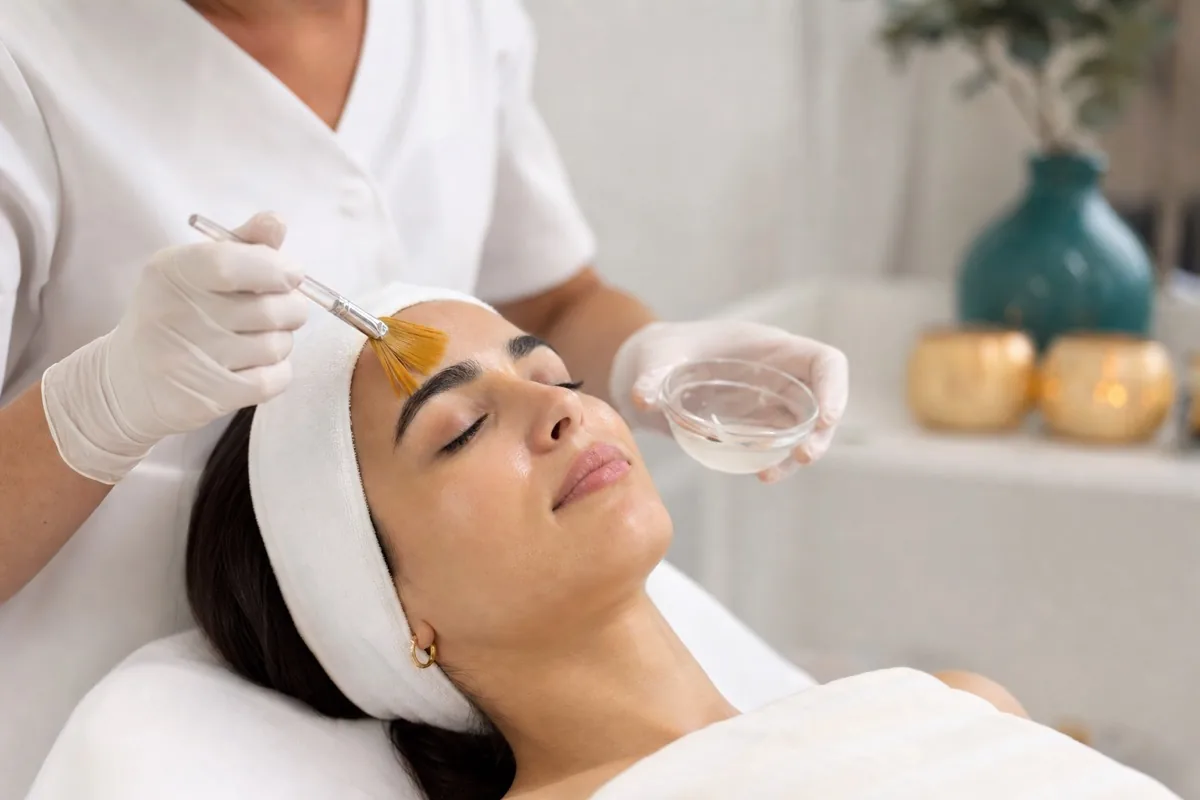
- In-office mask application. The skin is cleansed and degreased, then the provider applies a thick, ochre-toned Cosmelan 1 mask evenly across the treatment area. The visit itself is usually short.
- Wearing the mask home. You leave the office with the mask in place and wear it for the prescribed window, commonly 8 to 12 hours, going about a quiet day at home.
- Removing the mask. At the instructed time, you rinse the mask off with a gentle cleanser. Over the next day or two the skin typically turns red, warm, and tight, and peeling follows.
- Starting the home phase. A few days later, on your provider’s schedule, you begin the Cosmelan 2 maintenance cream, applied daily on a tapering plan that often runs for several months, alongside a repair moisturizer and strict sunscreen.
- Follow-up visits. Your provider checks progress over the following weeks, adjusts how often you apply the cream, and keeps the protocol on track through the maintenance phase.
The take-home point: the mask starts the process, but the weeks of disciplined home care are where melasma control is actually won.
Who Is a Candidate? Safety and Risks
The best candidates for a Cosmelan peel are adults with melasma or long-standing hyperpigmentation who have already learned that quick fixes do not hold, and who can commit to a multi-week protocol and strict daily sun protection. Providers typically postpone or advise against treatment during pregnancy or nursing (melasma often first appears in pregnancy, but treatment waits), with active cold sores, infection, or open irritation in the treatment area, after recent isotretinoin use, or with a known sensitivity to ingredients such as kojic acid. A patch test or a gradual introduction may be suggested for reactive skin.
Expected side effects are front-loaded: redness, warmth, tightness, and several days of visible peeling, followed by a week or two of sensitivity while the home phase begins. Less commonly, skin can become significantly irritated or develop contact dermatitis, and over-irritated skin can respond with new dark marks, the opposite of the goal. This is why the diagnosis, mask wear time, and cream schedule belong in experienced hands rather than a bargain setting.
Is Cosmelan Safe for Darker Skin Tones?
Cosmelan is widely used across the full range of skin tones, including Fitzpatrick types IV through VI, and is often considered one of the more appropriate pigment treatments for melanin-rich skin precisely because it regulates melanin production rather than relying on deep, injury-based resurfacing. The caveats still matter: skin of color is more prone to post-inflammatory hyperpigmentation when irritated, and melasma is notorious for rebounding when sun protection lapses. Choose a provider who treats darker skin regularly, follows a conservative schedule, and insists on rigorous sun habits.
Cosmelan Peel Recovery and Aftercare
Cosmelan peel recovery is real but manageable, and most of it happens in the first week. Here is the typical rhythm:
- Treatment day. You wear the mask home for the prescribed hours. Mild warmth, tingling, or itching under the mask is common.
- Days 1 to 3. After removal, skin looks red and feels hot, tight, and sensitive, like a strong sunburn. Most people work normally but skip makeup, saunas, and hard workouts per their provider’s guidance.
- Days 3 to 7. Visible peeling and flaking arrive, usually heaviest around mid-week. Do not pick or pull flakes; let them release on their own while you moisturize gently.
- Week 2. Redness and flaking settle, early brightness shows through, and the Cosmelan 2 home phase is underway on your provider’s schedule.
- Weeks 3 and beyond. Skin looks progressively clearer and more even while the maintenance cream keeps pigment production suppressed, often tapering over several months.
One rule towers over the rest: sun protection. Ultraviolet light, and even significant heat, can reactivate melasma while you are healing. Plan on broad-spectrum SPF 50 every morning, reapplication through the day, and a hat outdoors, not just during recovery but as a daily habit going forward.
Results: Cosmelan Peel Before and After
Most people notice meaningful lightening within two to four weeks, with results continuing to build through the second and third month as the home phase suppresses new pigment. Cosmelan peel before and after photos typically show melasma patches that are visibly softened and blended, a brighter overall complexion, and more even tone, rather than a changed face. How long results last depends on the triggers that created the pigment in the first place. With consistent use of the maintenance cream and daily sunscreen, improvement commonly holds for a year or longer. Without them, melasma can return, because hormones, heat, and UV exposure remain in play. The honest framing is management: Cosmelan can control melasma effectively for many patients, but it does not switch the condition off forever, and periodic maintenance keeps you ahead of it. The American Academy of Dermatology makes the same point about melasma generally: without diligent sun protection, pigment tends to come back.
How Much Does a Cosmelan Peel Cost?
Cosmelan sits at the premium end of pigment treatments because you are buying a program, not a single appointment. As an industry estimate, a full Cosmelan protocol in the United States commonly runs about $800 to $2,000, with many practices charging $1,000 to $1,500, a figure that usually includes the in-office mask, the take-home Cosmelan 2 kit, and follow-up visits. That is well above the roughly $100 to $300 typical of a single superficial peel, and the comparison only makes sense when you remember the package covers months of active treatment. Because depigmentation is considered cosmetic, insurance does not typically cover it. These figures are industry estimates, not a quote, and ChemicalPeel.org is an education resource rather than a clinic, so confirm pricing directly with a provider. For how this stacks up against every option, see our chemical peel cost guide.
Cosmelan Peel vs VI Peel
People researching pigment treatments often compare Cosmelan with the VI Peel, a branded in-office peel that blends TCA, salicylic acid, retinoic acid, a small amount of phenol, and vitamin C. They do different jobs. The VI Peel is a true chemical peel: applied in the office, it exfoliates pigmented layers over several days of peeling and is often repeated in a series for overall tone, texture, and sun damage. Cosmelan is a depigmentation system aimed squarely at melasma and treatment-resistant pigment, trading a single dramatic peel for months of production control.
| Cosmelan peel | VI Peel | |
|---|---|---|
| What it is | Two-phase depigmentation system, in-office mask plus home cream | Blended in-office chemical peel |
| Main target | Melasma and stubborn hyperpigmentation | Sun damage, tone, texture, post-acne marks |
| How it works | Inhibits tyrosinase to slow melanin production | Exfoliates pigmented surface layers with an acid blend |
| Protocol | One mask, then weeks to months of maintenance cream | Single visits, often repeated as a series |
| Peeling window | Roughly days 3 to 7 after the mask | Roughly 3 to 7 days after each peel |
| Typical cost | About $800 to $2,000 for the full program | A few hundred dollars per session |
For melasma specifically, many providers favor Cosmelan’s regulate-and-maintain approach. For a general refresh with some pigment benefit, a VI Peel or a series of lighter peels may fit better. A consultation with a clinician who offers both settles the question for your skin.
Frequently Asked Questions
What is a Cosmelan peel?
A Cosmelan peel is a professional two-phase depigmentation treatment developed by the pharmaceutical company mesoestetic. A provider applies an intensive mask in the office, you rinse it off at home several hours later, and you then use a take-home maintenance cream called Cosmelan 2 for weeks afterward. It targets melasma and stubborn dark patches by suppressing tyrosinase, the enzyme that drives melanin production.
Does a Cosmelan peel work for melasma?
Yes, a Cosmelan peel is one of the most widely used professional treatments for melasma, and many people see visible lightening within two to four weeks. It works upstream by inhibiting tyrosinase, the enzyme behind melanin production, which is why it can improve pigment that resisted surface-level peels. Melasma is a chronic condition, so results need upkeep: the maintenance cream and strict daily sun protection keep pigment controlled rather than gone for good.
How much does a Cosmelan peel cost?
As an industry estimate, a full Cosmelan program in the United States commonly runs about $800 to $2,000, with many practices charging $1,000 to $1,500 including the in-office mask, the take-home Cosmelan 2 cream, and follow-up visits. Prices vary by region and provider credentials, and insurance does not typically cover cosmetic depigmentation. These figures are estimates, not a quote, so confirm pricing directly with a provider.
How long do Cosmelan peel results last?
With consistent maintenance, Cosmelan results commonly hold for a year or longer. Longevity depends on the same triggers that created the pigment: sun exposure, heat, and hormones can all bring melasma back. Daily broad-spectrum sunscreen and the tapering Cosmelan 2 maintenance cream are what protect the result, so think of the treatment as ongoing control of a chronic condition rather than a one-time fix.
What is the Cosmelan peel recovery like?
Expect real but manageable downtime. Skin is typically red, warm, and tight for two to three days after the mask comes off, followed by visible peeling for roughly three to seven days. Most people return to work quickly but skip makeup, saunas, and hard workouts for the first several days per their provider’s guidance. Mild sensitivity can linger for a week or two, and strict daily sunscreen is essential throughout.
Is a Cosmelan peel safe for dark skin?
Cosmelan is generally considered one of the more suitable pigment treatments for darker skin tones, including Fitzpatrick types IV through VI, because it regulates melanin production instead of relying on aggressive, injury-based resurfacing. The caveat is experience: over-irritated skin of color can respond with new dark marks, and melasma can rebound without strict sun protection. Choose a provider who treats melanin-rich skin regularly.
Medical Disclaimer
This page is provided by ChemicalPeel.org for patient education and is not medical advice. Individual results vary, and the information here does not replace a consultation with a qualified, board-certified provider. Always discuss your medical history and treatment options with a licensed clinician before pursuing any chemical peel.
Ready to Take Control of Melasma?
A Cosmelan peel is a structured, months-long commitment to controlling pigment, and the outcome depends heavily on the clinician guiding your protocol. Find a qualified provider near you to ask whether the Cosmelan method fits your skin and history, or keep researching and compare all chemical peel types to see how depigmentation systems differ from traditional acid peels.