Written by the ChemicalPeel.org editorial team. Published September 26, 2026.
Clinical review pending. This page has not yet been reviewed by a licensed clinician; read it as patient education, not medical advice. How we review
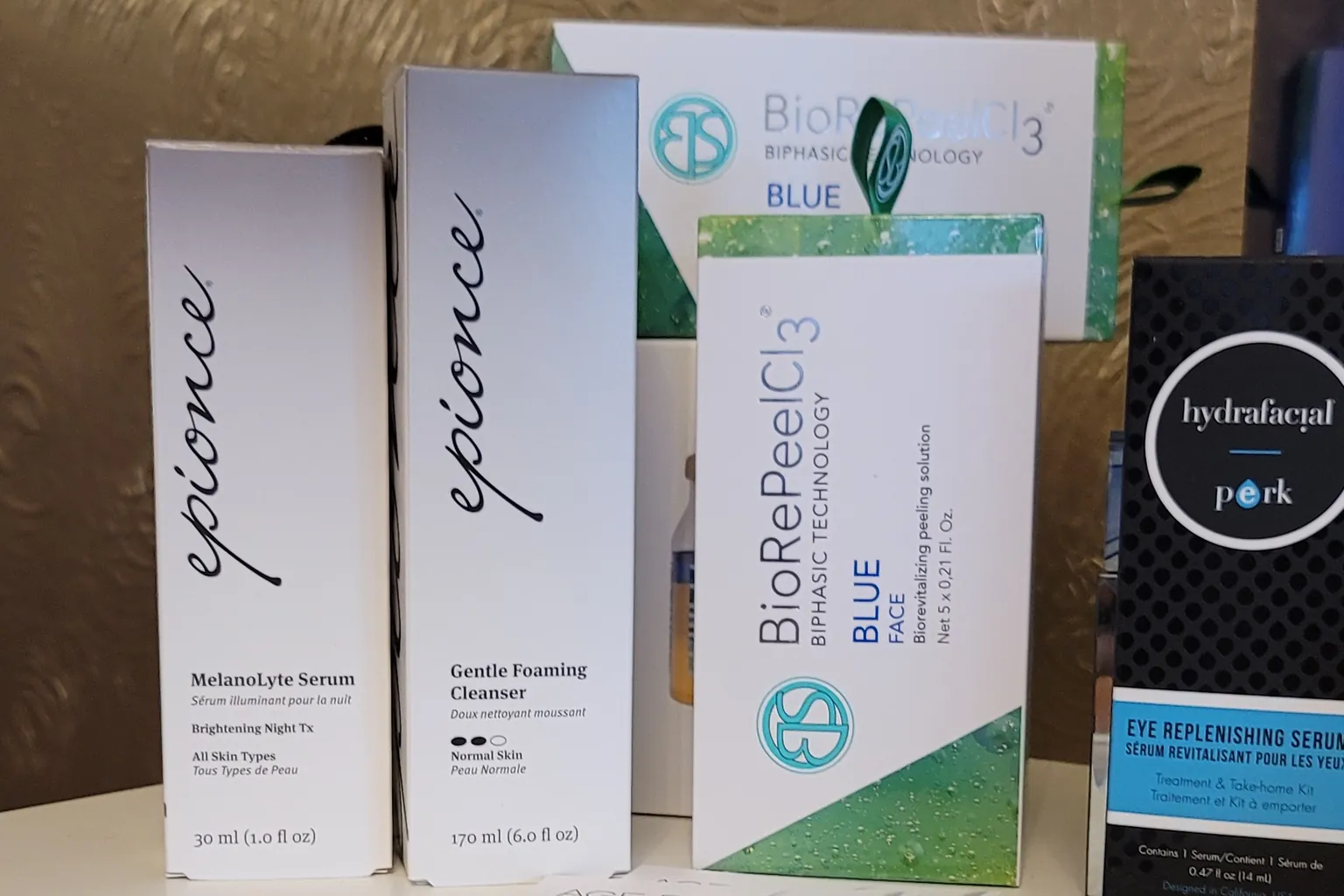
BioRePeel, sold as BioRePeelCl3, is an in-office chemical peel made by the Italian company CMed Aesthetics. The manufacturer describes it as a two-phase product that combines trichloroacetic acid (TCA) with other acids, amino acids and vitamins, and labels the face version at 35 percent TCA. How well it works is hard to judge, because PubMed lists no study of it by name.
This peel types guide compares it with a classic TCA peel and PRX-T33 and sets out what is still unknown.
What BioRePeel Is
CMed Aesthetics, based in Pisa, Italy, calls BioRePeelCl3 a biphasic chemical peel medical device. The manufacturer says the section of its website covering its medical devices is intended exclusively for qualified healthcare professionals.
The manufacturer describes two versions that differ only in TCA strength: BioRePeelCl3 FND for the face, neck and décolleté (upper chest), labeled at 35 percent TCA, and BioRePeelCl3 BODY for the hands, elbows, buttocks, knees and feet, labeled at 50 percent TCA. The manufacturer says the formula sits in two layers mixed just before treatment: a water-based layer holding TCA, alpha hydroxy, beta hydroxy and polyhydroxy acids, amino acids and vitamins, under an oil-based layer that it says protects the formula from oxygen. We found no independent published source confirming these details.
We found no FDA approval or clearance record for BioRePeel: searches of the FDA's 510(k) clearance and premarket approval databases for the name returned no matches in September 2026. In a 2024 warning, the FDA said it has not approved any chemical peel products.
Does BioRePeel Work? What the Evidence Says
Too little has been published to say. In September 2026, a PubMed search for "BioRePeel" returned no items, and neither did one for "BioRePeelCl3." In PubMed Central, the full-text journal archive, the name turns up in one article: a 2022 review of acne scar treatments in the Journal of Clinical Medicine. Its authors write that in their experience, combining microneedling with a treatment such as BioRePeel gives much better results than performing the treatments separately. That is an opinion from practice, not a measured trial result.
We found no published trial that measures how much BioRePeel changes the skin, how deep it reaches, how long any change lasts, or how often side effects occur. TCA on its own is a different matter: chemical peel guidelines published in the Indian Journal of Dermatology, Venereology and Leprology list TCA as a peeling agent with a Level A grade, the same grade they give glycolic and salicylic acid. That grade applies to TCA peels, not to this blend.
How BioRePeel Differs From a Classic TCA Peel
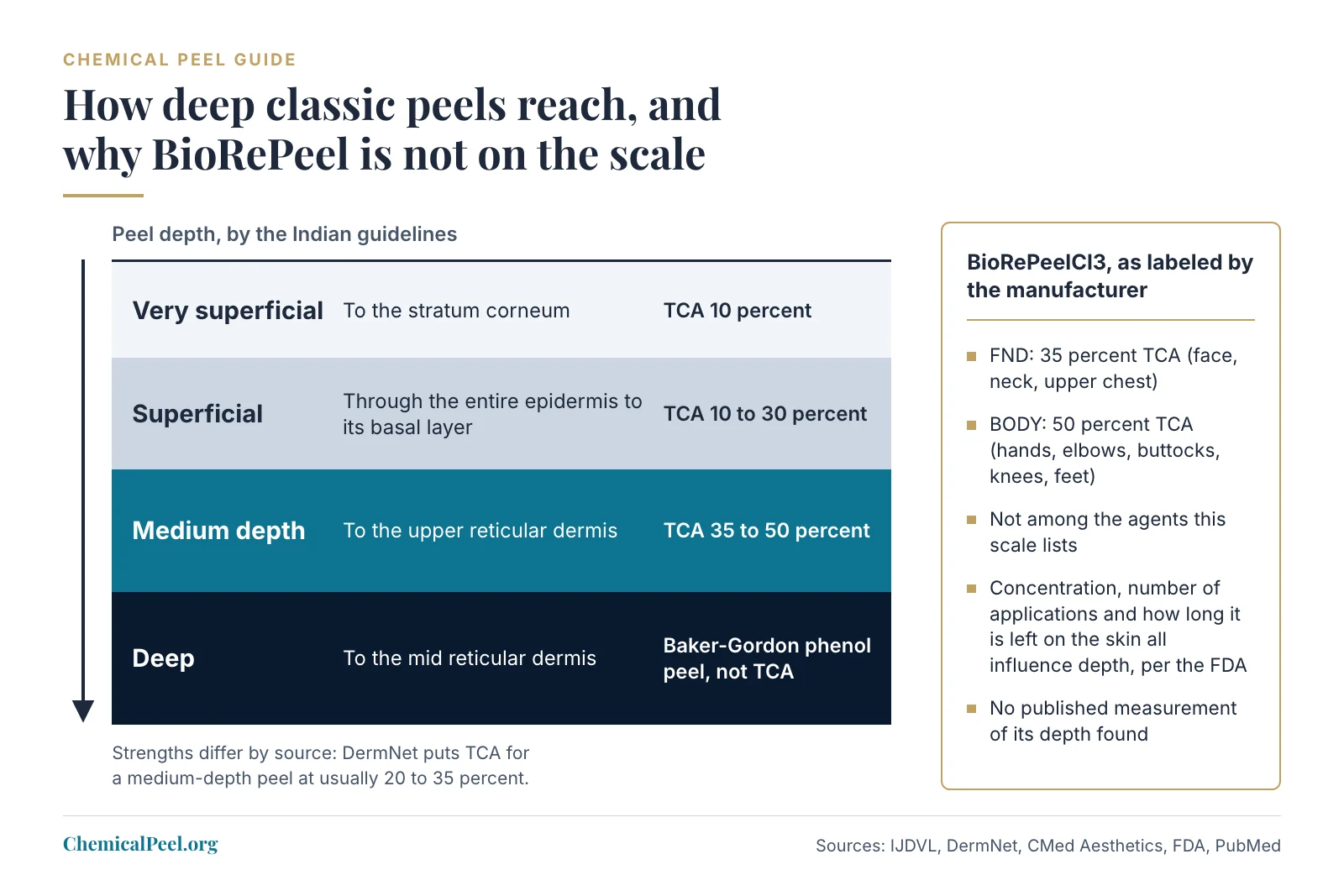
A classic TCA peel is a solution of trichloroacetic acid, the most common chemical used for a medium-depth peel, and its results depend on the concentration. Sources give different strengths. DermNet puts TCA for a medium-depth peel at usually 20 to 35 percent, while the Indian guidelines classify peels by how deep they injure the skin:
- Very superficial: to the stratum corneum; TCA at 10 percent.
- Superficial: through the entire epidermis to its basal layer; TCA at 10 to 30 percent.
- Medium depth: to the upper reticular dermis; TCA at 35 to 50 percent.
- Deep: to the mid reticular dermis; the Baker-Gordon phenol peel, not TCA.
BioRePeel is not among the agents that scale lists, so the scale cannot tell you how deep it acts. The FDA notes that a chemical peel product's concentration, the number of applications and how long it is left on the skin all influence how deeply it can penetrate, so a label strength alone does not show depth. Our chemical peel depths guide explains the scale.
BioRePeel vs PRX-T33
PRX-T33 is the closest comparison, another Italian product built on TCA. A published trial describes it as TCA at 33 percent with kojic acid and hydrogen peroxide at 5 percent each. That trial, double-blind and randomized, assigned 120 patients with atrophic acne scars to microneedling alone, the peel alone, or both, over four sessions 20 days apart; only the combined group improved significantly on the trial's scar grading scale. We found no comparable trial for BioRePeel. Our PRX-T33 guide covers that product, and our VI Peel guide covers another branded blend.
| Feature | Classic TCA peel | PRX-T33 | BioRePeelCl3 FND |
|---|---|---|---|
| TCA strength | Varies; results depend on the concentration | 33 percent, per a published trial | 35 percent, as labeled by the manufacturer |
| Other ingredients | None in a plain solution | Kojic acid and hydrogen peroxide, 5 percent each | Other acids, amino acids and vitamins, per the manufacturer |
| Published evidence | Graded Level A as a peeling agent in Indian peel guidelines | At least one randomized trial, in acne scars | No study by name found in PubMed |
BioRePeel vs Microneedling
Microneedling uses tiny needles to puncture the skin and works by stimulating the body to make collagen. The American Academy of Dermatology says this treatment is often used to treat acne scars and that downtime is minimal. A chemical peel instead uses a chemical solution to remove layers of skin.
We found no published study that compares BioRePeel with microneedling head to head. The one PubMed Central article that names BioRePeel concerns using the two together. See our comparison of chemical peels and microneedling.
Who It May Suit, and Who Should Not Have It
Dermatologists use chemical peels for concerns such as fine lines, discoloration, a dull complexion, rough-feeling skin and some types of acne. We found no published trial of BioRePeel for any of them, so ask a provider why they would choose it over a peel with published evidence.
We found no source on who should avoid BioRePeel specifically. For peels in general, guidelines and reviews list these reasons to skip or delay one:
- Pregnancy or breastfeeding.
- Active bacterial, viral, fungal or herpes (cold sore) infection, or open wounds.
- A tendency to form keloids or other abnormal scarring.
- Isotretinoin in the last six months: the Indian guidelines list it against medium-depth and deep peels, and a 2024 review calls it a relative contraindication.
- A weakened immune system, medicines that make skin more sensitive to light, or inflammatory skin disease such as psoriasis or atopic dermatitis.
If you have had cold sores, tell your provider before a peel; a peel carries a small chance of reactivating them, and medicine can lower that chance. People with Fitzpatrick skin types IV to VI have an increased risk of uneven color and of raised or keloid scarring, so peels must be done cautiously with full informed consent. See our guides to peels for dark skin and who should not get a chemical peel.
What a Session and Recovery Are Like
We found no published protocol for a BioRePeel visit. For a professional peel in general, Cleveland Clinic describes this pattern: the skin is cleansed to remove excess oil and the solution is applied. You may feel a warm to somewhat hot sensation for a few minutes, then stinging that a cool compress can ease, before the chemical is washed off or neutralized.
Recovery depends on depth. After a light peel, expect redness followed by scaling for three to seven days. After a medium peel, expect redness, swelling and flaking; blisters can form, and the skin crusts and peels off over seven to 14 days. Because we found no published measurement of BioRePeel's depth, ask which to plan for, and if you are told to expect little or no peeling, ask what that is based on.
We found no independent published schedule for BioRePeel; the manufacturer suggests its own, so ask your provider what schedule they plan and why. For a light peel, the American Academy of Dermatology says three to five peels may be necessary to give you the desired results, and Cleveland Clinic says additional light peels may be repeated every two to five weeks. DermNet advises waiting three to six months before repeating a medium-depth peel. Our guides to how often to get a peel, preparing for a peel and peel aftercare cover the basics, including daily sunscreen once the skin heals.
Side Effects and Warning Signs
For peels in general, the American Academy of Dermatology says that in the hands of an experienced doctor, side effects tend to be mild. They can include redness that lasts for months, temporary darkening, and lighter skin after medium and deep peels. The American Academy of Dermatology says scarring is very rare when a dermatologist performs the peel. Infection with bacteria, yeast or the cold sore virus is possible, and scarring can follow infection or picking at scabs. See our guide to chemical peel side effects.
Call your provider or doctor promptly if your skin itches, swells or burns; scratching can lead to infection. The Indian guidelines treat redness lasting more than three weeks after a peel as a sign of early scarring that needs treatment. Complications are easier to deal with early than late.
What BioRePeel Costs
This site publishes no BioRePeel price because it has no verified fee to report. The American Society of Plastic Surgeons says peel prices may be based on the expertise of the person performing it, the type of peel, the time the treatment requires and the location of the office. Ask for the price per session, the number of sessions planned, and whether aftercare products are extra. Insurance does not cover cosmetic treatments such as chemical peels. Our chemical peel cost guide explains what drives peel prices.
Questions to Ask Before You Book
The results of a chemical peel depend largely on the skill of the person performing it. Before a BioRePeel, ask which version and TCA strength will be used, how depth will be judged on your skin, what recovery to plan for and why, and how many sessions are suggested and why.
Do not buy BioRePeel online to use at home. The FDA warns that some peel products sold online are too strong to be used safely at home and may cause serious chemical burns, and it says consumers should only consider using chemical peel products under the supervision of a dermatologist or licensed and trained practitioner. See our guide to choosing a provider, find a qualified provider near you, or, when you are ready to compare clinics, search for a med spa near you.
Frequently Asked Questions
Does BioRePeel actually work?
Published evidence is too thin to say. In September 2026 a PubMed search for BioRePeel returned no items, and the only article in PubMed Central that names it, a 2022 review of acne scar treatments, mentions it only as the authors' own experience, not as a trial result. TCA, which its maker lists as an ingredient, is graded Level A as a peeling agent in Indian peel guidelines, but that grade concerns TCA peels, not this blend. Ask any provider what evidence they rely on.
Is BioRePeel better than microneedling?
We found no published study comparing the two, so neither can be called better. They work differently: microneedling uses tiny needles to puncture the skin and stimulate collagen, while a chemical peel uses a chemical solution to remove layers of skin. The only PubMed Central article that names BioRePeel concerns using it with microneedling, and it reflects the authors' experience rather than a measured result. A provider can explain which approach fits your concern.
How much does a BioRePeel treatment cost?
ChemicalPeel.org publishes no BioRePeel price because it has no verified fee to report. The American Society of Plastic Surgeons says peel prices may be based on the expertise of the person performing it, the type of peel, the time it requires and the location of the office. Ask for the price per session, the number of sessions planned, and whether aftercare products cost extra. Insurance does not cover cosmetic treatments such as chemical peels.
How long do BioRePeel results last?
We found no published study that measures how long any change from BioRePeel lasts. For chemical peels in general, the American Academy of Dermatology says most results are not permanent because skin continues to age, and people with a lot of sun-damaged skin will likely keep seeing new spots. Applying sunscreen every day once the skin heals helps maintain results. Your provider can tell you whether and when a repeat treatment makes sense for you.
Is BioRePeel FDA approved?
We found no FDA approval or clearance record for it. Searches of the FDA's 510(k) clearance and premarket approval databases for the name returned no matches in September 2026, and in a 2024 warning the FDA said it has not approved any chemical peel products. Its Italian manufacturer describes BioRePeelCl3 as a patented medical device, and says the section of its website covering its medical devices is intended exclusively for qualified healthcare professionals. Do not use it at home: the FDA says consumers should only consider using chemical peel products under the supervision of a dermatologist or licensed and trained practitioner.
How is BioRePeel different from PRX-T33?
According to a published trial, PRX-T33, an Italian product, combines TCA at 33 percent with kojic acid and hydrogen peroxide at 5 percent each. BioRePeel, as its Italian manufacturer describes it, labels TCA at 35 percent for the face and adds other acids, amino acids and vitamins in two layers mixed before use. PRX-T33 has been tested in at least one randomized trial, in acne scars; we found no such trial for BioRePeel.