
Written by the ChemicalPeel.org editorial team. Published October 6, 2026.
Clinical review pending. This page has not yet been reviewed by a licensed clinician; read it as patient education, not medical advice. How we review
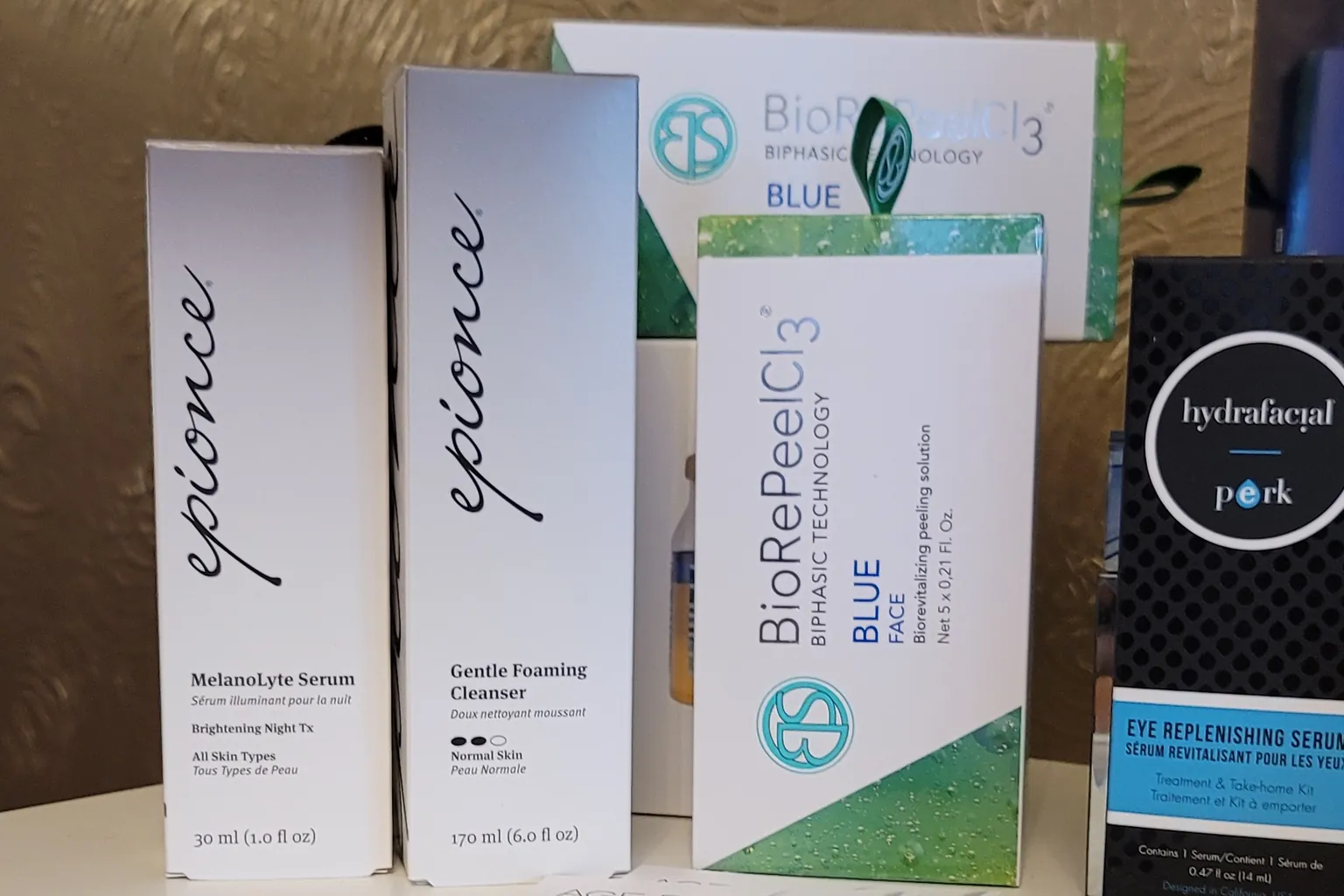
PRX-T33 and BioRePeel are both Italian products that, according to a published trial and to the BioRePeel maker, contain trichloroacetic acid (TCA), but they come from different makers and the published evidence on them differs. A randomized trial describes PRX-T33 as 33 percent TCA with 5 percent kojic acid and 5 percent hydrogen peroxide, and in that trial of atrophic acne scars only the group given the peel with microneedling improved significantly on the Goodman and Baron scar scale; the peel alone did not. BioRePeel's maker labels its face version at 35 percent TCA, and PubMed lists no study of it by name.
This guide, one of our chemical peel guides, compares their ingredients, application, aftermath and evidence, and who should ask a provider first. For each product alone, see our PRX-T33 guide and our BioRePeel guide.
Two TCA Products From Two Makers
PRX-T33 is sold by WiQo, and the 2021 trial credits it to WIQOmed of Italy. BioRePeel, sold as BioRePeelCl3, is made by CMed Aesthetics of Pisa, Italy, which calls it a biphasic chemical peel medical device. Both makers use the language of biorevitalization: WiQo calls PRX-T33 "the needle-free biorevitalization," and CMed calls its BioReTherapy line "a biorevitalizing line powered by BioRePeelCL3." That word is the makers' own.
Both are described as containing TCA, the acid used in a classic TCA peel, by a trial for PRX-T33 and by the maker for BioRePeel, but each adds other ingredients, so evidence on one product does not carry over to the other.
What Is in Each, According to a Trial or the Maker
PRX-T33. The WiQo product pages we read do not state the formula. The 2021 trial describes PRX-T33 as TCA at 33 percent, kojic acid at 5 percent and hydrogen peroxide at 5 percent. A 2026 review in Mini-Reviews in Medicinal Chemistry describes kojic acid as a tyrosinase inhibitor used in cosmetics to lighten skin by reducing hyperpigmentation. That describes the ingredient in general, not a finding about PRX-T33.
BioRePeel. CMed describes two versions that differ only in TCA strength: BioRePeelCl3 FND for the face, neck and décolleté (upper chest), labeled at 35 percent, and BioRePeelCl3 BODY for the hands, elbows, buttocks, knees and feet, labeled at 50 percent. CMed says a water-based phase holding TCA, alpha hydroxy, beta hydroxy and polyhydroxy acids, amino acids and vitamins sits under an oil-based phase that protects the formula from oxygen. It names ingredient classes, not individual acids, and we found no independent published source confirming the formula.
How Each Is Applied
PRX-T33. WiQo says PRX-T33 is applied by a doctor or skincare expert in a 15-minute session, that the doctor recommends the number and frequency of sessions, and that the doctor uses a special massage to work the active ingredients into the deeper layers of the skin. In the 2021 trial, PRX-T33 was massaged by hand over the treatment area until absorbed, in three layers 10 minutes apart, and the skin was later washed under running water. That trial also used numbing cream and microneedling or a sham device, so its steps describe a research protocol, not a standard visit.
BioRePeel. CMed says the two phases are mixed immediately before treatment and calls the procedure fast and painless, but on its public pages we found no description of how the solution is applied or how long it stays on. CMed suggests one session every 7 to 14 days depending on skin condition, for 4 to 5 sessions; we found no published study testing that schedule.
What You May Feel and See Afterward
Both makers describe little downtime. WiQo says PRX-T33 does not cause peeling or visible exfoliation, and CMed says BioRePeelCl3 delivers "exfoliation + biostimulation with minimal downtime." CMed's product page also claims "no post-treatment signs" for BioRePeel, while another CMed page advises avoiding direct sun exposure for at least 48 hours and applying SPF protection daily. These are the makers' statements, not measured results.
The 2021 trial adds an independent safety note. Of the 40 patients given PRX-T33 with microneedling, two women left the study because of facial skin discoloration, which the authors say occurred after they did not follow instructions to use SPF50 cream and avoid sun exposure. Apart from those two, the authors noted no major treatment-related side effects. The trial reports only early post-treatment outcomes. See our guide to chemical peel side effects for what to expect from peels in general.
Published Evidence Side by Side
PRX-T33. The 2021 trial, published in Advances in Dermatology and Allergology, was double-blind and randomized. It assigned 120 patients with atrophic acne scars to microneedling alone, PRX-T33 alone, or both, over four sessions 20 days apart; that schedule was the trial's design, not a recommended PRX-T33 plan. Only the combined group improved significantly on the Goodman and Baron scar scale; the peel alone did not. Patients in all three groups reported a significant improvement in quality of life. The trial was run at a single center. For other scar options, see our guides to chemical peels for acne scars and chemical peels versus microneedling.
BioRePeel. In October 2026, PubMed searches for "BioRePeel" and "BioRePeelCl3" returned no items. In PubMed Central, the name appears in one article, a 2022 review of acne scar treatments whose authors write that, in their experience, combining microneedling with a treatment such as BioRePeel gives much better results than performing the treatments separately. That is an opinion from practice, not a measured result.
The FDA says the concentration, number of applications and length of time a peel product is left on the skin all influence how deeply it can penetrate, so neither label strength shows how deep a product acts. Our chemical peel depths guide explains the depth scale, and our guide to what a chemical peel is covers the basics.
PRX-T33 and BioRePeel Compared
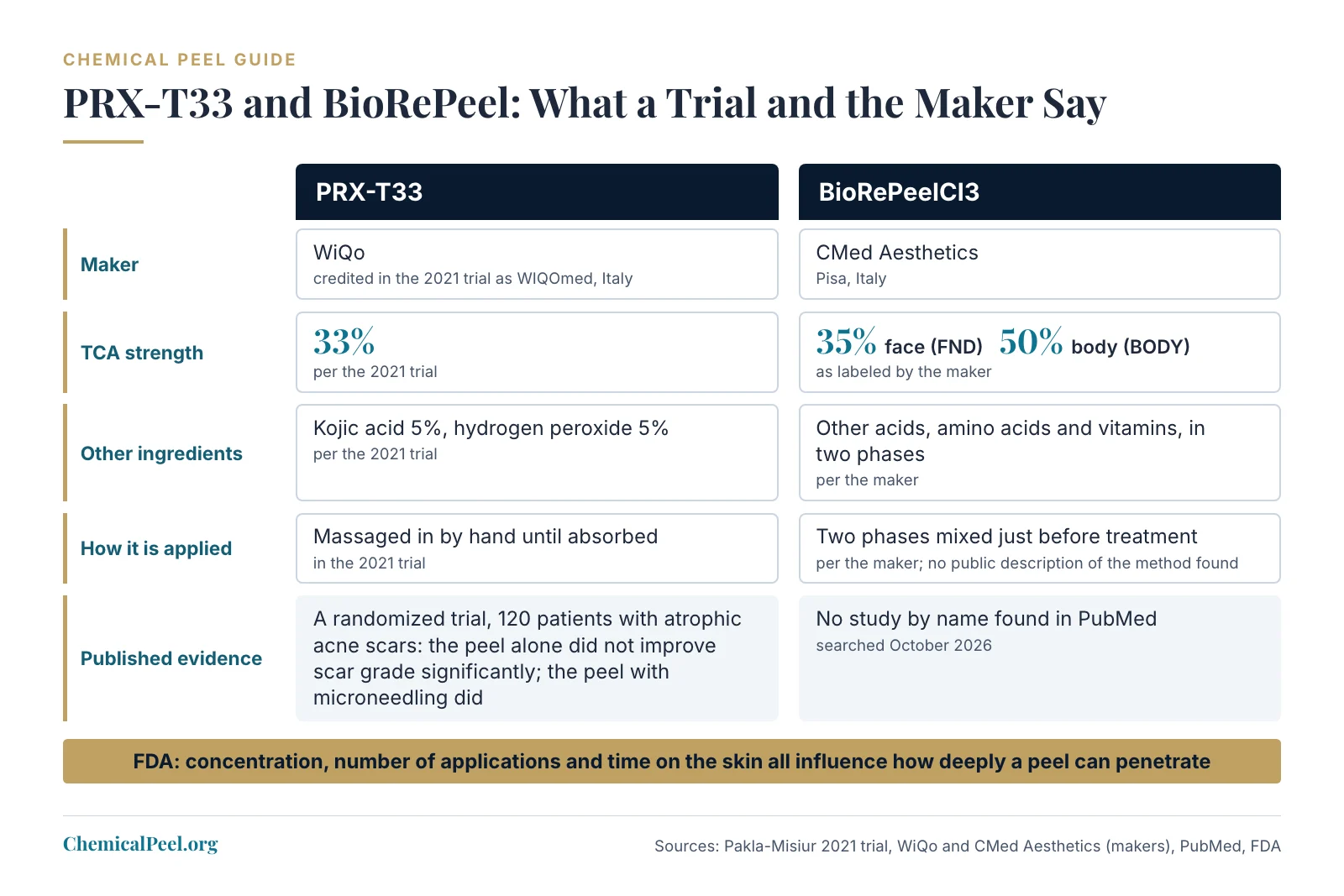
| Feature | PRX-T33 | BioRePeelCl3 |
|---|---|---|
| Maker | WiQo (credited in the 2021 trial as WIQOmed, Italy) | CMed Aesthetics, Pisa, Italy |
| TCA strength | 33 percent, per the 2021 trial | 35 percent (FND: face, neck and upper chest) or 50 percent (BODY), as labeled by the maker |
| Other ingredients | Kojic acid and hydrogen peroxide, 5 percent each, per the trial | Other acids, amino acids and vitamins in two phases, per the maker |
| How it is applied | Massaged in by hand until absorbed, in the trial; the maker describes a special massage | Two phases mixed just before treatment, per the maker; we found no public description of the method |
| What the maker says you will see | No peeling or visible exfoliation | No post-treatment signs |
| Maker's schedule | Number and frequency set by your doctor | One session every 7 to 14 days, 4 to 5 sessions |
| Published evidence | A randomized trial in atrophic acne scars: the peel alone did not improve scar grade significantly; the peel with microneedling did | No study by name found in PubMed |
Who Should Ask First
We found no source on who should avoid either product specifically. The PRX-T33 trial excluded people with active facial acne, a confirmed tendency to form keloid scars, impaired blood clotting, oral glucocorticoid use, active facial skin infection, or pregnancy or breastfeeding. For peels in general, StatPearls lists active infection and open wounds in the area among contraindications and precautions for all chemical peels, and pregnancy or breastfeeding and a known predisposition to keloids for medium and deep peels.
Isotretinoin. Sources differ. StatPearls lists active isotretinoin treatment among contraindications and precautions for all peels and use within the past 6 months for medium and deep peels, while a 2017 American Society for Dermatologic Surgery task force concluded there is insufficient evidence to justify delaying superficial chemical peels for patients currently or recently exposed to isotretinoin. Tell your prescriber and your provider.
Skin tone. WiQo says PRX-T33 is suitable for all skin types, tones, and identities, and CMed says BioRePeel is suitable for all ages and Fitzpatrick skin types I to VI. Independent sources are more cautious about peels in general. DermNet says people with Fitzpatrick skin types IV to VI have an increased risk of pigment changes and of hypertrophic or keloid scarring, so peels must be performed cautiously with full informed consent, and StatPearls lists Fitzpatrick skin types III to VI among contraindications and precautions for all chemical peels. StatPearls also says light or very light peels are generally suitable for all Fitzpatrick skin types, so ask your provider how deeply either product acts on your skin. We found no published study of either product reporting results in skin types IV to VI. See our guide to chemical peels for dark skin.
Questions to Ask a Provider
Before either treatment, ask:
- Which product and version will be used, and what TCA strength is on the label?
- How will it be applied, and how long will it stay on?
- What should I expect to see afterward, and what is that based on?
- How many sessions, how far apart, and what published evidence supports this product for my concern?
Do not buy either product online to use at home. The FDA says it has not approved any chemical peel products and that consumers should only consider using chemical peel products under the supervision of a dermatologist or licensed and trained practitioner. Our guide to at-home versus professional peels explains the difference.
ChemicalPeel.org publishes no BioRePeel price because it has no verified fee to report, and this guide does not compare the two products on price. Our chemical peel cost guide gives industry estimates by peel type and depth. When you are ready, find a qualified provider near you or search for a med spa near you.
Frequently Asked Questions
Which has more published evidence, PRX-T33 or BioRePeel?
PRX-T33 does. A 2021 double-blind randomized trial tested it in 120 patients with atrophic acne scars, and only the group given the peel with microneedling improved significantly on the scar scale; the peel alone did not. For BioRePeel, PubMed searches for the name returned no items in October 2026, and the one PubMed Central article that names it reports its authors' experience, not a measured result.
Do PRX-T33 and BioRePeel use the same strength of TCA?
No. A 2021 trial describes PRX-T33 as 33 percent trichloroacetic acid (TCA) with 5 percent kojic acid and 5 percent hydrogen peroxide. BioRePeel's maker, CMed Aesthetics, labels its face, neck and upper chest version (FND) at 35 percent TCA and its body version (BODY) at 50 percent. The FDA says concentration, the number of applications and contact time all influence how deeply a peel product penetrates, so a label strength alone does not show depth.
Will my skin peel after PRX-T33 or BioRePeel?
WiQo says PRX-T33 does not cause peeling or visible exfoliation. CMed Aesthetics claims "no post-treatment signs" for BioRePeel but also describes the treatment as delivering exfoliation with minimal downtime. Those are the makers' statements, not measured results. CMed still advises avoiding direct sun for at least 48 hours and using SPF daily. In the PRX-T33 trial, two patients developed facial skin discoloration after not following sun protection instructions, so follow your provider's aftercare.
Are PRX-T33 and BioRePeel suitable for darker skin?
Both makers say so: WiQo calls PRX-T33 suitable for all skin types and tones, and CMed Aesthetics says BioRePeel is suitable for Fitzpatrick skin types I to VI. Independent sources are more cautious about peels in general. DermNet says people with Fitzpatrick types IV to VI have an increased risk of pigment changes and of hypertrophic or keloid scarring, so peels must be done cautiously with full informed consent. We found no published study of either product in those skin types.
Can I have PRX-T33 or BioRePeel while taking isotretinoin?
Ask your prescriber and provider first, because sources differ. StatPearls lists active isotretinoin treatment among contraindications and precautions for all chemical peels, and use within the past 6 months for medium and deep peels. A 2017 American Society for Dermatologic Surgery task force concluded there is insufficient evidence to justify delaying superficial chemical peels for people currently or recently exposed to isotretinoin. We found no source that addresses either product specifically.
Can I buy PRX-T33 or BioRePeel to use at home?
Do not use either at home. WiQo says the PRX line is intended exclusively for application by trained professionals, and CMed Aesthetics says the section of its website covering its medical devices is intended exclusively for qualified healthcare professionals. The FDA says some peel products sold online contain acids at concentrations too high to be used safely at home without supervision, and that consumers should only consider using chemical peel products under the supervision of a dermatologist or licensed and trained practitioner.