Written by the ChemicalPeel.org editorial team. Published September 26, 2026.
Clinical review pending. This page has not yet been reviewed by a licensed clinician; read it as patient education, not medical advice. How we review
An azelaic acid peel is a superficial chemical peel: a provider applies an azelaic acid solution, sometimes blended with other acids, to the face during a session. It is a different product from the azelaic acid cream, gel or foam you apply yourself once or twice a day, and the FDA drug labels for acne and rosacea cover those leave-on forms. A 2021 study notes that little is known about azelaic acid peels, so this guide says which form each finding comes from.
It is part of our peel types series.
What Azelaic Acid Is
Azelaic acid is a naturally occurring dicarboxylic acid. DermNet describes it as a by-product of the metabolism of the yeast Malassezia furfur.
For leave-on azelaic acid, DermNet lists three actions: antibacterial, anti-inflammatory, and keratolytic and comedolytic, meaning it improves the disordered growth of skin cells lining the follicle. A 2023 review describes leave-on topical azelaic acid as an inhibitor of tyrosinase that is widely used for melasma and post-inflammatory hyperpigmentation.
Azelaic Acid Peel vs Azelaic Acid Cream, Gel or Foam
Leave-on cream, gel or foam
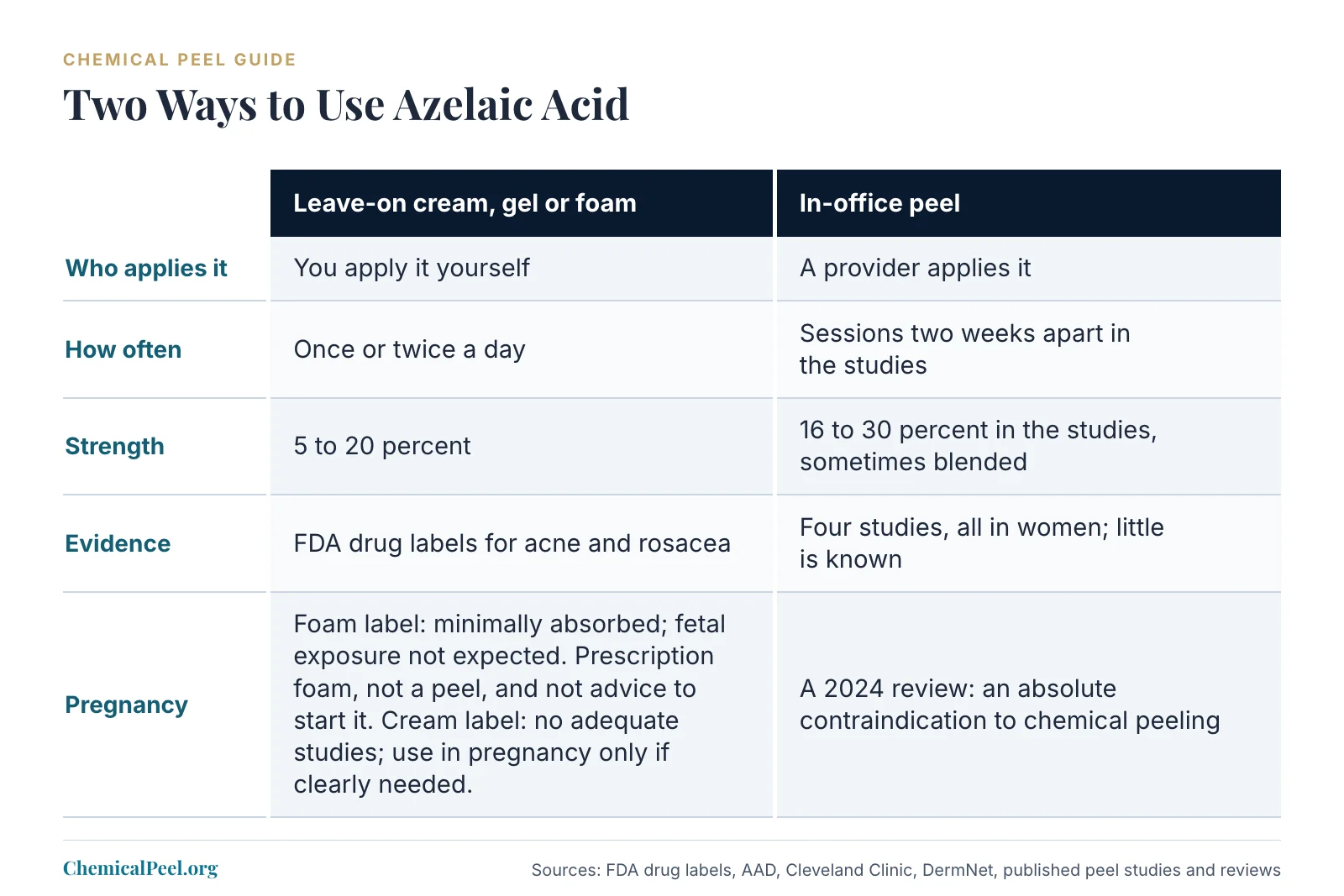
The 2023 review notes that commercial topical products contain 5 to 20 percent azelaic acid, as gels and creams. The FDA label for Azelex, a 20 percent cream, covers mild-to-moderate inflammatory acne, and the label for Finacea Foam, 15 percent, covers the inflammatory papules and pustules of mild to moderate rosacea. DermNet suggests applying the cream daily at first, building up to twice a day if tolerated.
In-office peel
Cleveland Clinic notes that a chemical peel can be performed in a doctor's office. The four azelaic peel studies cited here used 16 to 30 percent azelaic acid, sometimes blended. A 2013 study applied a 20 percent azelaic peel to the whole face for 5 to 10 minutes, then neutralized it with sodium bicarbonate. In a 2020 trial, a blend of 16 percent azelaic acid, 10 percent almond acid and 2 percent salicylic acid was applied twice, then 16 percent azelaic acid alone was applied twice, and participants were instructed to leave the acid on for 6 to 8 hours and then wash their face. See chemical peel depths.
The chart below sets the two forms side by side.
What Azelaic Acid Is Used For
Acne
Leave-on: besides the Azelex acne label above, DermNet says leave-on azelaic acid is useful for both comedonal and inflammatory acne.
Peel: a 2020 randomized trial in 120 young women with mild to moderate acne compared six azelaic peels with six pyruvic acid peels. Both produced similar decreases in acne severity and lesions, and the pyruvic peel reduced greasy skin more; the authors say the results cannot be generalized to men, adolescents and older people. A 2021 study of a series of six 30 percent azelaic peels, every two weeks, in 35 women reported fewer acne lesions and said all participants tolerated the procedure well. The abstract describes that one group and does not describe a comparison group. See chemical peels for acne and the pyruvic acid peel.
Rosacea
Leave-on: the Finacea Foam label covers the inflammatory papules and pustules of mild to moderate rosacea, and the American Academy of Dermatology (AAD) lists azelaic acid foam or gel, applied twice a day, among rosacea treatments. The same label tells patients using the foam to avoid abrasives and peeling agents. Peel: the azelaic peel studies cited here enrolled people with acne, melasma or aging skin, and the 2020 trial excluded active rosacea. See chemical peels and rosacea.
Melasma
Leave-on: the AAD lists azelaic acid among gentler medicines a dermatologist may prescribe for melasma. A 2023 review of six trials of 20 percent azelaic acid used daily or twice daily, a topical routine rather than a peel, concluded it may be better than hydroquinone at reducing melasma severity, while calling for larger, longer studies.
Peel: a 2017 trial in 42 women treated one side of the face with a blend of 20 percent azelaic acid, 10 percent resorcinol and 6 percent phytic acid and the other with a 50 percent glycolic acid peel, every two weeks for six sessions. The blend was similar to glycolic acid in efficacy, with fewer complications, but only women with skin types III and IV took part, and the finding is for the blend, not azelaic acid alone. The authors also saw melasma come back in the majority of both groups at the 3-month follow-up. See chemical peels for melasma.
Dark marks after acne
Leave-on: DermNet says leave-on azelaic acid is particularly useful for darker skinned patients whose acne spots leave persistent brown marks.
A 2023 expert consensus in the Journal of the American Academy of Dermatology listed azelaic acid and chemical peels as separate options that may be considered, said peels may be used as adjunctive or second-line therapy, and noted that large randomized trials are lacking. More on chemical peels for hyperpigmentation.
How an Azelaic Peel Compares With Salicylic and Mandelic Peels
The only study here that compared an azelaic peel with a mandelic or salicylic peel is the 2013 study of 28 women aged 49 to 71, which compared a 20 percent azelaic peel with a 40 percent mandelic peel for their effect on sebum. Both led to a subtle increase in sebum, and the authors wrote that the difference between the two did not appear to be clinically significant. Mandelic acid, an aromatic alpha hydroxy acid, penetrates the epidermis more slowly because of its larger molecular size, making it gentler, a 2025 study notes. More in our mandelic acid peel guide.
A 2015 review calls salicylic peels, which use a lipid-soluble acid, a good therapeutic option for comedonal acne. See our salicylic acid peel guide.
| Feature | Azelaic peel | Salicylic peel | Mandelic peel |
|---|---|---|---|
| Type of acid | Dicarboxylic acid | Lipid-soluble; called a beta hydroxy acid or a phenolic aromatic acid | Aromatic alpha hydroxy acid |
| Strength in the sources | 16 to 30 percent, sometimes blended | 20 or 30 percent | 40 percent in the azelaic comparison |
| What the sources describe | Acne, melasma (as a blend), sebum in aging women | Comedonal acne | Slower penetration; described as gentler |
| Evidence note | Four studies, all in women; little is known | Reported well tolerated in all skin types | Described as well tolerated by sensitive skin |
Who an Azelaic Peel May Suit
Peel: all four azelaic peel studies cited here enrolled only women, and the two that reported skin type enrolled types II and III in one study and types III and IV in the other. Cleveland Clinic says superficial peels can generally be used on all skin types, but a darker skin tone carries a greater risk of darkening after treatment. Leave-on: the Finacea Foam label says azelaic acid has not been well studied in dark complexions and advises monitoring for early signs of hypopigmentation, and DermNet says very sensitive skin or eczema may find it irritating. See chemical peels for dark skin.
Side Effects and Who Should Not Have One
Peel: in the 2013 study no immediate or long-term side effects were observed, the 2021 study said all participants tolerated the procedure well, and in the 2020 trial participants reported no harm or unintended effects related to the treatment. After a light peel, Cleveland Clinic says to expect a sunburn-like reaction, with redness then scaling for three to seven days. For chemical peels in general, it lists a risk of temporary or permanent color change in certain skin types, a low risk of scarring, a small chance of reactivating cold sores if you have had herpes outbreaks, and infections that are rare but still a risk.
Leave-on: the Azelex label lists itching, burning, stinging and tingling as the most common adverse reactions, and the Finacea Foam label lists local site pain, itching, dryness and redness. The foam label also warns of eye irritation and notes postmarketing reports of hypersensitivity, rash and worsening of asthma.
Reasons to wait or skip a peel
- Pregnancy or breastfeeding, a history of keloids or hypertrophic scars, active infection, or immunosuppression: a 2024 review lists these as absolute contraindications to chemical peeling.
- Active herpes, isotretinoin treatment, active rosacea, eczema, tanned skin, or allergy to peeling ingredients: the 2020 azelaic peel trial excluded these.
- Open sores or skin infections in the area (Cleveland Clinic).
After a peel, Cleveland Clinic says to call your doctor if your skin itches, swells or burns. For azelaic acid cream, it says to report allergic reactions, such as swelling of the face, lips, tongue or throat, to your care team as soon as possible. See who should not get a chemical peel.
Azelaic Acid and Pregnancy
Leave-on: the Finacea Foam label says azelaic acid is minimally absorbed and maternal use is not expected to result in fetal exposure. That sentence describes the prescription foam used as labeled, not a peel, and it is not advice to start the foam on your own. The Azelex cream label says there are no adequate and well-controlled studies in pregnant women and that, because animal reproduction studies are not always predictive of human response, the drug should be used during pregnancy only if clearly needed. Cleveland Clinic lists pregnancy among what to tell your care team before using azelaic acid cream.
Peel: the 2024 review lists pregnancy and breastfeeding as absolute contraindications to chemical peeling, and the 2020 and 2017 azelaic peel trials excluded pregnancy. The 2015 review adds that salicylic peels are not recommended during pregnancy, and one studied azelaic blend contained salicylic acid. See chemical peels during pregnancy.
How Often, Aftercare and Cost
Peel: for light peels in general, Cleveland Clinic says additional peels may be repeated every two to five weeks, and that typically three to five peels are needed. The azelaic peel studies cited here spaced sessions two weeks apart.
Cleveland Clinic advises avoiding retinoid products, such as tretinoin, for one to two weeks before a peel unless your physician says otherwise, and after a light peel, applying lotion or cream as directed until the skin heals, then daily sunscreen. See chemical peel aftercare, and for pricing, our chemical peel cost guide.
Questions to Ask Before an Azelaic Peel
- Is it azelaic acid alone or a blend, and at what strength?
- How long does it stay on, and is it neutralized or washed off later?
- Has a peel been studied for my concern, or does the evidence come from the leave-on cream?
- Should I pause retinoids, an azelaic acid foam or other products first?
- Will you test a hidden spot first? The 2024 review advises this for skin types IV to VI.
To compare providers, see our find a doctor page or med spas near me.
Frequently Asked Questions
What are the benefits of azelaic acid for the skin?
DermNet and the FDA labels describe leave-on azelaic acid, the cream, gel or foam you apply yourself. DermNet describes it as antibacterial, anti-inflammatory, keratolytic and comedolytic, and useful for both comedonal and inflammatory acne. FDA labels cover a leave-on cream for mild-to-moderate inflammatory acne and a foam for the inflammatory papules and pustules of mild to moderate rosacea. A 2023 review says leave-on topical azelaic acid is widely used for melasma and post-inflammatory hyperpigmentation. A 2021 study notes that little is known about azelaic acid peels.
Is an azelaic acid peel the same as azelaic acid cream?
No. Azelaic acid cream, gel or foam is a leave-on product you apply yourself once or twice a day, and commercial products contain 5 to 20 percent azelaic acid. An azelaic acid peel is applied by a provider during a session; the peel studies cited here used 16 to 30 percent, sometimes blended with other acids, and three describe neutralizing or washing it off. The FDA labels for acne and rosacea cover the leave-on products, so findings about the cream should not be assumed to apply to a peel.
Is azelaic acid good for melasma?
For leave-on azelaic acid, the American Academy of Dermatology lists it among gentler medicines a dermatologist may prescribe for melasma, and a 2023 review of six trials of 20 percent azelaic acid found it may be better than hydroquinone at reducing melasma severity, while calling for larger, longer studies. For peels, one 2017 trial in women found a blend of azelaic acid, resorcinol and phytic acid similar to a glycolic acid peel, with fewer complications, but melasma came back in the majority of both groups at 3 months.
Azelaic acid vs salicylic acid: which is better for acne?
No study cited in this guide compares the two directly. For leave-on azelaic acid cream, DermNet says evidence suggests it may be less effective for acne than benzoyl peroxide, and some evidence suggests it is probably similarly effective to tretinoin. For peels, a 2015 review calls salicylic peels a good therapeutic option for comedonal acne, while the four azelaic peel studies cited here enrolled only women, and a 2021 study notes that little is known about azelaic acid peels.
Can I get an azelaic acid peel while pregnant?
Postpone the peel. A 2024 review in the Journal of Cosmetic Dermatology lists pregnancy and breastfeeding as absolute contraindications to chemical peeling, and two azelaic peel trials excluded pregnant women. The FDA label for the leave-on Finacea Foam says azelaic acid is minimally absorbed and maternal use is not expected to result in fetal exposure. That sentence describes the prescription foam used as labeled, not a peel, and it is not advice to start the foam on your own. The Azelex cream label says there are no adequate and well-controlled studies in pregnant women and that the drug should be used during pregnancy only if clearly needed. Cleveland Clinic lists pregnancy among what to tell your care team before using azelaic acid cream.
What are the side effects of an azelaic acid peel?
One azelaic peel study cited here reported that all participants tolerated the procedure well, and another observed no immediate or long-term side effects. After a light peel, Cleveland Clinic describes a sunburn-like reaction with redness and scaling for three to seven days. For chemical peels in general, it lists a risk of temporary or permanent color change in certain skin types, a low risk of scarring and rare infections, and says darker skin tones have a greater risk of darkening. Call your doctor if the skin itches, swells or burns.