Written by the ChemicalPeel.org editorial team. Published September 26, 2026.
Clinical review pending. This page has not yet been reviewed by a licensed clinician; read it as patient education, not medical advice. How we review
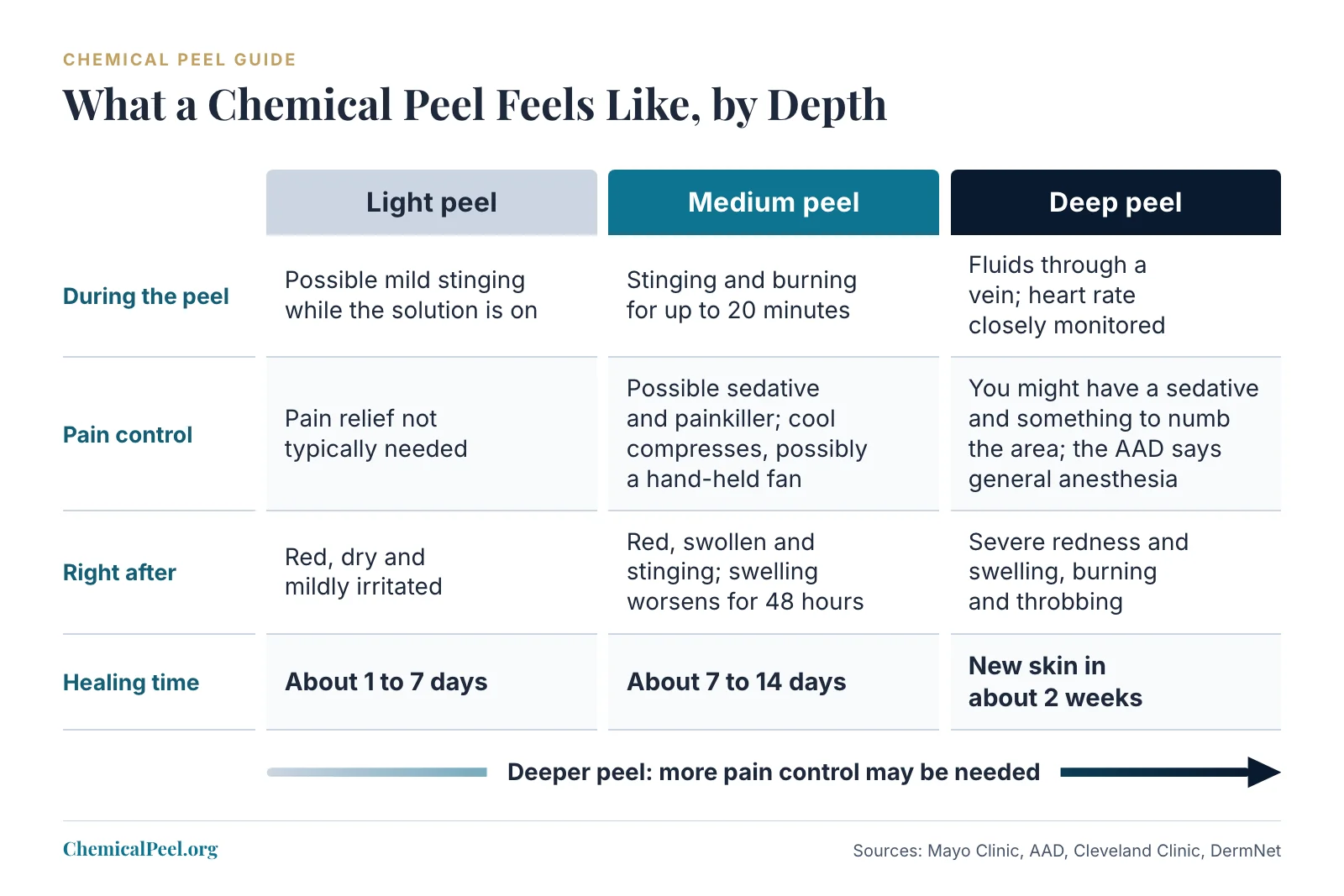
A chemical peel stings, and the deeper the peel, the more pain control it may need. With a light peel you might feel mild stinging while the solution is on your skin, a medium peel can sting and burn for up to 20 minutes, and for a deep peel the American Academy of Dermatology says you will receive general anesthesia. This guide, part of our chemical peel guides, covers what each depth feels like during the peel, right after it and in the days that follow, what providers use to keep you comfortable, and when to call your provider.
Why Some Peels Hurt More Than Others
A chemical peel is a procedure in which a solution is applied to the skin to remove its top layers, and it can be done at different depths, from light to deep. A light peel removes the outer layer of skin, the epidermis. A medium peel also removes cells from the upper part of the middle layer, the dermis, and a deep peel goes deeper still. Our guide to chemical peel depths explains the layers in more detail.
Pain control follows depth. Mayo Clinic notes that pain relief isn't typically needed for a light peel, that a medium peel may come with a sedative and painkiller, and that a deep peel may involve a sedative, numbing medicine and fluids through a vein. DermNet adds that how badly a peel stings, and for how long, depends on the chemical, its concentration and individual factors.
Our chemical peel myths article gives pain one paragraph; the sections below take each depth in turn.
What the First Few Minutes Feel Like
Cleveland Clinic says that as the solution goes on, you may feel a warm to somewhat hot sensation that lasts a few minutes, followed by stinging, and that a cool compress may be applied to relieve the sting. The chemical is then washed off or neutralized. DermNet notes that a fan can help, and that once the peel is neutralized, the burning sensation lessens.
What a Light Peel Feels Like
A light peel usually uses a solution containing glycolic acid or salicylic acid, and the treated skin begins to whiten. You might feel mild stinging while the solution is on your skin. DermNet describes superficial peels as well tolerated.
Right After and the Next Few Days
Afterward, the treated skin will be red, dry and mildly irritated. Cleveland Clinic calls it a sunburn-like reaction: redness followed by scaling that lasts between three and seven days. Treated areas take about one to seven days to heal, and you can usually wear makeup the next day.
You might have a light peel every two to five weeks, and three to five peels may be necessary to give you the desired results. Mayo Clinic notes that the redness, dryness and irritation might be less noticeable with each repeat treatment. Our guide on how often to get a chemical peel covers the spacing.
What a Medium Peel Feels Like
Mayo Clinic says a medium peel uses a chemical solution containing trichloroacetic acid, or TCA, sometimes in combination with glycolic acid. DermNet names TCA as the most common chemical for a medium-depth peel and says plainly that the treatment is painful. Before it starts, you might receive a sedative and painkiller. See our TCA peel guide.
During the peel, the treated skin begins to whiten. After a few minutes, the provider applies cool compresses to soothe it, and you might be given a hand-held fan to cool your skin. You might feel stinging and burning for up to 20 minutes.
Right After and the Next Two Weeks
After a medium peel, the treated skin will be red and swollen, and you'll feel stinging. The American Academy of Dermatology (AAD) notes that swelling worsens for 48 hours and that eyelids may swell. For comfort afterward, Mayo Clinic suggests ice packs and says over-the-counter pain relievers such as ibuprofen and naproxen sodium may help reduce any discomfort. Ask your provider which one suits you before you take it.
As the swelling goes down, the skin begins to crust and might darken or develop brown blotches. Treated areas take about seven to 14 days to heal, though redness might last for months. DermNet notes that most people take a week off from work after a peel of this depth.
What a Deep Peel Feels Like
A deep peel uses carbolic acid, also called phenol; see our guide to phenol peels. The AAD says you will receive general anesthesia, which puts you to sleep, and that a deep peel must be performed in a surgical setting. Mayo Clinic says you might have a sedative, something to numb the treatment area and fluids through a vein, and that your heart rate will be closely monitored. Mayo Clinic also notes that phenol can damage heart muscle and cause the heart to beat irregularly.
Right After and the Next Few Weeks
After a deep peel, expect severe redness and swelling, along with burning and throbbing, and the swelling may even make your eyelids swell shut. The treated skin gets a surgical dressing, and your doctor might prescribe painkillers. New skin forms within about two weeks, though redness might last for months, and the AAD says recuperation at home takes two to three weeks. The AAD also states that a person can have only one deep peel.
What Providers Use to Keep You Comfortable
Comfort measures step up with depth:
- Cooling. A fan or cool compresses during the peel, and at home, DermNet advises keeping treated areas cool with a water spray.
- Medicine. Superficial peels need no special arrangements, but deeper peels may call for painkillers, sedation, a local anesthetic or even a general anesthetic. If you will be sedated, arrange a ride home.
- Relief afterward. Ice packs and over-the-counter pain relievers after a medium peel, and painkillers your doctor might prescribe after a deep one.
- Moisturizer as directed. The AAD advises it to keep skin moist and supple, because skin that dries and cracks can scar.
Questions to Ask Before Your Peel
- What will I feel during the peel, and for how long?
- What will you use for comfort: a fan, cool compresses, a painkiller or sedation?
- Which pain reliever, if any, can I take afterward?
- Whom do I call if my skin burns, itches or swells after I get home?
Our checklist on how to prepare for a chemical peel covers the rest of the consultation.
How Your Face Looks and Feels Afterward
After a peel of any depth, your skin will be red, tight, irritated or swollen. Avoid picking, rubbing or scratching it: the AAD warns that rubbing or scratching treated skin can cause an infection. It may take several months before your skin color returns to normal.
Which day feels worst depends on the depth. After a light peel, redness is followed by scaling that lasts three to seven days. After a medium peel, swelling may last or worsen for the first 48 hours, and the skin then crusts and peels off over 7 to 14 days. Our day-by-day peeling timeline and aftercare guide cover that stretch in detail.
Normal Discomfort Versus a Reason to Call
Mayo Clinic says you'll feel stinging after a medium peel and burning and throbbing after a deep one, but you do not have to judge that discomfort alone. The AAD and Cleveland Clinic both tell patients to contact their doctor if the skin burns, itches or swells, and warn that scratching could lead to an infection.
| What you notice | Expected or a reason to call | What to do |
|---|---|---|
| Stinging, warmth or burning while the solution is on | Expected. Mayo Clinic says a light peel might feel like mild stinging, and a medium peel might sting and burn for up to 20 minutes | A fan or cool compress can help; tell your provider how it feels |
| Stinging, and swelling that worsens for 48 hours, after a medium peel | Expected | Ice packs; ask which pain reliever you can take |
| Burning, throbbing and severe swelling after a deep peel | Expected; follow-up visits are needed | Painkillers if your doctor prescribes them; keep every follow-up visit |
| Skin that burns, itches or swells after you get home | A reason to call | Contact your provider, as the AAD and Cleveland Clinic advise; do not scratch |
| Severe burns, pain or swelling from a peel product used at home | A reason to get care | Get medical care; the FDA warns these injuries may even need emergency care |
DermNet advises letting your doctor know promptly about any problem, because complications are easier to deal with early than late. For warning signs beyond pain, such as infection, see our guides to chemical peel side effects and a chemical peel gone wrong, which list the signs that call for a same-day call.
Who Should Wait, and Why Not at Home
A doctor might advise against a peel, or certain types of peel, if you have taken the acne medicine isotretinoin in the past six months, have a personal or family history of keloids, are pregnant, or get frequent or severe cold sores. Peel areas must be free of open sores, lesions and skin infections. Our reference on who should not get a chemical peel has the full list.
At-home products carry their own risk of pain. The FDA warns that some peel products sold in beauty product stores and online are too strong to use safely at home without supervision and may cause severe chemical burns, pain, swelling, infection, skin color changes and disfiguring scars. Our comparison of at-home and professional peels explains the difference.
Choosing Who Does Your Peel
Do dermatologists recommend chemical peels? The AAD says dermatologists use them to treat some types of acne and conditions that discolor the skin, and that dermatologists have been performing chemical peels for more than 50 years with an excellent safety record. It also warns that results depend largely on the skill of the person performing the peel. DermNet notes that complications are uncommon when the professional doing the peel is properly trained and experienced, and that a dermatologist or plastic surgeon usually performs medium and deeper peels.
Our guide to finding a qualified provider lists what to check, and when you are ready to compare clinics, you can find a med spa near you.
Frequently Asked Questions
How painful is a chemical peel?
It depends on the depth. With a light peel you might feel mild stinging while the solution is on, and pain relief is not typically needed. A medium peel can sting and burn for up to 20 minutes, DermNet describes it as painful, and you might receive a sedative and painkiller. For a deep peel, Mayo Clinic says you might have a sedative, something to numb the treatment area and fluids delivered through a vein, and the American Academy of Dermatology says you will receive general anesthesia. Afterward you will feel burning and throbbing, and your doctor might prescribe painkillers.
Do dermatologists recommend chemical peels?
Dermatologists use chemical peels to treat some types of acne and conditions that discolor the skin, and the American Academy of Dermatology notes they have performed peels for more than 50 years with an excellent safety record. The AAD also says results depend largely on the skill of the person performing the peel. Your skin tone matters too: Cleveland Clinic notes that darker skin tones carry a greater risk of darkening after treatment.
What's the worst day of a chemical peel?
It depends on the depth. After a light peel, redness is followed by scaling that lasts three to seven days. After a medium peel, swelling worsens for the first 48 hours, then the skin crusts and peels off over 7 to 14 days. After a deep peel, burning, throbbing and severe swelling come first, with new skin forming in about two weeks. Contact your provider if your skin burns, itches or swells.
What does your face look like right after a chemical peel?
After a peel of any depth, skin is red, tight, irritated or swollen. A light peel leaves skin red, dry and mildly irritated, much like a sunburn. A medium peel leaves it red and swollen, and it may later crust, darken or develop brown blotches as it heals. After a deep peel, expect severe redness and swelling under a surgical dressing, and your eyelids may swell shut.
How long do results of a chemical peel last?
Most results are not permanent, because skin continues to age, and new sun damage can bring new lines and color changes. You might have a light peel every two to five weeks, and three to five peels may be necessary to give you the desired results. DermNet says it is wise to wait 3 to 6 months before repeating a medium-depth peel. A person can have only one deep peel. Daily sunscreen after healing helps maintain results.
Will I be numbed or put to sleep for a chemical peel?
Usually not for a light peel: pain relief is not typically needed. For a medium peel, you might receive a sedative and painkiller, along with cool compresses and possibly a hand-held fan during the peel. For a deep peel, Mayo Clinic says you might have a sedative, numbing medicine and fluids through a vein, while the AAD and Cleveland Clinic say you will receive general anesthesia, which puts you to sleep. If you will be sedated, arrange a ride home.