
Written by the ChemicalPeel.org editorial team. Published September 26, 2026.
Clinical review pending. This page has not yet been reviewed by a licensed clinician; read it as patient education, not medical advice. How we review
Dermaplaning and a chemical peel both remove dead skin, but they work in different ways. Dermaplaning uses a small blade to shave peach fuzz and dead skin cells off the surface, while a chemical peel uses a chemical solution that causes a controlled injury at a depth you and your provider choose. In its at-home form, dermaplaning is a gentle, superficial treatment; a peel is matched to concerns such as uneven color, fine lines, or some types of acne, and its downtime grows with depth.
This guide, part of our chemical peel guides, compares the two. See also our comparisons of peels and microdermabrasion and enzyme and chemical peels.
What Dermaplaning Removes
Dermaplaning removes peach fuzz, the fine hair doctors call vellus hair, and it exfoliates, removing dead skin cells from the surface. Clearing that surface can perk up a dull complexion, can keep pores from clogging, and may help makeup go on more smoothly.
The word covers more than one procedure. The at-home version uses a single blade on a small plastic handle. In a clinic, a provider uses an instrument with a small blade, which Cleveland Clinic calls a dermatome, to shave away the uppermost layers of skin, for example to reduce the appearance of acne scars. Afterward, Cleveland Clinic says, skin is likely to be red, swollen, and slightly tender, and most people can return to normal activities a few weeks after the treatment, so ask which kind you are booking.
In a 2023 laboratory study in AAPS PharmSciTech, four strokes of a dermaplaning device removed the stratum corneum, the skin's outer barrier layer, and some of the living epidermis beneath it. A 2011 systematic review in Aesthetic Plastic Surgery that covered dermaplaning, oxygen therapy, and light therapy found the scientific data supporting these methods scarce, anecdotal, and not well documented.
How a Chemical Peel Works
For a chemical peel, the provider applies a solution such as glycolic acid, salicylic acid, lactic acid, trichloroacetic acid (TCA), or phenol, which causes a controlled injury. Each chemical penetrates to a different depth, and the injured layers peel away to reveal a new layer of skin.
Your skin's outer layer is the epidermis, and the layer beneath it is the dermis. According to Cleveland Clinic, a light peel removes the outermost layer of skin, a medium peel removes the outermost layer and the upper part of the middle skin layer, and a deep peel penetrates down to the lower middle layer. TCA is the most common chemical for a medium peel. Our guide to chemical peel depths explains each level.
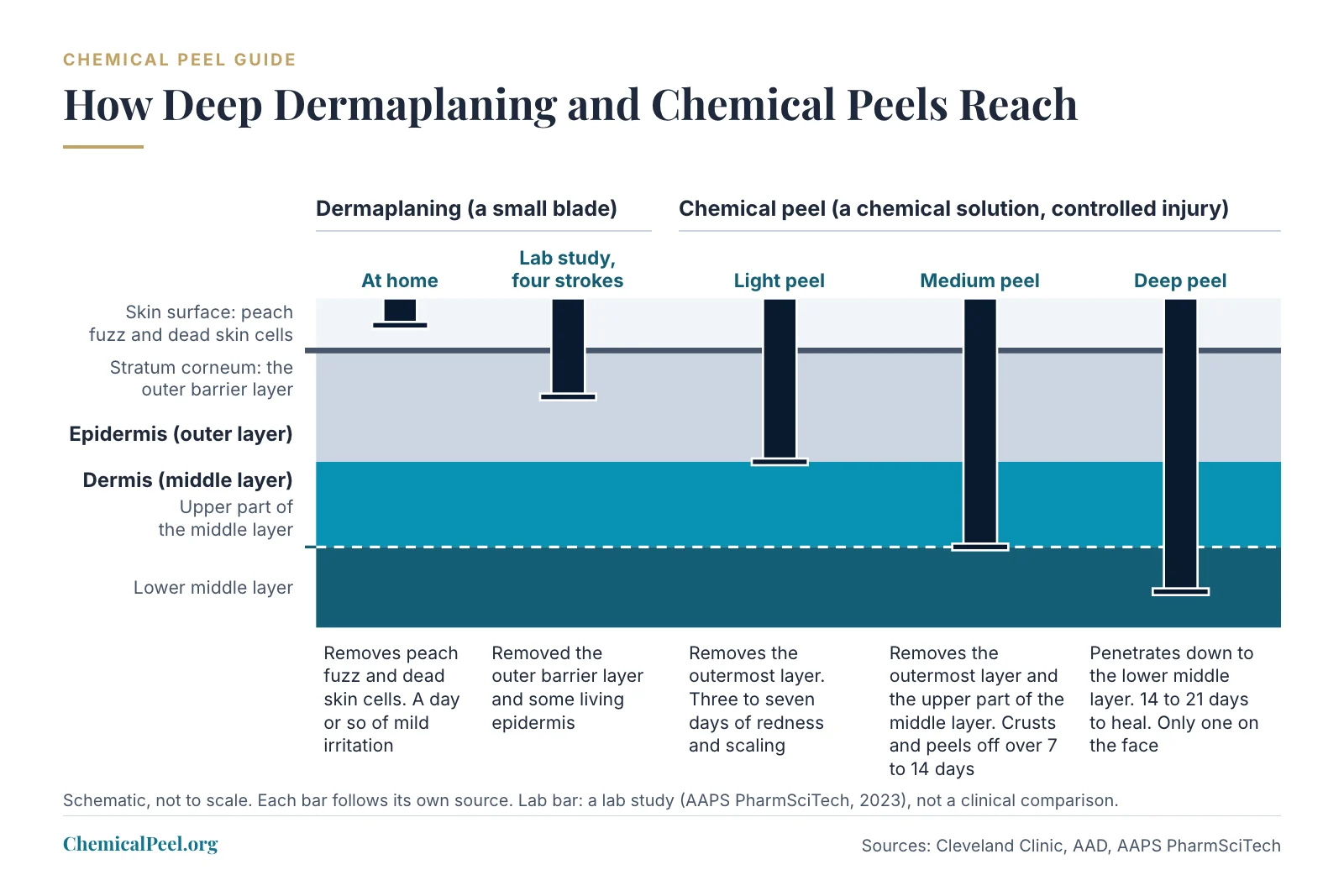
Dermaplaning vs Chemical Peel at a Glance
| Factor | Dermaplaning | Chemical peel |
|---|---|---|
| Tool | A small blade | A chemical solution |
| What it removes | At home, peach fuzz and dead skin cells. In a clinic, the uppermost layers of skin | From the outermost layer (light) down to the lower middle layer (deep) |
| Downtime | At home, a day or so of mild irritation. Clinic procedure: Cleveland Clinic says most people can return to normal activities a few weeks after the treatment | Light: three to seven days of redness and scaling. Deep: 14 to 21 days |
| How often | At home, no more than once a week. Clinic procedure: only after skin heals completely | Light: three to five peels may be necessary, and they may be repeated every two to five weeks. Deep: only one on the face |
| Hair removal | Temporary; the hair grows back | Not among the uses the AAD lists |
Who Each One Suits
When Dermaplaning Fits
Cleveland Clinic says you may consider dermaplaning for skin concerns such as dull or dry skin, peach fuzz, acne scars, and fine lines. It may not reduce the appearance of deep or raised acne scars; some people need more intense treatments, such as laser surgery.
When a Chemical Peel Fits
The American Academy of Dermatology (AAD) lists these uses for peels: some types of acne, age spots, discoloration such as uneven skin tone, dull complexion, fine lines, freckles, melasma, rough-feeling skin, and sun-damaged skin. Cleveland Clinic adds that deep scars, deep facial lines, and more severe wrinkles don't respond well to peels. Our guides to chemical peels for acne and the chemical peel facial cover two common starting points.
Do Chemical Peels Pull Out Blackheads?
Not by pulling. According to the AAD, a peel applied to acne helps remove the dead skin cells and excess oil that clog your pores, which can help clear acne. Acne extraction, in which a dermatologist physically removes acne breakouts, is a separate procedure. For blackheads that remain after six to eight weeks of treatment, the AAD suggests seeing a dermatologist; a procedure such as comedo extraction may help. Our guide to chemical peels for large pores covers congested pores.
Downtime and Recovery
After at-home dermaplaning, your skin may feel a little irritated for a day or so, so moisturize well and keep wearing sunscreen.
According to Cleveland Clinic, after a light peel you will see redness followed by scaling for three to seven days, and you can wear makeup right away or the next day. After a medium peel, the skin crusts and peels off over 7 to 14 days. A deep peel takes 14 to 21 days to heal. Our chemical peel aftercare guide covers the steps.
How Often Each Is Repeated
Cleveland Clinic dermatologist Melissa Piliang, MD, advises dermaplaning at home no more than once a week, so skin has time to recover. After the clinic procedure, skin should heal completely before another treatment. For light peels, three to five peels may be necessary to give you the desired results, and these peels may be repeated every two to five weeks. You can have only one deep peel on your face.
Risks and Who Should Skip Each
Is There a Downside to Dermaplaning?
Yes, a few. A cut or nick can lead to infection. Dermaplaning can agitate existing acne and even cause more, so skip it during a breakout or an eczema flare, or ask a dermatologist about professional options. The clinic procedure is generally considered safe but carries risks of infection, raised scars, and skin that turns lighter or darker than the skin around it. Cleveland Clinic says some people with preexisting skin concerns shouldn't have dermaplaning, and advises talking to your provider first if you have active acne, cold sore outbreaks, eczema, psoriasis, moles or other skin growths, skin burns, or rashes.
Chemical Peel Risks
In the hands of a doctor experienced with peels, side effects tend to be mild, according to the AAD. Some people develop persistent redness that may last for months, temporary darkening, lighter skin color after medium and deep peels, or scarring, which is very rare when a dermatologist performs the peel. Darker skin tones carry a greater risk of darkening after treatment, called post-inflammatory hyperpigmentation, so choose a dermatologist with expertise in treating darker skin. See chemical peel side effects and chemical peels for dark skin.
Tell your provider if you take or have ever taken isotretinoin, get cold sores, or scar easily. Cleveland Clinic says peeling may not be recommended if you take medicines that make your skin more sensitive or cannot stay out of the sun while healing. Peel areas must be free of open sores and skin infections, and pregnancy may increase the risk of abnormal pigmentation. Our page on who should not get a chemical peel has the full list.
Warning Signs to Report
After dermaplaning, contact your provider if the treated area is bleeding, blistered, infected, or swollen for longer than a week, or if swelling worsens. After a peel, contact your dermatologist if your skin burns, itches, or swells. DermNet advises telling your doctor promptly about any problem, because complications are easier to deal with early than late.
Does Hair Grow Back Thicker or Darker After Dermaplaning?
No. According to Cleveland Clinic, peach fuzz doesn't grow back thicker after you remove it. New hairs can seem thicker because the top part of each regrowing hair has to push through the skin's surface, and they feel softer as they grow. Cleveland Clinic compares it to a haircut, which doesn't make your hair grow faster, thicker, or darker, and neither does dermaplaning.
If you notice more vellus hair, see your healthcare provider, because excessive growth can be a sign of a medical condition.
Can You Combine Dermaplaning and a Chemical Peel?
Ask first. Cleveland Clinic lists whether to combine dermaplaning with another type of facial resurfacing, such as a chemical peel, among the questions to ask your provider, and none of the sources this guide uses sets a rule on dermaplaning before a peel or on the same day.
StatPearls, a clinical reference, advises patients to steer clear of procedures that could potentially traumatize the skin, such as dermabrasion and waxing, before a peel. Cleveland Clinic says dermaplaning lightly disrupts your skin barrier, and in the 2023 laboratory study, dermaplaned skin let two test drugs pass through more readily. That study tested drugs, not peels, but it is a reason to ask whether dermaplaning belongs in your peel plan and on which day.
Keep peels out of your home routine. Some peels sold for at-home use have caused serious injuries, and the FDA advises using a chemical peel only under the supervision of a licensed, trained provider. See at-home versus professional peels.
Cost
This site publishes no dermaplaning price. As an industry estimate, a superficial chemical peel runs about $100 to $400 per session, and our chemical peel cost guide covers every depth. The AAD notes that insurance does not cover cosmetic treatments such as peels.
Questions to Ask a Provider
The AAD warns that the results of a chemical peel depend largely on the skill of the person performing it. Ask:
- Which kind of dermaplaning is this, and how deep does it go?
- Should I combine dermaplaning with a chemical peel, and if so, on which day?
- How many peels have you performed on people with my skin coloring?
- Will I have downtime, and how should I prepare and care for my skin afterward?
You can find a qualified provider, or search for a med spa near you when you are ready to compare clinics.
Frequently Asked Questions
Is dermaplaning or a chemical peel better?
Neither is better for everyone. Dermaplaning uses a small blade to remove peach fuzz and dead skin cells from the surface, and the at-home version is a gentle, superficial treatment. A chemical peel uses a chemical solution to cause a controlled injury at a chosen depth, and the AAD lists uses such as some types of acne, discoloration, fine lines, and melasma. Choose based on your concern, and ask a qualified provider which one fits your skin.
Is there a downside to dermaplaning your face?
Yes. Your skin may feel irritated for a day or so, and a nick can lead to infection. Dermaplaning can agitate existing acne and cause more, so skip it during a breakout or an eczema flare. The clinic procedure carries risks of infection, raised scars, and skin that turns lighter or darker. Hair removal is temporary because the hair grows back, and a Cleveland Clinic dermatologist advises dermaplaning at home no more than once a week.
Does your face get hairier after dermaplaning?
No. According to Cleveland Clinic, peach fuzz doesn't grow back thicker after you remove it, and dermaplaning, like a haircut, doesn't make hair grow faster, thicker, or darker. Regrowing hairs can seem thicker because the top part of each new hair has to push through the skin's surface, and they feel softer as they grow. If you notice a real increase in fine hair, or coarse hair where you usually have peach fuzz, see your healthcare provider.
Can you get dermaplaning and a chemical peel on the same day?
No source used here sets a same-day rule. Cleveland Clinic lists whether to combine dermaplaning with a chemical peel among the questions to ask your provider. StatPearls advises patients to steer clear of procedures that could potentially traumatize the skin, such as dermabrasion and waxing, before a peel, and Cleveland Clinic says dermaplaning lightly disrupts your skin barrier. Ask whether dermaplaning belongs in your plan and on which day.
Does dermaplaning really make you look younger?
Possibly, but it does not stop aging. Cleveland Clinic says dermaplaning can make your skin look younger, though it doesn't stop the aging process, and it may not reduce the appearance of deep or raised acne scars. A 2011 systematic review covering dermaplaning and two other noninvasive methods found the scientific data supporting them scarce, anecdotal, and not well documented. For chemical peels too, the AAD says most results are not permanent because skin continues to age.
How often can you get dermaplaning or a chemical peel?
A Cleveland Clinic dermatologist advises dermaplaning at home no more than once a week, so skin can recover in between; after the clinic procedure, skin should heal completely before the next one. For light chemical peels, three to five peels may be necessary to give you the desired results, and they may be repeated every two to five weeks. Your dermatologist can tell you how often a medium peel can be repeated. You can have only one deep peel on your face.