
Written by the ChemicalPeel.org editorial team. Published September 26, 2026.
Clinical review pending. This page has not yet been reviewed by a licensed clinician; read it as patient education, not medical advice. How we review
Yes, you can have a chemical peel on your chest, or decolletage. The American Academy of Dermatology says a chemical peel can diminish many signs of aging on the face as well as the hands, neck, and chest. Chest skin is thinner than facial skin, though, and deep peels are best avoided there; superficial or medium-depth peels are the ones used. This guide is part of our skin concerns series.
What a Chest Peel Can Help With
Widespread sun damage is common on the arms and chest, according to a 2003 report in the journal Dermatologic Surgery. The American Academy of Dermatology (AAD) lists sun-damaged skin, age spots, uneven skin tone, fine lines, and some types of acne among the uses of chemical peels. See also our guide to peels for sun damage.
| Chest concern | Where a peel fits | What to know first |
|---|---|---|
| Sun spots (solar lentigines) | One option; DermNet ranks others ahead of peels | Strict sun protection helps prevent their return |
| Uneven or blotchy tone | Among the AAD's listed uses | Darker skin risks darkening after treatment |
| Fine lines | Light peels treat fine wrinkles | Deep wrinkles and sagging do not respond well |
| Crepey skin | Mayo Clinic says light peels are used to treat fine wrinkles; a peel cannot tighten sagging skin | Sun protection matters most |
| Acne | One procedure dermatologists use | Deep, painful acne needs a dermatologist |
| Actinic keratoses | A medical-grade peel is one treatment | Precancerous; see a dermatologist |
| Seborrheic keratoses | Not among the AAD's listed treatments | Harmless; removed other ways if needed |
Why Chest Skin Is Treated Differently From the Face
A 2024 review of neck, chest, and hand rejuvenation in the Journal of Cosmetic Dermatology describes chest skin as having thinner dermal and epidermal layers than the face and fewer pilosebaceous glands, meaning fewer oil glands and hair follicles, which the authors link to the chest being more prone to aging. The 2003 report adds that resurfacing was traditionally limited to the face because peeling nonfacial skin lacked predictability and standardization.
Scarring is the other concern. DermNet notes that the upper chest, shoulders, ears, and neck are especially prone to keloids, firm raised scars that extend beyond the original wound, and that keloids are more frequent in people with Fitzpatrick skin types III to VI. See our guides to peels for the neck and the hands.
Which Peel Depths Are Used on the Chest
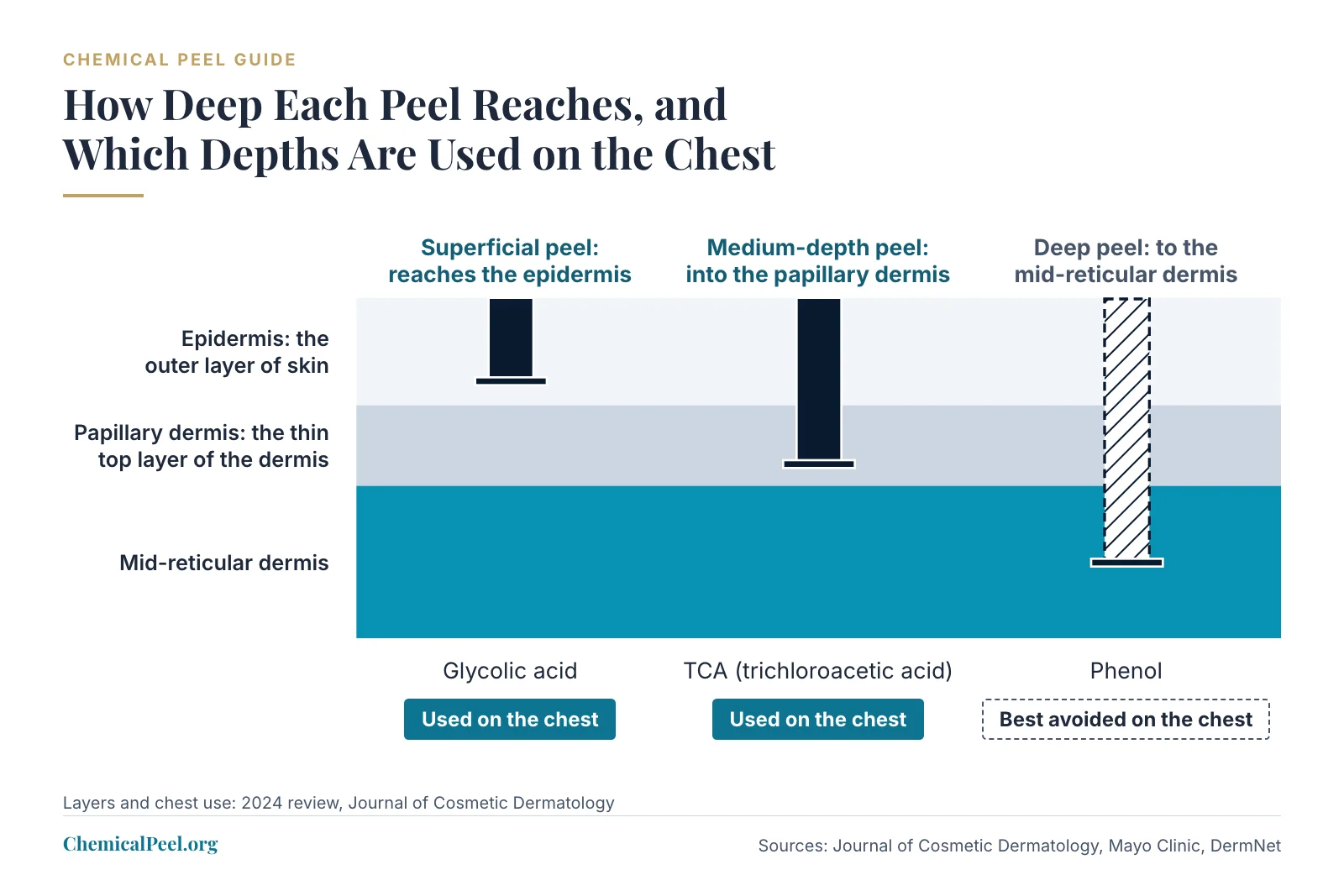
According to the 2024 review, superficial peels work at the level of the epidermis, the outer layer of skin; medium-depth peels go through the epidermis into the papillary dermis, the thin top layer of the dermis; and deep peels reach the mid-reticular dermis. For the chest, the review says deep chemical agents are best avoided, while superficial and medium-depth peels are safe. Our guide to chemical peel depths explains these layers.
Superficial Peels
Mayo Clinic says a light peel treats fine wrinkles, acne, uneven skin tone, and dryness. For the chest, the review lists glycolic acid followed by a neutralizing agent such as sodium bicarbonate; a glycolic acid peel is one example.
Medium-Depth Peels
The review's chest table lists superficial or light medium peels, including glycolic acid mixed with trichloroacetic acid (TCA), the most common chemical used for a medium-depth peel. The side effects the review lists for chest peels include redness, pain, and temporary darkening of the skin. The 2003 report described an unusual complication after a body peel of glycolic acid gel plus TCA: the rapid development of keratoacanthomas, which DermNet describes as rapidly growing skin tumors. See our TCA peel guide.
Deep Peels
Deep peels use phenol, which Mayo Clinic says can damage heart muscle and harm the kidneys and liver, and the review says deep agents are best avoided on the chest. The review also notes that post-inflammatory hyperpigmentation, a darkening of the skin after treatment, limits all peels, especially medium and deep ones.
Crepey Skin and Chest Wrinkles
Cleveland Clinic describes crepey skin as skin that has become thin and developed wrinkles or fine lines, giving it a crepe paper-like look, and lists sun damage and age among the common reasons. Mayo Clinic states that chemical peels can't remove deep scars or wrinkles or tighten sagging skin, though light peels treat fine wrinkles. See our guide to peels for wrinkles.
Cleveland Clinic's dermatology advice for crepey skin starts with staying out of the sun, a broad-spectrum sunscreen of at least SPF 30 every day, and a good moisturizer. Treatments it describes include retinol creams, dermal fillers, fractional lasers, and focused ultrasound, which it says can be used on the decolletage; the article does not list chemical peels.
Keratoses on the Chest: Get a Diagnosis First
Keratosis covers different growths, and some can look like skin cancer, so have a dermatologist identify a growth first.
Actinic Keratoses
An actinic keratosis (AK) is a precancerous growth caused by the sun or indoor tanning. With severe, long-term sun damage, AKs may be found on the upper trunk. Left untreated, some AKs turn into a skin cancer called squamous cell carcinoma. Dermatologists use a medical-grade chemical peel, which destroys the top layers of skin, as one procedure to treat AKs; you cannot get this type of peel at a salon or from a home kit. An AK that is tender, thickened, ulcerated, or enlarging is suspicious for skin cancer and belongs with a dermatologist.
Seborrheic Keratoses
Seborrheic keratoses are harmless growths that most often appear on the chest, back, head, or neck, and they usually do not need treatment. For removal, the AAD lists shaving or scraping, freezing with liquid nitrogen, and electrosurgery with curettage, not a chemical peel. Do not try to remove one yourself. See a dermatologist if a growth grows quickly, turns black, itches, or bleeds, or if it appears suddenly along with many other new growths.
Acne on the Chest
The AAD lists a chemical peel among the procedures a dermatologist may add to an acne treatment plan: it helps remove the dead skin cells and excess oil that clog pores. Deep, painful acne anywhere needs a dermatologist's help. A peel can also cause breakouts: the 2024 review lists acneiform, or acne-like, eruptions among the side effects of chest peels. See our guide to peels for back acne.
How Many Sessions a Chest Peel Takes
Mayo Clinic says you might have a light peel every two to five weeks, and the AAD says three to five peels may be necessary to give you the desired results. DermNet advises waiting three to six months before repeating a moderate-depth peel. These figures are general rather than specific to the chest, so your provider sets the plan. Most results are not permanent, because skin continues to age.
Aftercare for a Peeled Chest
Mayo Clinic gives healing times for peels that it says are usually done on the face, so ask your provider how long your chest is likely to take to heal. The 2024 review's post-peel care for the chest is sun avoidance and a healing ointment at least twice a day. Follow your provider's instructions, and:
- Skip tanning beds. Once your skin has healed, use sunscreen every day.
- Do not rub, scratch, or pick. The review advises limiting rubbing or scratching, and the AAD warns that rubbing or scratching treated skin can cause an infection.
- Keep the skin moist. Use the moisturizer as directed; the AAD notes that skin that dries and cracks can scar.
A peel can lead to a bacterial, fungal, or viral infection, including a flare-up of the virus that causes cold sores, and the review lists raised (hypertrophic) scarring, sun sensitivity, and infection among the complications of chemical peeling. Call your provider if the treated skin burns, itches, or swells. See our aftercare guide.
Who Should Not Have a Chest Peel
A provider may advise against a peel if you:
- Are pregnant or breastfeeding.
- Have taken isotretinoin, an oral acne medicine, in the past six months.
- Have a personal or family history of keloids, or a history of abnormal scarring, which matters on the keloid-prone upper chest.
- Have an active infection or open sores in the area, or frequent or severe cold sores.
- Have a weakened immune system.
- Take medicines or have skin conditions that make your skin more sensitive.
- Cannot stay out of the sun for the healing period.
The 2024 review calls pregnancy, breastfeeding, a history of keloids or hypertrophic scars, active infection, and immunosuppression absolute contraindications. Tell your provider about all surgeries and cosmetic treatments you have had. Mayo Clinic advises stopping hair removal such as electrolysis or depilatories about a week before a peel, and not shaving the treatment area starting 24 hours before it. See who should not get a chemical peel.
Darker Skin Tones
DermNet says people with Fitzpatrick skin types IV to VI have a higher risk of uneven color and of raised or keloid scarring, so peels must be done cautiously and with full informed consent. Mayo Clinic notes that darker or lighter patches after a peel are more common in brown or black skin and can sometimes be permanent, and the 2024 review advises a spot test in a hidden area before treatment. See our guide to peels for dark skin.
No At-Home Peels on the Chest
The AAD warns that some chemical peels sold for home use have caused serious injuries and notes that the FDA advises buying and using a chemical peel only under the supervision of a licensed, trained provider, such as a dermatologist. See our guide to at-home versus professional peels.
Choosing a Provider
Mayo Clinic advises choosing a doctor with knowledge of the skin and the procedure, a dermatologist or dermatologic surgeon, and notes that results can be variable and depend on the expertise of the person doing the peel. The AAD suggests asking how many peels the doctor has performed on people with your skin coloring and whether you have a higher risk of complications. Insurance does not cover cosmetic peels; see our cost guide. Find a qualified provider, or browse our med spa directory when you are ready to compare clinics.
Frequently Asked Questions
Can you do a chemical peel on your chest?
Yes. The American Academy of Dermatology says a chemical peel can diminish signs of aging on the chest as well as the face, hands, and neck. Chest skin has thinner layers than facial skin and fewer oil glands and hair follicles, and a 2024 review in the Journal of Cosmetic Dermatology advises that deep peels are best avoided there, while superficial and medium-depth peels are used. Have a provider examine the area first.
How can I get rid of crepey skin on my chest?
Cleveland Clinic advice for crepey skin starts with staying out of the sun, daily broad-spectrum sunscreen of at least SPF 30, and a good moisturizer. Treatments it describes include retinol creams, fillers, fractional lasers, and focused ultrasound, which it says can be used on the decolletage; it does not list chemical peels. Mayo Clinic states that chemical peels cannot tighten sagging skin, though light peels can treat fine wrinkles. A dermatologist can help you choose.
Who cannot have a chemical peel?
A provider may advise against a peel if you are pregnant or breastfeeding, have taken isotretinoin in the past six months, have a personal or family history of keloids or abnormal scarring, have an active infection or open sores, get frequent or severe cold sores, or have a weakened immune system. Medicines or conditions that make skin more sensitive, and being unable to avoid the sun while healing, are other reasons. Darker skin tones need extra caution.
Will a chemical peel get rid of keratosis?
It depends on the type. For actinic keratoses, precancerous growths caused by the sun or indoor tanning, a medical-grade chemical peel is one of the procedures dermatologists use, and it is not available at a salon or in a home kit. Seborrheic keratoses are harmless growths often found on the chest; the AAD lists removal by shaving, scraping, freezing, or electrosurgery, not peels. Have a dermatologist identify any growth before you treat it.
Can a chemical peel treat sun damage on the chest?
It can help with some signs of it. The American Academy of Dermatology lists age spots, freckles, uneven skin tone, fine lines, and sun-damaged skin among the uses of chemical peels, and it names the chest as an area a peel can treat. On the chest, superficial or medium-depth peels are used rather than deep ones. Precancerous spots called actinic keratoses need a dermatologist, and strict sun protection helps keep sun spots from returning after treatment.
Can a chemical peel help chest wrinkles?
A light peel can treat fine wrinkles, but Mayo Clinic notes that chemical peels cannot remove deep wrinkles or tighten sagging skin. On the chest, fibers of the platysma muscle can extend past the second and third ribs in some people, which makes chest wrinkles more apparent, and a severely sun-damaged chest may need a combination of treatments. Ask a provider which lines a peel can reach and what else may help.