Written by the ChemicalPeel.org editorial team. Published September 29, 2026.
Clinical review pending. This page has not yet been reviewed by a licensed clinician; read it as patient education, not medical advice. How we review
A chemical peel has a limited role in keratosis pilaris (KP), one of the skin concerns we cover. StatPearls, an NCBI medical reference, says there are no controlled clinical trials or a cure for keratosis pilaris, that none of the available treatments works well or is consistently effective, and that some are more likely to cause harm than good. It also says chemical peels utilizing 70 percent glycolic acid for 5 to 7 minutes have been useful in improving the appearance of KP. In this guide, moisturizers and exfoliating creams come first, and a peel is one in-office option to discuss with a dermatologist.
What Keratosis Pilaris Is
The American Academy of Dermatology (AAD) describes keratosis pilaris as a common skin condition that appears as tiny bumps on the skin, and says these rough-feeling bumps are actually plugs of dead skin cells. Mayo Clinic calls it harmless, with tiny bumps often on the upper arms, thighs, cheeks or buttocks. The bumps form when keratin, a hard protein, builds up and blocks the openings of hair follicles; Mayo Clinic says it is not clear why.
The AAD says the bumps can itch, feel rough and dry like sandpaper, and become more noticeable in winter or a dry climate. They can be skin colored, white, red, pinkish purple on fair skin, or brownish black on dark skin. See also chemical peels for large pores and textured skin and chemical peels for inner thighs and underarms.
Do You Need to Treat It?
No. The AAD says you don't have to treat keratosis pilaris, but treatment can help if the itch, dryness, or appearance of the bumps bothers you. StatPearls adds that KP is often refractory, or resistant, to the available treatment options, and Cleveland Clinic says some people don't see any benefit from treatment. The AAD says that for many people KP goes away with time, even without treatment, but there is no way to know who will see it clear.
Where a Chemical Peel Fits in KP Care
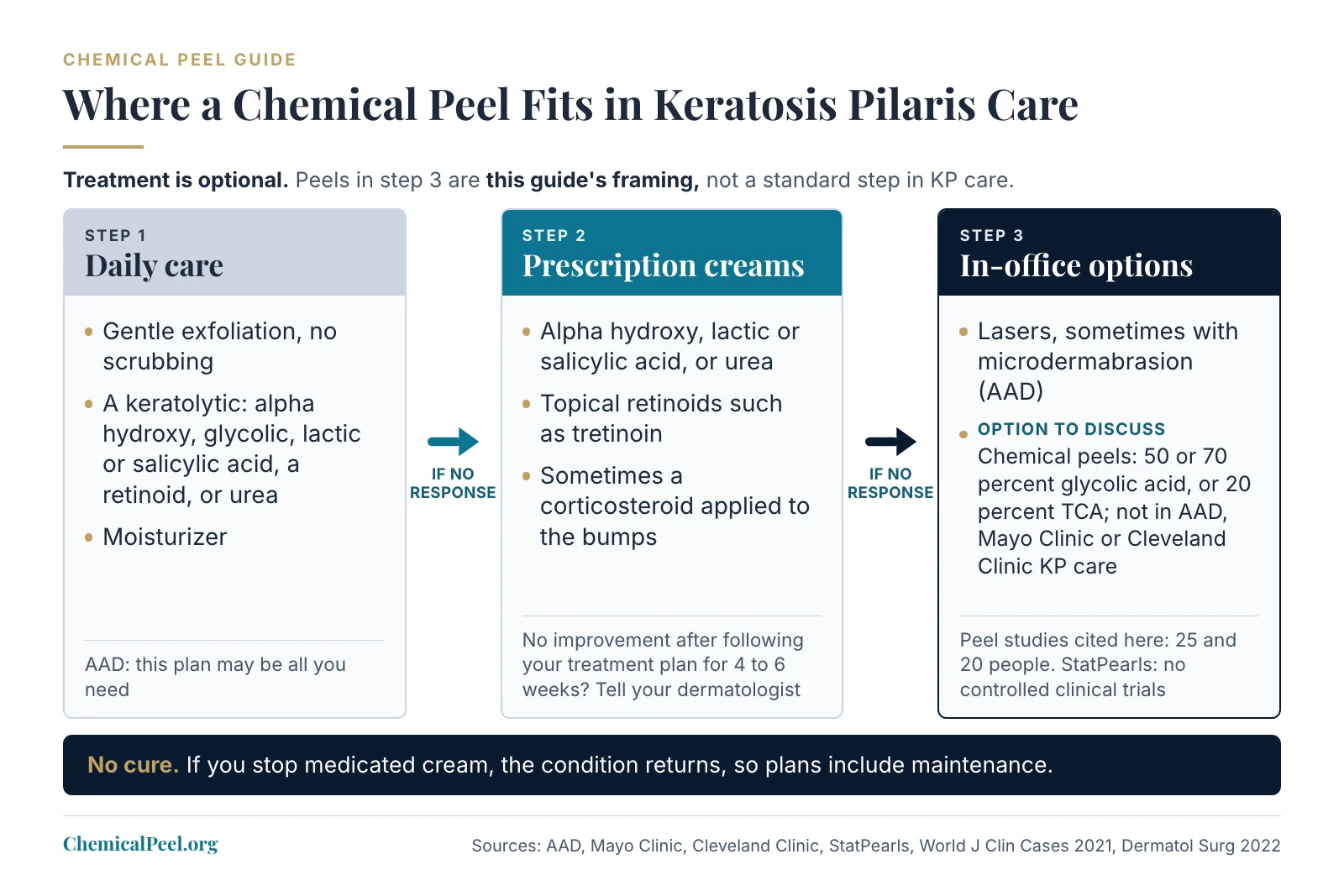
StatPearls describes a stepwise approach that starts with emollients, or moisturizers, and topical keratolytics, products that help loosen and remove dead skin cells. If there is no response, it lists retinoids, topical anti-inflammatories, vitamin D3 derivatives, phototherapy and lasers. Peels are not in that list or on the AAD, Mayo Clinic and Cleveland Clinic KP pages. Placing a peel after the creams is this guide's framing, an option to discuss rather than an established step, as the chart below shows.
Step 1: Daily care
The AAD's three-step home plan: exfoliate gently; apply a keratolytic, also called a chemical exfoliator, containing an alpha hydroxy acid, glycolic acid, lactic acid, a retinoid, salicylic acid or urea; then apply moisturizer. It says this plan may be all you need, and warns that scrubbing tends to worsen KP and that applying too much or using it more often than indicated can cause raw, irritated skin.
Step 2: Prescription creams
If moisturizing and other self-care measures don't help, Mayo Clinic says your health care provider may prescribe medicated creams. Creams with alpha hydroxy acid, lactic acid, salicylic acid or urea help loosen and remove dead skin cells, and topical retinoids such as tretinoin work by promoting cell turnover and preventing plugged hair follicles. Mayo Clinic says retinoids can irritate and dry the skin, and if you're pregnant or nursing, your provider may suggest delaying them or choosing another treatment. The AAD adds that some patients may need to apply a corticosteroid to the areas with keratosis pilaris to soften the bumps and reduce redness, and that if you see no improvement after following your treatment plan for 4 to 6 weeks, you should tell your dermatologist. See lactic acid peel and salicylic acid peel.
Step 3: In-office options
The AAD says lasers may work when moisturizer and medicine fail, and a dermatologist may add a few microdermabrasion sessions to a laser plan. A 2022 systematic review found laser therapy appears to be the most effective form of KP treatment. See chemical peel vs laser and chemical peel vs microdermabrasion.
What the Evidence on Peels for KP Shows
The peel evidence for KP is thin. StatPearls says there are no controlled clinical trials of KP treatments, and the TCA paper below opens by noting that none of the KP treatment options is completely satisfactory.
Glycolic acid peels
In a 2021 study in the World Journal of Clinical Cases, 25 participants had 50 or 70 percent glycolic acid applied to a test area four times, on days 0, 20, 40 and 60, followed each time by a neutralizing solution. The authors reported that it significantly improved skin roughness and follicular hyperpigmentation and called the treatment relatively safe; one participant had burning, itching and discomfort with 70 percent glycolic acid. The report describes no untreated comparison group. After 5 years, only 9 participants could be contacted, and there was no significant difference compared with before treatment. See our glycolic acid peel guide.
TCA peels
A 2022 trial in Dermatologic Surgery enrolled 20 patients with matching KP areas on both sides of the body, randomly assigned to 4 sessions of either 20 percent trichloroacetic acid (TCA) or a long-pulsed Nd:YAG laser, and two blinded physicians rated the results. The authors concluded that both are effective in the treatment of KP. The investigator global assessment and the reduction in dermoscopic scores were comparable between the two. The abstract does not report side effects. See TCA peel and chemical peel depths.
No source cited here ranks one peel acid above another for KP.
How many sessions
No source cited here gives a peel schedule for KP. Both studies used four sessions, 20 days apart in the glycolic acid study. Treatment cannot cure KP, so the AAD says you will need a maintenance plan, and Mayo Clinic says that if you stop using medicated cream, the condition returns.
Skin of Color and Dark Spots
On dark skin, KP bumps can look brownish black, and the AAD notes brown spots that may appear when the bumps clear. The general peel guidance cited here is written mainly for the face: Cleveland Clinic names the face, neck and hands as the usual sites, and Mayo Clinic says peels are used usually on the face. Ask your dermatologist how it applies to the arms, thighs or buttocks.
Cleveland Clinic says superficial peels can generally be used on all skin types, but a darker skin tone carries a greater risk of darkening after treatment, and Mayo Clinic says darker or lighter skin after a peel is more common in brown or black skin and can sometimes be permanent. DermNet says people with Fitzpatrick skin types IV to VI have an increased risk of uneven color and of raised or keloid scars, so peels must be done cautiously with full informed consent. The AAD says people with skin of color can safely have a chemical peel but should see a dermatologist with expertise in using peels on darker skin tones; without this knowledge, they can develop permanent pigment problems. See chemical peels for dark skin.
Who Should Be Careful
Mayo Clinic says your doctor might caution against a chemical peel if you:
- Have taken the oral acne medicine isotretinoin in the past six months.
- Have a personal or family history of keloids, overgrowths of scar tissue.
- Are pregnant.
- Have frequent or severe outbreaks of cold sores.
Cleveland Clinic says peel areas must be free of open sores, lesions or skin infections. The AAD says to stop a keratolytic for a few days if your skin becomes too dry or irritated, so tell the person doing a peel which KP products you use; the 2021 glycolic acid study excluded people who could not guarantee they would not use other exfoliant products. Cleveland Clinic advises avoiding retinoids for one to two weeks before a peel unless your physician says otherwise, while Mayo Clinic notes a doctor might recommend a retinoid cream beforehand to help with healing. Mayo Clinic also says the acids in exfoliating creams aren't recommended for young children, and the AAD says children and teenagers are most likely to have KP; no source cited here addresses peels in children. See who should not get a chemical peel.
Preparing for a Peel and Caring for Your Skin
- Hair removal. Mayo Clinic advises stopping electrolysis or depilatories about a week before a peel and not shaving the area for 24 hours before it. The AAD says shaving or waxing KP skin can cause more bumps.
- Do not pick. Cleveland Clinic says not to pick at, scratch or try to pop KP bumps, to prevent scarring or infection, and the AAD warns that rubbing or scratching skin treated with a chemical peel can cause an infection.
- Protect and watch the skin. Cleveland Clinic says to avoid tanning and direct sun exposure for two weeks before each treatment, and Mayo Clinic says too much sun exposure before a peel can cause permanent irregular pigmentation in treated areas. Afterward, the AAD says to avoid tanning beds, apply sunscreen every day once your skin heals, and contact your dermatologist if it burns, itches or swells.
The AAD warns that some peels sold for at-home use are causing serious injuries, and the FDA advises using one only under the supervision of a licensed, trained provider. See at-home vs professional peels.
Choosing a Provider and Questions to Ask
The AAD says the results of a chemical peel depend largely on the skill of the person performing it, and advises seeing a dermatologist or dermatologic surgeon. Cleveland Clinic notes that eczema, psoriasis, allergies and fungal infections cause similar symptoms, so confirm the diagnosis first. Questions to ask:
- Which acid and strength would you use, and what is the evidence for KP?
- With my skin tone, what is my risk of dark spots?
- Should I pause my retinoid first, and what maintenance will I need?
The AAD says chemical peels are considered a cosmetic treatment and insurance does not cover the cost of cosmetic treatments; see our cost guide. Compare providers with find a doctor or our med spa directory.
Frequently Asked Questions
Will a chemical peel help keratosis pilaris?
The evidence is limited. StatPearls says there are no controlled clinical trials or a cure for keratosis pilaris, and that none of the available treatments works well or is consistently effective. It also says chemical peels utilizing 70 percent glycolic acid for 5 to 7 minutes have been useful in improving its appearance, and a 2022 trial in 20 people found 20 percent TCA and an Nd:YAG laser both effective. In this guide, moisturizers and exfoliating creams come first, and a peel is one option to discuss with a dermatologist.
Will glycolic acid remove keratosis pilaris?
One study suggests it can improve how keratosis pilaris looks. The AAD lists glycolic acid among the ingredients in keratosis pilaris treatments. In a 2021 study of 25 people, four sessions of 50 or 70 percent glycolic acid significantly improved skin roughness, the authors reported, but among the 9 participants reached 5 years later there was no significant difference compared with before treatment, and two patients reported that they were worse than before treatment. The AAD says treatment cannot cure keratosis pilaris, so a maintenance plan is needed.
Is an AHA or a BHA better for keratosis pilaris?
No source cited here ranks one above the other for everyone. The AAD lists alpha hydroxy acid, glycolic acid, lactic acid and salicylic acid among keratosis pilaris treatments; glycolic and lactic acid are alpha hydroxy acids, and salicylic acid is a beta hydroxy acid. In a 2023 dermatologist survey, topical lactic acid was the most used first-line therapy, followed by salicylic acid, and a 2025 systematic review found lactic and glycolic acids were the preferred topicals. Those describe use and preference, not proof that one is better.
Does keratosis pilaris ever fully go away?
It can. The AAD says that for many people keratosis pilaris goes away with time, even without treatment, and that clearing tends to happen gradually over many years, but there is no way to know who will see it clear. Mayo Clinic says the condition usually disappears by age 30, and that even with treatment it might last for years. Treatment cannot cure it, so the AAD describes treatment as keeping the bumps under control.
What makes keratosis pilaris worse?
Mayo Clinic says dry skin tends to make keratosis pilaris worse, and the AAD says the bumps can become more noticeable in winter or a dry climate. The AAD also says scrubbing tends to irritate the skin and worsen it, shaving or waxing can cause more bumps, and self-tanners tend to make the bumps more obvious. It suggests a short bath or shower of 20 minutes or less in warm rather than hot water, and a thick moisturizer with urea or lactic acid applied to damp skin.
What gets mistaken for keratosis pilaris?
Cleveland Clinic says eczema, psoriasis, allergies and fungal infections cause similar symptoms, and StatPearls lists folliculitis, atopic dermatitis, milia and acne vulgaris among the conditions to consider. The AAD notes that some people mistake the bumps for small pimples. Mayo Clinic says a health care provider will likely be able to diagnose keratosis pilaris just by looking at the skin, with no testing needed. Get a diagnosis before treating bumps with a peel.