Written by the ChemicalPeel.org editorial team. Published September 26, 2026.
Clinical review pending. This page has not yet been reviewed by a licensed clinician; read it as patient education, not medical advice. How we review
A chemical peel and IPL (intense pulsed light) both treat sun-damaged skin, but they work differently. A peel applies chemicals that remove damaged skin cells, while IPL sends pulses of light that colored targets in the skin, such as melanin in brown spots and the red pigment in blood, absorb as heat. That is why IPL also treats redness and broken blood vessels, while a peel is aimed at concerns such as uneven color, rough skin, fine lines and some types of acne.
This guide is part of our chemical peel guides.
How a Chemical Peel Works
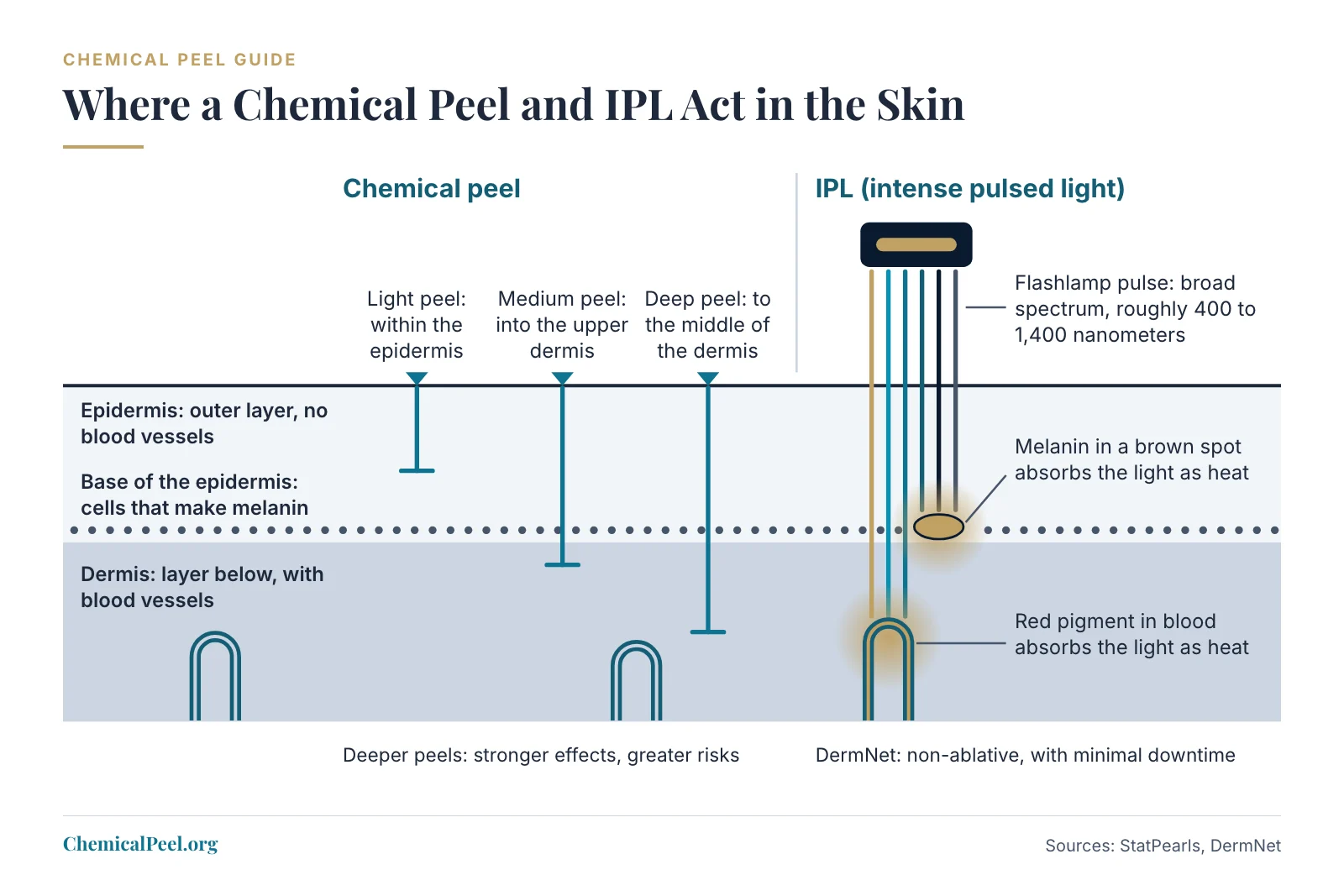
A chemical peel is a controlled injury: a chemical applied to the skin damages the outer layer, sometimes the layer beneath too, and the skin regenerates and remodels as it heals. Light peels stay within the epidermis, the outer layer. Medium peels reach into the upper dermis, the layer below, and deep peels reach the middle of the dermis. Deeper peels bring stronger effects and greater risks. See chemical peel depths for each level.
How IPL Works, and Why It Is Not a Laser
A laser emits light of a single wavelength. An IPL device uses a flashlamp to emit a broad spectrum, roughly 400 to 1,400 nanometers, in each pulse, and filters adjust it to a target. Colored molecules such as hemoglobin and melanin absorb the light, heat up and are destroyed. DermNet calls IPL non-ablative: its results are not as dramatic as ablative resurfacing, which injures both the epidermis and the dermis, but its downtime is minimal. Lasers are compared in chemical peel vs laser resurfacing.
The epidermis has no blood vessels of its own. The cells that make melanin sit at its base, and peels that reach that base layer can even out uneven color. Blood vessels sit lower, in the dermis, where the red pigment in blood absorbs IPL light.
What Each Treatment Targets
| Concern | Chemical peel | IPL |
|---|---|---|
| Sun spots and freckles | Yes | Yes, with light aimed at melanin |
| Redness and broken blood vessels | Not among the AAD's options for visible blood vessels | Yes, with light aimed at blood |
| Fine lines | Yes; medium peels also treat shallow wrinkles | A 2012 review in the Journal of Clinical and Aesthetic Dermatology: finer lines respond better than deeper furrows; results are often subtle and require multiple sessions |
| Blackheads | Helps remove what clogs pores | FDA-approved when paired with a vacuum |
| Number of sessions | Light peels, per the AAD: three to five may be necessary, and may be repeated every two to five weeks | Sources differ: StatPearls, routinely three to six every two to four weeks; DermNet, four to six every three to six weeks may be needed |
Sun Spots, Freckles and Sun Damage
The American Academy of Dermatology (AAD) lists age spots, freckles, discoloration and sun-damaged skin among peel uses. IPL light aimed at melanin is used for age spots and freckles.
Have any spot checked first: the AAD warns that what looks like an age spot could be skin cancer, and fading a skin cancer can give it time to grow and possibly spread. Spots can return, so protect treated skin from the sun. See peels for dark spots and peels for sun damage.
Redness, Rosacea and Broken Blood Vessels
For rosacea redness, the AAD says intense pulsed light therapy can reduce flushing and improve skin texture, is gentler on the skin than a laser, and needs more sessions than laser therapy. For visible blood vessels, the AAD lists laser or light treatments and electrodesiccation, not peels. StatPearls, a clinical reference, still lists rosacea among peel uses; see chemical peels and rosacea.
Texture, Fine Lines and Sagging Skin
A peel removes layers of sun-damaged cells and leaves fresh skin with a more even surface. For IPL, a review in the Journal of Clinical and Aesthetic Dermatology describes texture change as a secondary observation in several studies, and says results on wrinkles are often subtle.
Does IPL tighten sagging skin? IPL is not among the options in the AAD's guide to firming sagging skin, and in a study of six volunteers in the Journal of Drugs in Dermatology, none reported improvement in skin tightening after IPL.
Acne and Blackheads
On acne, the AAD says a peel helps remove the dead skin cells and excess oil that clog pores, while acne extraction, a separate procedure, is how a dermatologist physically removes breakouts. The AAD also notes that photopneumatic therapy, which pairs IPL with a gentle vacuum, is FDA-approved to treat blackheads, whiteheads and some pimples. See our guide to chemical peels for acne.
Skin Tone Changes the Risk for Both
StatPearls says IPL is particularly challenging to use on dark-skinned individuals. It explains that shorter wavelengths are generally reserved for fair skin types, as these wavelengths are absorbed by melanin and lead to pigmentation changes in patients with darker skin, though device cooling technology has helped minimize these side effects. Selecting longer wavelengths may benefit patients with darker skin. Higher energy settings and pulse durations, thinner skin and darker skin types may increase the likelihood of side effects. DermNet advises avoiding sun exposure in the days and weeks before and after IPL.
For peels, StatPearls says light or very light peels are generally suitable for all Fitzpatrick skin types, but that it is crucial to be cautious with types III to VI, which may be more susceptible to uneven pigmentation. DermNet notes that people with types IV to VI have an increased risk of uneven color and of raised or keloid scarring. The AAD says people with skin of color can safely have a chemical peel but should see a dermatologist who has expertise using peels on darker skin tones; without that knowledge, permanent pigment problems can develop. See our guide to chemical peels for dark skin.
Downtime, Sessions and Side Effects
Peel healing depends on depth: after a light peel, healing takes 1 to 7 days; a medium peel takes 7 to 14 days, with swelling and crusting, and a deep peel 14 to 21 days, with the area bandaged. For light peels, the AAD says three to five peels may be necessary to give you the desired results, and these peels may be repeated every two to five weeks; DermNet says it is wise to wait 3 to 6 months before repeating a medium-depth peel; and a person can have only one deep peel (see how often to get a chemical peel). The AAD lists possible side effects as persistent redness that may last for months, temporary darkening, lighter skin color after medium and deep peels, and scarring, which is very rare when a dermatologist performs the peel.
DermNet says an IPL session usually lasts about 20 minutes and most patients can return to work immediately. DermNet also says skin may turn pink and a little sore right after treatment, and a mild sunburn feeling may last a few days. On sessions, sources differ: StatPearls says the effect of pulsed light is cumulative, routinely requiring three to six treatments every two to four weeks, while DermNet says a course of four to six sessions every three to six weeks may be needed. StatPearls calls IPL side effects typically rare and minimal in severity; the most common include pain and redness, and others include swelling, blisters, bruising, crusting, darker or lighter patches, whitened hair, scarring, keloid formation and infection. IPL light can damage the retina, so protective eyewear is required. IPL can also trigger herpes simplex outbreaks, so if you have had them, a provider may start an antiviral the day before.
Who Should Wait or Skip Each Treatment
For any peel, StatPearls lists active infection, open wounds, current isotretinoin treatment and a past allergy to a peeling agent among contraindications and precautions. For medium and deep peels it adds isotretinoin in the past 6 months, pregnancy or breastfeeding, recent facial surgery, smoking and a tendency to form keloids. The AAD advises telling your dermatologist about cold sores, easily scarring skin and past cosmetic treatments. For IPL, StatPearls says it may be beneficial to avoid treatment after a recent sunburn and during pregnancy or breastfeeding. See who should not get a chemical peel.
After a peel, the AAD advises contacting your dermatologist if the skin burns, itches or swells, and DermNet notes that complications are easier to deal with early than late. After IPL, DermNet notes that, rarely, blistering can occur, and that damaged pigment cells can leave darker or paler patches of skin; ask before treatment whom to contact if either happens.
Can You Combine a Peel and IPL?
The AAD notes that a dermatologist may recommend more than one treatment. In a 2026 split-face trial in the Journal of Cosmetic Dermatology, 36 people with rosacea had IPL on the whole face monthly for three sessions, and a randomly assigned half of the face also had a 30% supramolecular salicylic acid peel at each session. Among the 33 who finished, the side that also had the peel showed a greater drop in redness on two instrument measures, while clinician and patient ratings improved on both sides with no significant difference between them. Side effects were mild and comparable between sides. That is one study, so ask your provider about order and spacing.
What Each Costs
This site lists no IPL price. Our chemical peel cost guide lists typical peel prices by depth, and the AAD notes that insurance does not cover cosmetic treatments such as peels. Both treatments can take several sessions (see the table above), so ask for a quote for the full course.
Choosing a Provider
The AAD says the results you see after a chemical peel depend largely on the skill of the person performing the peel. For visible blood vessels, the AAD warns that in inexperienced hands, laser therapy, light treatments, or electrodesiccation can be dangerous. Burns, permanent changes to your skin color, or scars can occur. StatPearls says IPL is frequently given by a midlevel provider, such as a physician assistant or nurse practitioner, and that having a physician, such as a dermatologist or plastic surgeon, on the care team means complications can be managed promptly. Ask who will treat you, their training, and how many people with your skin coloring they have treated. See choosing a provider for more questions, find a qualified provider near you, or compare med spas near you.
Frequently Asked Questions
Is IPL better than a chemical peel?
Neither is better for everything. IPL treats redness, rosacea flushing and broken blood vessels, because its light is absorbed by the red pigment in blood, and chemical peels are not among the American Academy of Dermatology's options for visible blood vessels. The AAD lists chemical peels for rough skin, fine lines, discoloration and some types of acne. Both can treat age spots and freckles. Your skin tone, the cause of your spots and the downtime you can take should guide the choice.
Does IPL tighten sagging skin?
IPL is not among the options in the American Academy of Dermatology's guide to firming sagging skin. That guide names ultrasound, radiofrequency and laser treatments, calls laser resurfacing the most effective procedure for tightening loose skin, and says a surgical lift gives the most dramatic results. With a lot of sagging, it notes, skin tightening may not help. In a study of six volunteers in the Journal of Drugs in Dermatology, none reported improvement in skin tightening or wrinkles after IPL.
Is a chemical peel more effective than laser?
It depends on the problem. For loose skin, the American Academy of Dermatology says laser resurfacing can tighten skin, usually better than any other skin-tightening procedure, though it requires downtime and has a greater risk of side effects such as scarring. For age spots, it says one or two laser treatments can treat them quickly, and that chemical peeling can effectively treat age spots on the hands. The site's chemical peel vs laser guide compares the two in more depth.
Do chemical peels pull out blackheads?
Not physically. A chemical peel works chemically: on acne, the American Academy of Dermatology says it helps remove the dead skin cells and excess oil that clog pores, and it lists some types of acne among peel uses. Physically removing breakouts is a separate procedure, acne extraction, done by a dermatologist. Among light treatments, the AAD notes that photopneumatic therapy, which pairs IPL with a gentle vacuum, is FDA-approved to treat blackheads, whiteheads and some pimples.
Which is better for dark spots, IPL or laser?
It depends on the spot. A small split-face trial in the Journal of the American Academy of Dermatology treated 15 Asian patients with freckles and 17 with lentigines (flat brown spots such as sun spots). A Q-switched alexandrite laser worked better on freckles, and the authors concluded that IPL should be used for lentigines in Asian patients. Dark marks developed in some patients after the laser but in none after IPL. Have any spot checked first, since what looks like an age spot could be skin cancer.
What are the side effects of IPL?
StatPearls, a clinical reference, calls IPL side effects typically rare and minimal in severity; the most common include pain and redness. Other side effects StatPearls reports include swelling, blisters, bruising, crusting, darker or lighter patches, whitened hair, scarring, keloid formation and infection, and StatPearls says IPL can trigger herpes simplex outbreaks. DermNet describes a mild sunburn feeling (redness, peeling or swelling) that may last a few days. Darker skin, thinner skin and higher energy settings may make side effects more likely. Protective eyewear is required because IPL light can damage the retina.