Written by the ChemicalPeel.org editorial team. Published September 26, 2026.
Clinical review pending. This page has not yet been reviewed by a licensed clinician; read it as patient education, not medical advice. How we review
A HydraFacial is a brand-name hydradermabrasion treatment. Its maker says it cleanses, exfoliates, extracts and hydrates the skin in one continuous treatment, and it lists a chemical peel among the steps. A chemical peel applies an acid that removes skin at a chosen depth, from light to deep, and deeper peels take longer to recover from. Research on hydradermabrasion is a handful of small studies, while dermatologists have performed chemical peels for more than 50 years.
This comparison is part of our chemical peel guides.
What a HydraFacial Is
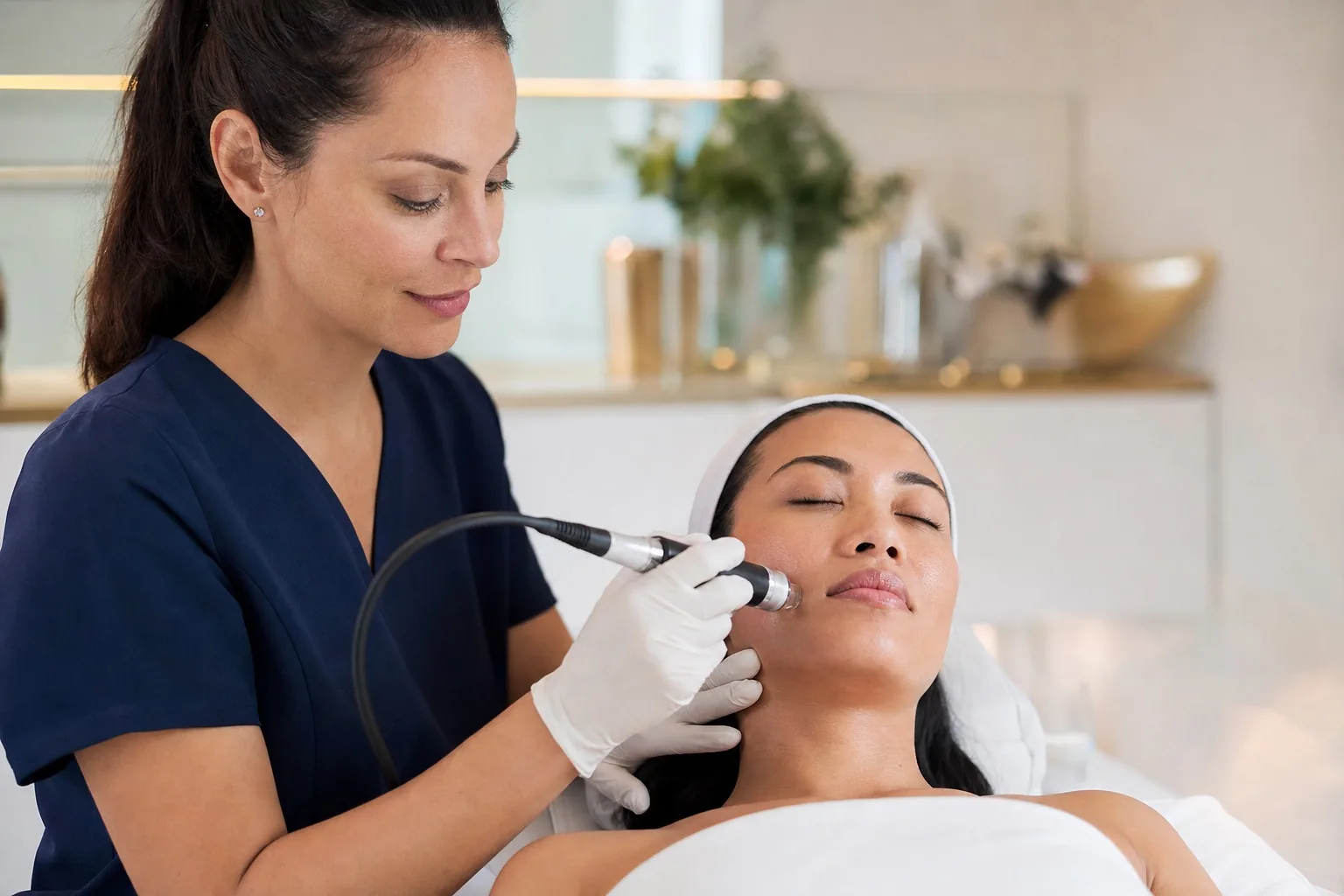
Researchers describe hydradermabrasion as a procedure in which a handheld suction wand that emits a stream of water is moved across the skin, traditionally on the face, combining suction with gentle cleansing by water and serums. A 2022 study calls the HydraFacial a hydradermabrasion device from The HydraFacial Company, and a 2024 study calls hydradermabrasion an alternative to traditional microdermabrasion; see our comparison of chemical peels and microdermabrasion.
The maker describes one of its steps as a customizable chemical peel and gives no acid strength. The Cleveland Clinic describes it as a three-in-one service performed by an esthetician, with steps that include a chemical peel, extractions, and an infusion of antioxidants and hyaluronic acid. In a 2022 study of the HydraFacial Clarifying Treatment for acne, the peel step used solutions listed as 7.5 percent glycolic acid and 2 percent salicylic acid, followed by suction and blue LED light. No source we found measured how deep that step reaches on its own.
What a Chemical Peel Is
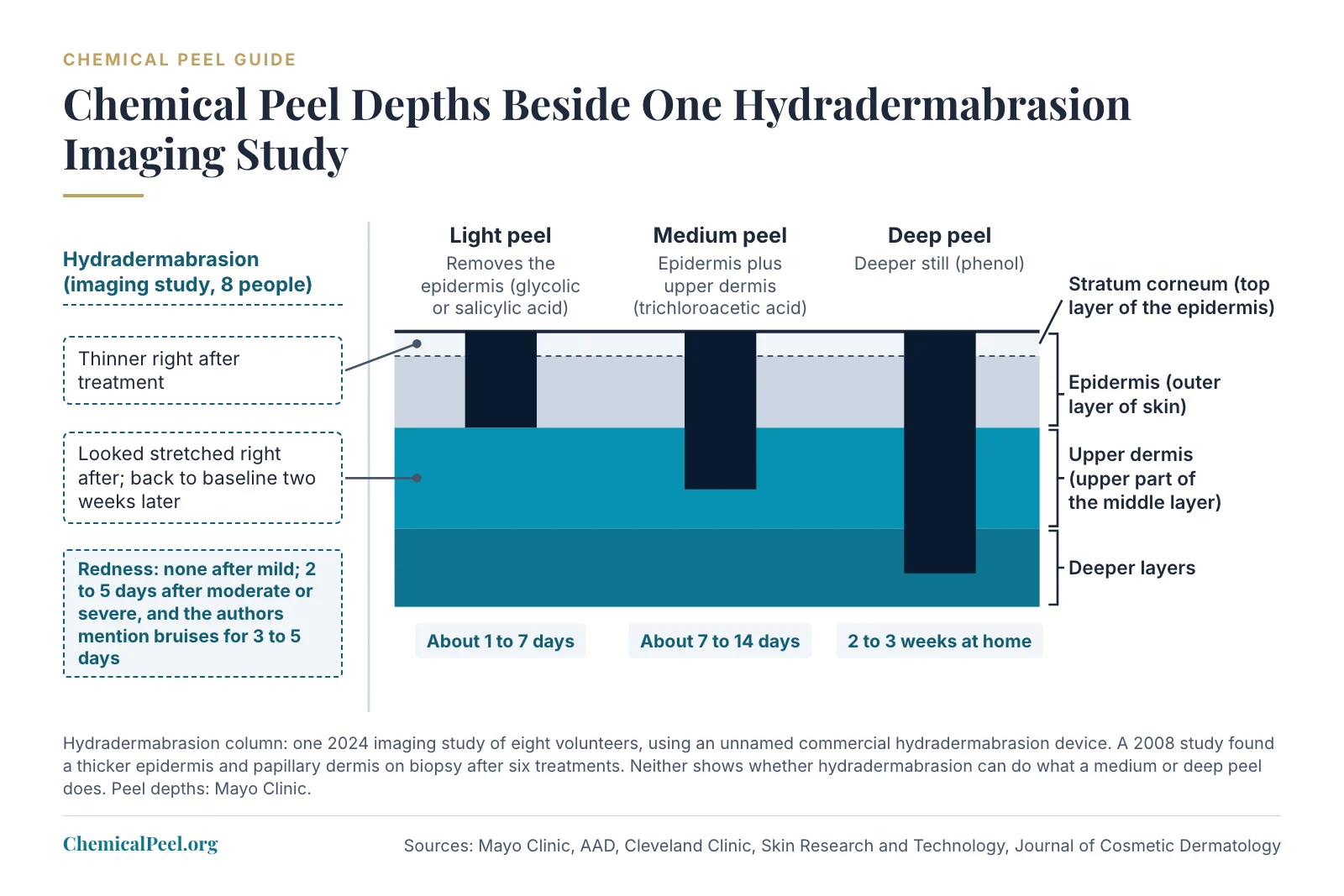
A chemical peel applies a chemical solution to the skin to remove its top layers, and the skin that grows back is smoother. A light peel removes the outer layer of skin, the epidermis, typically with glycolic or salicylic acid. A medium peel also removes cells from the upper part of the dermis, the middle layer of skin, with trichloroacetic acid. A deep peel removes cells deeper still, using phenol. Our guide to chemical peel depths explains each level, and our chemical peel facial guide covers peels given as part of a facial.
In a 2024 hydradermabrasion imaging study of eight volunteers, the stratum corneum, the top layer of the epidermis, was thinner right after treatment, and the upper dermis looked stretched; two weeks later the dermis was back to baseline, with no visible difference in its collagen. The diagram below sets those findings beside the three peel depths.
HydraFacial vs Chemical Peel at a Glance
| Factor | HydraFacial | Chemical peel |
|---|---|---|
| How it works | Maker: cleanses, exfoliates, extracts and hydrates, with a peel step | Acid solution removes layers of skin |
| How deep | Hydradermabrasion imaging study (8 people): top layer thinned, upper dermis briefly stretched | Epidermis (light), upper dermis (medium), deeper still (deep) |
| Recovery | Same study: no visible redness after mild treatment. After moderate or severe treatment, redness that resolved after 2 to 5 days; the authors say those patients are content with redness and bruises for 3 to 5 days. | About 1 to 7 days (light), 7 to 14 days (medium), 2 to 3 weeks at home (deep) |
| How often | Six sessions, one every two weeks, in the acne study | Light: you might have one every two to five weeks; three to five may be necessary. Deep: only one |
| Who performs it | An esthetician, per the Cleveland Clinic | Nurse or esthetician (light); DermNet: usually a dermatologist or plastic surgeon (medium, deep) |
Downtime and Side Effects
After a HydraFacial
In the acne study of 20 adults, treatments were generally well tolerated. Redness was the most common sign investigators recorded, and stinging and itching the most common symptoms patients reported. In the hydradermabrasion imaging study, mild treatments caused no visible redness. At the 2-week follow-up, there was no improvement in fine lines, overall red areas of the face or clogged pores. Moderate or severe treatments caused visible redness that resolved after 2 to 5 days. At the 2-week follow-up, a decrease in red areas and fine lines was visible. The authors say mild treatment is for people who want smoother skin without redness or bruises, and that moderate or severe treatment is for people who want improvement in skin redness and fine lines but are content with redness and bruises for 3 to 5 days.
After a Chemical Peel
After a peel of any depth, skin is red, tight, irritated or swollen. Light peels take about one to seven days to heal, and you can usually wear makeup the next day. Medium peels take about seven to 14 days, and redness might last for months. A deep peel means two to three weeks of recovery at home. Risks listed by the Mayo Clinic:
- Scarring. Rare, and typically on the lower part of the face.
- Color changes. Skin can turn darker or lighter than normal; Mayo Clinic says this is more common in people with brown or black skin and can sometimes be permanent.
- Infection. Including a flare of the herpes virus that causes cold sores.
- Organ harm. The phenol in deep peels can damage heart muscle and harm the kidneys and liver.
What Each Is Used For
Dermatologists use chemical peels to treat some types of acne, age spots, blotchy or uneven color, a dull complexion, fine lines, freckles, melasma, rough skin and sun damage. Peels cannot remove deep scars or wrinkles or tighten sagging skin. See our guides to chemical peels for acne and salicylic acid peels.
A 2008 study randomized 20 women to six hydradermabrasion treatments with an antioxidant serum or to the same serum applied by hand. Fine lines, pore size and hyperpigmentation decreased in the hydradermabrasion group, with no reported complications, and the hand-applied group showed no change. In the 2022 HydraFacial study, 20 adults with mild to moderate acne had six treatments over 12 weeks, and acne severity improved as graded by both investigators and patients. That paper reports no funding, and one author is an employee of The HydraFacial Company.
Do HydraFacials Remove Blackheads?
The Cleveland Clinic lists extractions among a HydraFacial's steps, and the acne study used suction to extract dead skin cells, sebum and debris, but it graded overall acne rather than counting blackheads. A 2015 split-face study of 23 women, which names no device brand, found that a 4 percent acid solution applied with suction reduced whiteheads and blackheads more than the same acid alone at one week.
Blackheads, open pores clogged with oil and dead skin, can return after extraction, so you need a skin-care plan. Dermatologists recommend a retinoid, such as adapalene, and a benzoyl peroxide wash, given six to eight weeks to work; if blemishes remain, you may want to see a dermatologist. Do not squeeze blackheads yourself, which can delay clearing. For acne, a chemical peel helps remove the dead skin cells and excess oil that clog pores; see our guide to chemical peels for large pores.
What the Evidence Does and Does Not Show
A PubMed search on September 26, 2026, returned five records for hydradermabrasion; the four studies cited here enrolled 8 to 23 people each. We found no study comparing a HydraFacial directly with a chemical peel. The acne study names its device, the HydraFacial Elite machine; the imaging study used an unnamed commercial hydradermabrasion device, and the 2008 and 2015 abstracts name none. The acne study was not randomized or blinded, its sample was only 20 patients, and eight returned for its two-week follow-up. The imaging study's authors declared no conflict of interest.
In the 2008 study, biopsies after six treatments showed a thicker epidermis and papillary dermis, the top layer of the dermis. In the imaging study, by contrast, the dermis returned to baseline within two weeks. Neither shows whether hydradermabrasion can do what a medium or deep peel does.
Who Should Wait
Before a Chemical Peel
A doctor might caution against a chemical peel if you have taken isotretinoin in the past six months, have a personal or family history of keloid scars, are pregnant, or have frequent or severe cold sores. People with skin of color can safely have a peel, but should see a dermatologist with expertise in darker skin tones, because without it they can develop permanent pigment problems. See who should not get a chemical peel for the full list.
Before a HydraFacial
We found no medical society guidance written for HydraFacial. The acne study excluded people who had taken oral isotretinoin within six months, had cystic acne, or had frequent or active facial cold sores. Since a 2008 study describes hydradermabrasion as crystal-free microdermabrasion combined with a serum, the American Academy of Dermatology's microdermabrasion advice is worth knowing: see a dermatologist before a spa treatment if a mole or spot is growing, bleeding or changing, if you took isotretinoin in the past six months, or if you scar easily.
When to Call Your Provider
After a peel, the American Academy of Dermatology advises contacting your dermatologist if your skin burns, itches or swells. Report any problem promptly, since complications are easier to deal with early than late.
Can You Combine the Two?
In a sense, a HydraFacial already does, since its maker lists a peel among its steps. The acne study's authors note that using HydraFacial with other treatments was not studied there, and we found no study pairing a HydraFacial with a chemical peel.
Mention a recent HydraFacial before a peel and ask how far apart to space them. The Mayo Clinic advises avoiding facial masks and facial scrubs in the week before a peel. Do not add an at-home peel: the American Academy of Dermatology reports that some peels sold for home use are causing serious injuries, and that the FDA advises using one only under the supervision of a licensed, trained provider. See at-home vs professional peels.
Cost, and Whether a HydraFacial Is Worth It
This site publishes no HydraFacial price. Our chemical peel cost guide puts a superficial peel at $100 to $400 per session. Insurance does not cover cosmetic treatments such as chemical peels, and facials are typically not covered either (see insurance and chemical peels).
Whether a HydraFacial is worth it depends on your goal and how much weight you give small, short studies. As the Cleveland Clinic advises for facials, if a claim seems too good to be true, proceed with caution.
Choosing a Provider
The results of a chemical peel depend largely on the skill of the person performing it. Before either treatment, ask what results to expect, what side effects are possible, whether you will have downtime, and how many treatments the provider has done on people with your skin coloring. See how to choose a qualified provider, and when you are ready to compare clinics, find a med spa near you.
Frequently Asked Questions
What are the disadvantages of a HydraFacial?
One disadvantage is thin evidence. The 2022 acne study of a HydraFacial device enrolled 20 people, was not randomized or blinded, and had an author employed by The HydraFacial Company. Side effects recorded in that study included redness, swelling, dryness, peeling, stinging and itching. In a hydradermabrasion imaging study of eight people, mild treatments caused no visible redness, and at two weeks there was no improvement in fine lines, overall red areas of the face, or clogged pores. Moderate or severe treatments caused redness that resolved after 2 to 5 days, and at two weeks a decrease in red areas and fine lines was visible. The authors say a moderate or severe treatment is for people who are content with redness and bruises for 3 to 5 days. No study we found compared a HydraFacial with a chemical peel.
What are the downsides of a chemical peel?
Deeper peels take longer to recover from. A light peel takes about one to seven days to heal, a medium peel about seven to 14 days, and a deep peel two to three weeks of recovery at home. Risks include rare scarring, skin that turns darker or lighter than normal, which is more common in brown or black skin and can sometimes be permanent, infection including cold sore flares, and heart, kidney or liver harm from the phenol in deep peels.
Do HydraFacials remove blackheads?
No study we found counted blackheads after a HydraFacial. The Cleveland Clinic lists extractions among its steps, and a 2022 acne study used suction to extract dead skin cells, sebum and debris, but it graded overall acne. A 2015 split-face study of 23 women, which names no device brand, found that an acid solution applied with suction reduced blackheads and whiteheads more than the acid alone at one week. Blackheads can return, so follow a skin-care plan, such as a retinoid like adapalene and a benzoyl peroxide wash.
Is a HydraFacial worth the money?
It depends on your goal. In a 2022 study of 20 adults with mild to moderate acne, six HydraFacial treatments over 12 weeks improved acne severity; the study was not blinded, and one author is an employee of the maker. A 2008 hydradermabrasion study of 20 women reported decreases in fine lines, pore size and hyperpigmentation. No study we found compared either with a chemical peel. This site publishes no HydraFacial price, so ask what each session includes and how many you would need.
Does a HydraFacial include a chemical peel?
Yes, as its maker describes it: the maker lists a peel among the steps and calls it a customizable chemical peel. The Cleveland Clinic also lists a chemical peel, alongside exfoliation, extractions, and an infusion of antioxidants and hyaluronic acid. The maker gives no acid strength. In a 2022 acne study, the peel step used solutions listed as 7.5 percent glycolic acid and 2 percent salicylic acid. No source we found measured how deep that step reaches on its own.
Which has more downtime, a HydraFacial or a chemical peel?
It depends on the depth of the peel. Light peels heal in about one to seven days, and you can usually wear makeup the next day; medium peels take about seven to 14 days, and deep peels need two to three weeks of recovery at home. In a hydradermabrasion imaging study of eight people, mild treatments caused no visible redness, while moderate or severe treatments caused redness that resolved after 2 to 5 days. The authors say a moderate or severe treatment is for people who are content with redness and bruises for 3 to 5 days.