Written by the ChemicalPeel.org editorial team. Published August 15, 2026. Updated September 2, 2026.
Clinical review pending. This page has not yet been reviewed by a licensed clinician; read it as patient education, not medical advice. How we review
A retinol peel is a professional resurfacing treatment that delivers a high concentration of a vitamin A derivative into the skin, where it acts on cell receptors to change how skin cells mature and shed, rather than dissolving the surface on contact the way an acid peel does. That one difference explains most of what patients find confusing about it. The product is left on for hours and washed off at home rather than neutralized in the room, almost nothing visible happens on treatment day, and peeling usually begins on day two to day four. Here is how it works, what it treats, who it suits, and what a series costs.
What Is a Retinol Peel?
A retinol peel, also called a retinoid peel or vitamin A peel, is an in-office treatment in which a concentrated retinoid is applied to cleansed skin, left in place for several hours, and washed off by the patient at home. Many formulations are visibly yellow, so it is sometimes sold as a yellow peel, and because it causes no obvious redness on treatment day, clinics market it as a red carpet peel. Those are marketing labels. What defines the treatment is the active: retinol, retinaldehyde, or retinoic acid (tretinoin), the biologically active form the others must convert into inside the cell.
By depth it is superficial, confined to the epidermis, on the same rung as glycolic, lactic, mandelic, and salicylic acid peels rather than medium peels such as TCA or deep phenol peels. Our overview of chemical peel types and depths lays out the ladder. Superficial depth does not mean invisible recovery: a retinol peel can shed more visibly than its gentle application suggests.
How a Retinol Peel Works, and Why It Is Not an Acid Peel
What an acid peel does
An alpha hydroxy acid such as glycolic, or a beta hydroxy acid such as salicylic, works chemically and immediately. It lowers surface pH and weakens the bonds holding corneocytes, the flattened dead cells of the outermost layer, to one another. The reaction starts on contact and continues while the acid stays active, which is why the session ends with neutralization or with a self-neutralizing formula exhausting itself. The exfoliation has largely happened before you leave the room, as our glycolic acid peel guide describes.
What a retinoid does instead
A retinoid dissolves nothing. It is absorbed into living epidermal cells and converts, as needed, into retinoic acid, which binds nuclear retinoic acid receptors acting as ligand-activated transcription factors. In plain terms, the molecule docks with a receptor and changes which genes that cell is reading. The documented effects of topical retinoids follow: keratinocytes turn over on a faster, more orderly schedule, the outer layer is compacted, pigment disperses more evenly, and over a longer horizon collagen production in the dermis is supported. That is instructions rewritten inside cells, not a surface chemical reaction.
Why the peeling is delayed
Because the skin has to act on those instructions, there is a lag. Treatment day looks unremarkable. Accelerated turnover then works outward, and flaking characteristically begins around day two to day four, later than the day two or three typical of an acid peel. Patients who do not know this either assume the peel failed, or panic on day three when the sheeting starts. Neither reaction is warranted, and the same biology is why benefit accrues cumulatively across a series rather than from one session.
What a Retinol Peel Treats
Retinoids have one of the better-supported track records in dermatology for photoaging, and a professional peel is a concentrated, intermittent version of that chemistry. Providers use it for:
- Photoaging and fine lines. Sun-driven surface aging, crepiness, and early lines respond to retinoid signaling better than to exfoliation alone.
- Tone, dullness, and texture. Even pigment distribution, faster turnover, and a compacted outer layer read as a brighter, smoother surface across a series.
- Mild acne and congestion. Retinoids normalize the follicular lining and reduce the plugging that produces comedones.
- Post-inflammatory pigment, cautiously. Retinoids can fade marks left by acne, though melanin-rich skin needs a provider experienced with priming and pacing.
It does not erase deep wrinkles, tighten laxity, or remodel established scarring. Those are dermal problems a superficial treatment cannot reach.
What Is Actually in a Retinol Peel?
Ask this before you book, because “retinol peel” on a menu is a marketing category, not a formula. Many are combination peels: a low-strength acid base, often lactic, glycolic, salicylic, or a Jessner’s-type blend, with a retinoid layered over it. Several branded protocols are multi-agent and include retinoic acid alongside other actives, which is why the VI Peel peels the way it does. An acid base can improve penetration, but it changes your candidacy, contraindications, and downtime. Ask which retinoid is used and at what percentage, whether there is an acid base, and how long the product stays on.
Professional strength versus over the counter
The gap is large. Over-the-counter retinol serums generally sit between a fraction of a percent and roughly two percent, and prescription tretinoin is dispensed around 0.025 to 0.1 percent, both for regular use. Professional peel formulations run far higher, typically several percent and sometimes into double digits, applied for a few hours at visits that may be repeated every two to five weeks: one large intermittent pulse instead of a small daily dose. See our comparison of at-home versus professional chemical peels.
What Happens During a Retinol Peel Session
- Consultation and history. Your provider reviews your skin and Fitzpatrick type, current actives, any isotretinoin history, pregnancy status, and cold sores.
- Cleansing and degreasing. Surface oil is removed so the product contacts skin uniformly, and the eyes and lips are protected.
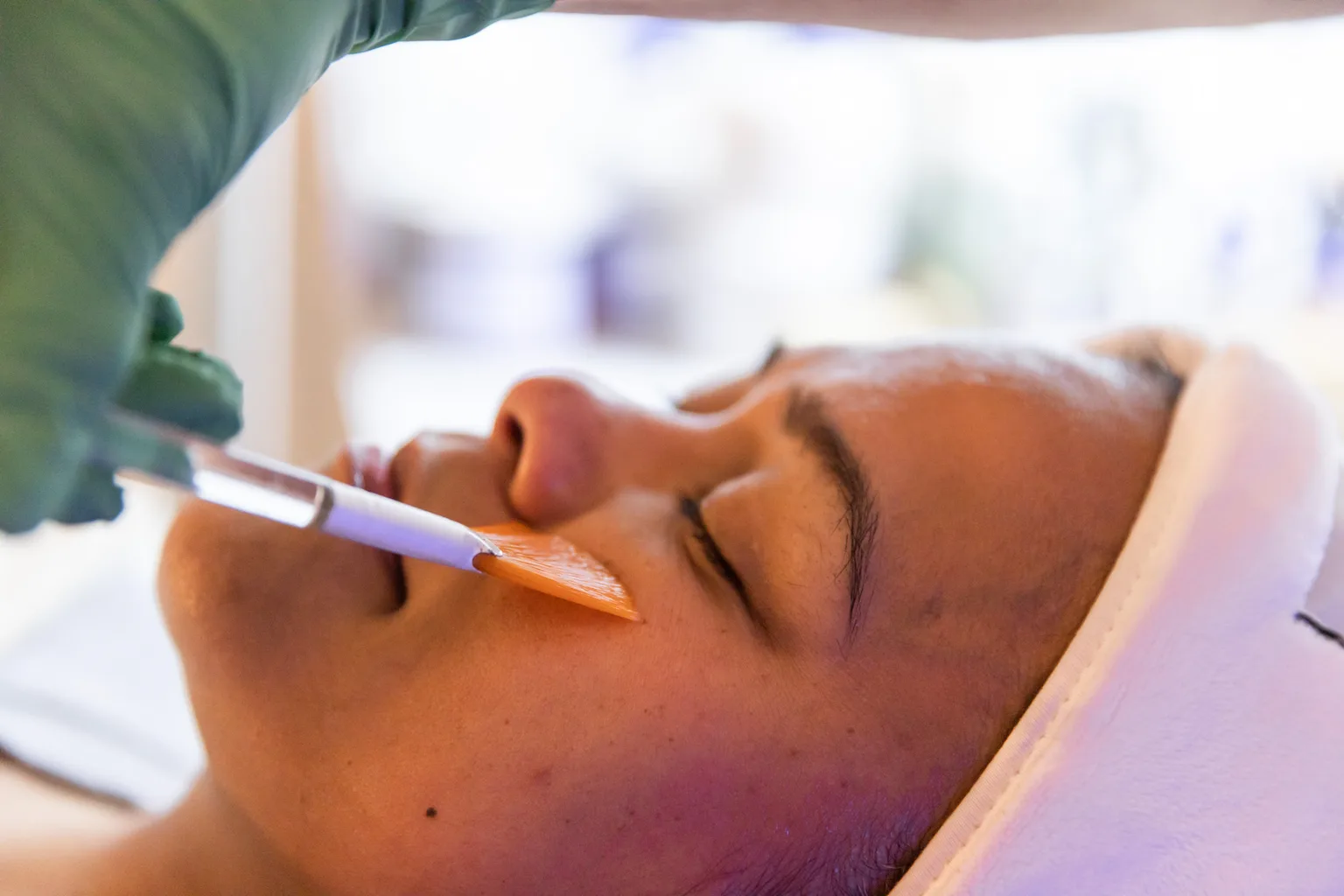
- Application. The retinoid, sometimes over a low-strength acid prep layer, is brushed on in one or more coats. Sensation is usually mild warmth, not a strong sting.
- You leave with the product on. Nothing is neutralized, and the skin often holds a faint yellow tint for the day.
- You remove it at home. At the hour your provider specifies, commonly four to eight hours later, wash it off with a gentle cleanser, then moisturize.
After that it is standard superficial peel care: bland cleanser, moisturizer, daily broad-spectrum SPF 30 or higher, no picking, and every other active paused until your provider clears it. Retinoids raise sun sensitivity in their own right, so photoprotection is not optional. Our chemical peel aftercare guide has the full routine.
Retinol Peel Recovery Timeline, Day by Day
- Day 0. Product on the skin, faint yellow cast, minimal redness. You wash it off at the specified hour and carry on as usual.
- Day 1. Usually uneventful: tightness, mild dryness, sometimes pinkness. It is common to think nothing is happening.
- Days 2 to 4. Peeling begins, typically around the mouth, chin, and nose first. This is the characteristic delayed onset, and the sheeting can be heavier than expected.
- Days 4 to 6. Peak flaking, then tapering. Moisturize freely and do not pull skin before it releases, the most common cause of a lasting mark.
- Days 6 to 8. Shedding finishes and fresher, more even skin is visible, though pinkness can linger in reactive skin.
Some people flake very little, particularly at lower strengths or on a first session, and that does not mean the peel failed. Peeling is a side effect of accelerated turnover, not the benefit itself.
How Many Retinol Peels Do You Need?
A retinol peel is designed as a series: three to five sessions may be needed, and they may be repeated every two to five weeks, with the interval set by how your skin recovers, because cells need repeated signaling across several turnover cycles before the change shows. Expect modest brightness after the first session and more convincing tone and fine-line improvement around the third or fourth. After the series, ask your provider whether and when to repeat a peel, and whether a nightly retinoid suits your skin. No peel holds its result indefinitely, and daily sun protection preserves the outcome better than any extra session.
Retinol Peel vs Glycolic Peel vs a Nightly Retinoid at Home
| Factor | Retinol peel | Glycolic acid peel | Nightly retinoid at home |
|---|---|---|---|
| Mechanism | Receptor level, alters cell turnover | Loosens surface cell bonds on contact | Same receptors, small daily dose |
| How it ends | Left on for hours, washed off at home | Neutralized in the treatment room | Washed off each morning |
| Peeling onset | Day 2 to day 4 | Day 2 to day 3, sometimes none | Light flaking in the first weeks |
| Schedule | 3 to 5 may be needed, every 2 to 5 weeks | 3 to 5 may be needed, every 2 to 5 weeks | Most nights, ongoing |
| Best suited to | Photoaging, tone, texture, mild acne | Dullness, texture, congestion | Anyone able to stay consistent |
An honest summary: a well-tolerated nightly retinoid used consistently for six to twelve months delivers much of what a peel series delivers, at lower cost. The peel earns its place when someone cannot tolerate nightly use or has plateaued at home.
Safety, Risks, and Who Should Avoid a Retinol Peel
Common reactions are those of any superficial peel: dryness, tightness, redness, itching, and days of flaking. Less common but real risks include prolonged irritation or contact dermatitis, post-inflammatory hyperpigmentation, cold sore reactivation, and, rarely, infection or scarring after picking. Because retinoids increase photosensitivity, a sunburn during a series is both more likely and more consequential.
Higher Fitzpatrick phototypes, roughly IV through VI, carry a genuinely higher risk of post-inflammatory hyperpigmentation after any resurfacing. That is a reason to choose a conservative strength, request a test spot, prime beforehand, and work with a provider experienced in richly pigmented skin, not a reason to rule out treatment.
Pregnancy, breastfeeding, and isotretinoin
This part is not negotiable. Retinoids are contraindicated in pregnancy. Oral isotretinoin is a known teratogen with well-documented risk of serious birth defects, which is why prescribing in the United States is governed by a strict federally mandated risk management program with pregnancy testing and contraception requirements. Topical retinoid use during pregnancy is conventionally avoided as well. Systemic absorption from routine topical use is low, but the standard of care is avoidance, and a professional peel is not routine topical use: it is a high concentration held against the skin for hours. If you are pregnant, breastfeeding, or trying to conceive, do not book a retinoid treatment of any kind without discussing it with your clinician first.
Oral isotretinoin also matters: Mayo Clinic says your doctor might caution against a chemical peel if you have taken isotretinoin in the past six months. Recent expert consensus has revisited that caution for superficial procedures, and practice varies. The decision belongs to your prescribing clinician, so disclose isotretinoin use even if the course ended a while ago.
Providers also typically defer a retinol peel with active eczema, dermatitis, or a rosacea flare, broken skin, sunburn, an active cold sore, known retinoid sensitivity, or recent waxing, laser, or other resurfacing.
How Much Does a Retinol Peel Cost?
As an industry estimate, retinol peels sit in the superficial peel price band in the United States, around $100 to $400 per session, with branded medical-grade protocols at the upper end or above it. Because three to five sessions may be needed, the more useful figure is the cost of the whole series. These are industry estimates, not a quote, and price varies with geography, credentials, and formulation, so confirm pricing with a provider. Our chemical peel cost guide compares pricing across peel types.
Frequently Asked Questions
What is a retinol peel and how is it different from a chemical peel?
A retinol peel applies a concentrated vitamin A derivative that is absorbed and acts on cell receptors, changing how skin cells mature and shed. An acid peel instead loosens the bonds between surface cells on contact, then is neutralized. That is why a retinol peel stays on for hours and peels later.
How long does it take for a retinol peel to start peeling?
Peeling characteristically begins around day two to day four, later than with an acid peel, because the retinoid must be absorbed and act on the cell before turnover accelerates. Peak flaking falls between days four and six, with shedding usually finished by about day seven.
Is a retinol peel stronger than a glycolic peel?
Not in depth. Both are superficial treatments working within the epidermis, differing in mechanism and timing rather than intensity, although a retinol peel can shed more visibly. Which one suits you depends on your skin and your concerns, so discuss it with your provider.
Can you get a retinol peel while pregnant or breastfeeding?
No. Retinoids are contraindicated in pregnancy. Oral isotretinoin carries a known risk of serious birth defects, and topical retinoid use in pregnancy is conventionally avoided. A professional peel holds a high concentration against the skin for hours. Anyone pregnant, breastfeeding, or trying to conceive should ask their clinician before booking.
How many retinol peels do you need to see results?
Three to five sessions may be needed, and they may be repeated every two to five weeks, because benefit accumulates across treatments rather than arriving from one. Expect modest brightness after the first session and clearer improvement by the third or fourth; after that, ask your provider whether and when to repeat a peel.
Is a retinol peel the same as using retinol at home?
It is the same molecule family and receptor mechanism at a very different dose and schedule. Home products deliver a small amount most nights, while a peel delivers a much higher concentration for a few hours at visits that may be repeated every two to five weeks. Consistent home use over six to twelve months achieves much of the same, at lower cost.
Medical Disclaimer
This page is provided by ChemicalPeel.org for patient education and is not medical advice. Individual results vary, and the information here does not replace a consultation with a qualified provider. Always discuss your medical history and treatment options with a licensed clinician before pursuing any chemical peel.
Ready to Ask the Right Questions?
A retinol peel is only as good as the provider choosing its formulation, strength, and interval, and the right one will tell you what is in the bottle and what to expect on day three. Find a qualified provider near you, or keep researching and compare every chemical peel type and depth before you book.